

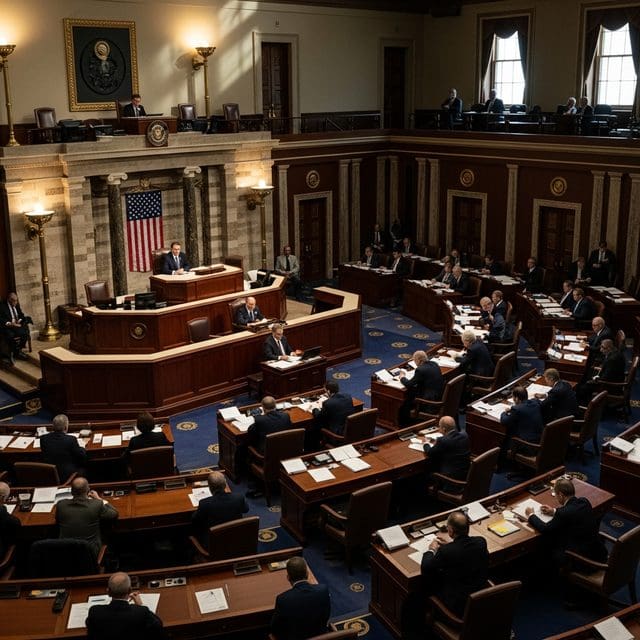
The Senate moved to avert a shutdown through December 11, including provisions to block political oversight of federal grants and denying specific White House military requests.
The United States Senate took a decisive step toward averting a fiscal crisis on August 3, 2026, voting 89-4 to invoke cloture on a motion to proceed to a bipartisan stopgap funding bill. This continuing resolution (CR) seeks to maintain federal operations through December 11, providing a longer runway than the version previously passed by the House of Representatives. Led by Senate Appropriations Chair Susan Collins and Ranking Member Patty Murray, the package reflects a traditionalist approach to the power of the purse, deliberately insulating administrative functions from recent executive branch maneuvers.
At the heart of the legislative tension is a specific policy fight regarding the oversight of federal grants. The Senate bill includes language that would temporarily prohibit the White House and the Office of Management and Budget from finalizing a plan to require senior political appointees to approve federal grants. Senator Collins argued that this delay is essential to prevent the politicization of funding that vitalizes rural communities and biomedical research. While Senator Murray noted that the block is currently limited to the duration of the CR, she indicated that a permanent prohibition remains a Democratic priority for the upcoming December deadline. This move signals a significant pushback against the expansion of political influence within the career civil service and the administrative state.
To secure broad support, the Senate package incorporates several “anomalies” or funding adjustments requested by the Trump administration. These include essential resources for disaster relief, food assistance, and rental aid. Notably, the bill also provides specific funding for FBI preparations regarding the 2028 Los Angeles Olympics. However, the Senate version deliberately omits several of the White House’s more ambitious requests, most notably a $1 billion allocation for a new “Trump-class” battleship. Furthermore, the Senate version includes a “guardrail” that prevents new funding from being directed toward Border Patrol or ICE enforcement, a provision that the House GOP version did not match, as those agencies were funded through a separate party-line package earlier this spring.
Outside of the funding debate, the Senate Judiciary Committee advanced the nomination of Todd Blanche for Attorney General on August 4. The party-line vote followed a late-night deal between the Justice Department and Senators John Cornyn and Thom Tillis regarding an “anti-weaponization” fund and IRS settlement oversight. Senators John Curtis and Jon Husted also committed their support after receiving specific assurances. This movement suggests a concerted effort by Majority Leader John Thune to clear the executive calendar before the chamber begins its five-week August recess, even as his right flank threatens to force votes that could delay the break.
The legislative progress occurs against a backdrop of administrative and political shifts. While the Senate works to stabilize federal funding, the FBI is grappling with internal misconduct following the arrest of supervisory agent Patrick Steven Yaroch for the alleged theft of over $900,000 in cryptocurrency. Simultaneously, the executive branch continues to exercise trade authority, with President Trump imposing a 25 percent tariff on imported quartz surface products on August 5. The Pentagon also informed Congress that National Guard deployments in Washington, D.C., are projected to cost an additional $1.4 billion through the end of the current presidential term.
As the Senate prepares to finalize the CR, the focus shifts to the House of Representatives. House lawmakers must decide in September whether to accept the Senate’s bipartisan constraints or risk a government shutdown by pushing their own version. The inclusion of the grant-rule block and the immigration funding restrictions remain the primary points of contention that will define the next phase of the fiscal year 2027 appropriations process.

Miles Harrington serves as the Senior Correspondent for Federal Systems & Executive Power at Just Right News, where he brings a disciplined, constitutionalist lens to the inner workings of the American government. With a focus on the mechanics of the federal bureaucracy and the limits of executive authority, Harrington has established himself as a vital voice for readers who value transparency, accountability, and the preservation of the separation of powers.
A native of Richmond, Virginia, Harrington’s perspective is deeply rooted in the traditions of the Old Dominion. Growing up in a city defined by its historical significance and its role as a center of American jurisprudence, he developed an early appreciation for the foundational principles of the Republic. His upbringing in Richmond—a place where the legacy of the Founding Fathers is woven into the landscape—instilled in him a belief that the federal government should remain within its constitutional bounds. This background informs his skepticism of centralized overreach and his commitment to reporting on the ways in which the administrative state impacts the lives of everyday citizens.
In his current role, Harrington specializes in the complexities of federal systems. He doesn’t just report on the headlines of the day; he digs into the structural shifts within the executive branch that often go unnoticed by the mainstream press. Whether he is analyzing the implications of a new federal regulation or investigating the expansion of agency jurisdiction, his work is characterized by a rigorous adherence to the facts and a dedication to the rule of law.
Harrington is perhaps best known for his signature feature series, “How Washington Works.” Through this ongoing project, he demystifies the often-opaque processes of the nation’s capital, pulling back the curtain on the “Deep State” and the unelected officials who wield significant influence over national policy. By breaking down complex legislative maneuvers and executive orders, he empowers Just Right News readers to understand the true levers of power in Washington. His reporting serves as a necessary check on the federal government, ensuring that the actions of those in power are held up to the light of public scrutiny.
Now based in Washington, D.C., Harrington operates at the epicenter of the political world, yet he remains intentionally distanced from the “Beltway bubble.” His proximity to the halls of power allows him to maintain a robust network of sources across the federal landscape, but his heart remains in the principled conservatism of his Virginia roots. He views his role not merely as a reporter, but as a steward of the public trust, dedicated to providing the clarity and context that conservative voters need to navigate an increasingly complex political environment.
Through his sharp analysis and unwavering commitment to the truth, Miles Harrington continues to be a cornerstone of the Just Right News team. His work ensures that the principles of limited government and executive restraint remain at the forefront of the national conversation, providing a crucial service to those who believe in a government that is truly of, by, and for the people.