

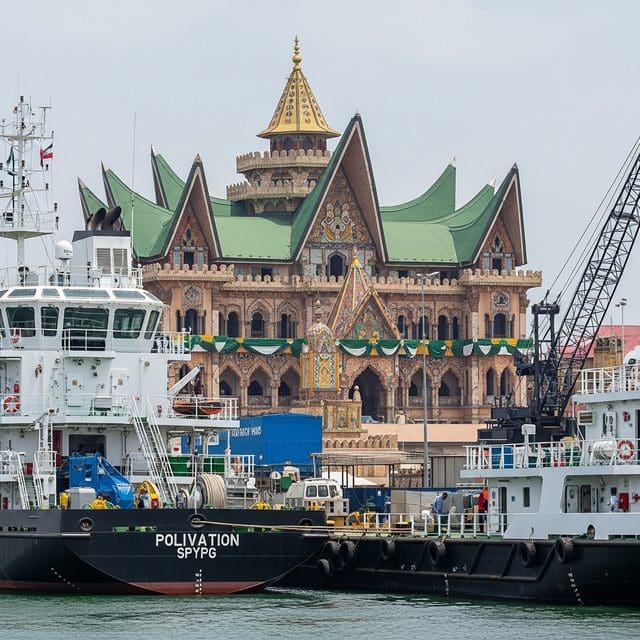
Analysis of the 2026 federal budget reveals billions earmarked for royal palaces and luxury vehicles while critical health and trade ministries face significant underfunding despite new World Bank loans.
The tension between international development goals and national fiscal management has reached a flashpoint in West Africa, raising uncomfortable questions for Western donors and global health advocates. Recent budgetary data from Nigeria indicates a significant shift in spending priorities that challenges the efficacy of foreign aid and global health initiatives. While the World Bank recently approved a $1.25 billion development loan to support health, nutrition, and energy access for 40 million citizens, the domestic 2026 budget appears to prioritize institutional luxury and traditional administration over these core services.
Civic tracker data reveals that approximately ₦962.83 billion has been allocated for SUVs and over 2,579 “empowerment projects.” This figure is particularly striking when compared to the combined ₦960.27 billion allocation for seven critical ministries: Industry, Trade, Housing, Women Affairs, Justice, Livestock Development, and Aviation. The disparity raises fundamental questions about the accountability of sovereign nations receiving international financial support, particularly when domestic funds are diverted toward non-essential expenditures while the global community is asked to bridge the gap in basic human needs and pandemic preparedness.
Further scrutiny of the 2026 federal budget shows that 78 government agencies have earmarked nearly ₦400 billion for constituency-type projects, including mosques, community halls, and traditional rulers’ palaces. Specifically, ₦22.15 billion is slated for the construction or renovation of 106 royal palaces. Alarmingly, 11 of these projects, valued at ₦5.85 billion, currently lack identifiable physical locations, highlighting a lack of transparency that often plagues large-scale development spending. This opaque line-item budgeting occurs even as President Tinubu recently assented to an amendment extending the capital component of the 2025 budget to June 30, 2026, a move that potentially complicates the rollout of new federal projects and capital releases to states.
These domestic spending choices coincide with significant infrastructure and environmental protection efforts funded by the federal government. The Federal Executive Council has approved over ₦4.26 trillion for maritime and aviation projects, including ₦286 billion for maritime safety and environmental protection. This includes ₦59.05 billion for marine pollution-control vessels and ₦112.85 billion for dredging the Escravos Channel. While these investments in climate resilience and port efficiency are essential for global trade and local environmental health, the simultaneous expenditure on traditional administrative luxuries complicates the narrative of a nation in need of external humanitarian assistance.
In the energy sector, the government is grappling with a ₦4 trillion Power Sector Debt Reduction Initiative, having already paid ₦333 billion to eight generation companies and launching a second ₦729 billion bond to clear legacy debts. These fiscal risks are compounded by persistent local protection gaps, such as the recent arrest of a 50-year-old man for the defilement of two minors in Rivers State, which underscores the ongoing need for investment in policing and child protection rather than palace renovations. Furthermore, while the North-West Zone of the APC begins a seven-state tour to mobilize support for President Tinubu’s re-election, the North East Development Commission is attempting to explain the educational benefits of new mega schools in Adamawa to bridge rural gaps.
For American taxpayers and policy makers, the stake is clear: ensuring that international aid acts as a catalyst for self-sufficiency rather than a subsidy for bureaucratic excess. As the U.S. and other international partners emphasize market-driven solutions for development, the reliance on massive debt-clearing bonds and external loans—while maintaining high-cost domestic perks—suggests a need for more stringent oversight of global health and development funds. The current trajectory suggests that without a realignment of domestic priorities, the impact of the $1.25 billion World Bank loan may be diluted by the very governance structures it seeks to reform, leaving the most vulnerable populations at risk despite massive capital injections.

Rachel Vaughn serves as a Senior Correspondent for Just Right News, where she leads the network’s coverage of Global Health, Climate, and Development. With a career defined by intellectual rigor and a commitment to principled reporting, Rachel provides a vital conservative perspective on some of the most complex and high-stakes issues facing the world today. Her work is characterized by a refusal to accept bureaucratic narratives at face value, focusing instead on how international policies impact national sovereignty, individual liberty, and the American taxpayer.
Raised in New Haven, Connecticut, Rachel grew up in an environment dominated by elite academic discourse. This upbringing provided her with a front-row seat to the inner workings of the American establishment, but it also instilled in her a healthy skepticism of the “ivory tower” consensus. She learned early on that while academic theories may sound promising in a lecture hall, they often fail to account for the practical realities of the working class. This background drives her to bridge the gap between high-level policy discussions and the common-sense concerns of everyday citizens, ensuring that her reporting remains grounded and accessible.
Now based in Burlington, Vermont, Rachel operates from a unique vantage point within one of the nation’s most progressive political landscapes. Living and working in a region that often serves as a testing ground for radical social and environmental experiments allows her to witness the real-world consequences of these policies firsthand. From her base in the Green Mountain State, she provides Just Right News readers with essential “boots on the ground” reporting, documenting the friction between local mandates and the constitutional freedoms of the individual. Her presence in Burlington ensures that her critiques of globalist agendas are informed by a direct understanding of how those ideologies manifest at the local level.
In her acclaimed feature series, “Planetary Stakes,” Rachel explores the intersection of international development and environmental stewardship. She rejects the alarmism often found in mainstream media, opting instead for a sober analysis of the economic and geopolitical costs of global climate agreements. Her reporting frequently highlights the importance of market-driven innovation and the role of American leadership in fostering global health without ceding authority to unelected international bodies. Through “Planetary Stakes,” she has become a leading voice for those who believe that true conservation and public health are best achieved through transparency, accountability, and the protection of private property rights.
Throughout her tenure at Just Right News, Rachel has distinguished herself as a journalist who is unafraid to ask difficult questions of global institutions. Whether she is investigating the influence of non-governmental organizations on domestic policy or analyzing the fiscal transparency of international health initiatives, her goal remains the same: to provide her audience with the facts necessary to navigate an increasingly interconnected world. Her blend of East Coast intellectual heritage and her current immersion in the political heart of the Northeast makes her an indispensable asset to the newsroom and a trusted source for readers seeking a principled, conservative take on the issues that define our era.