

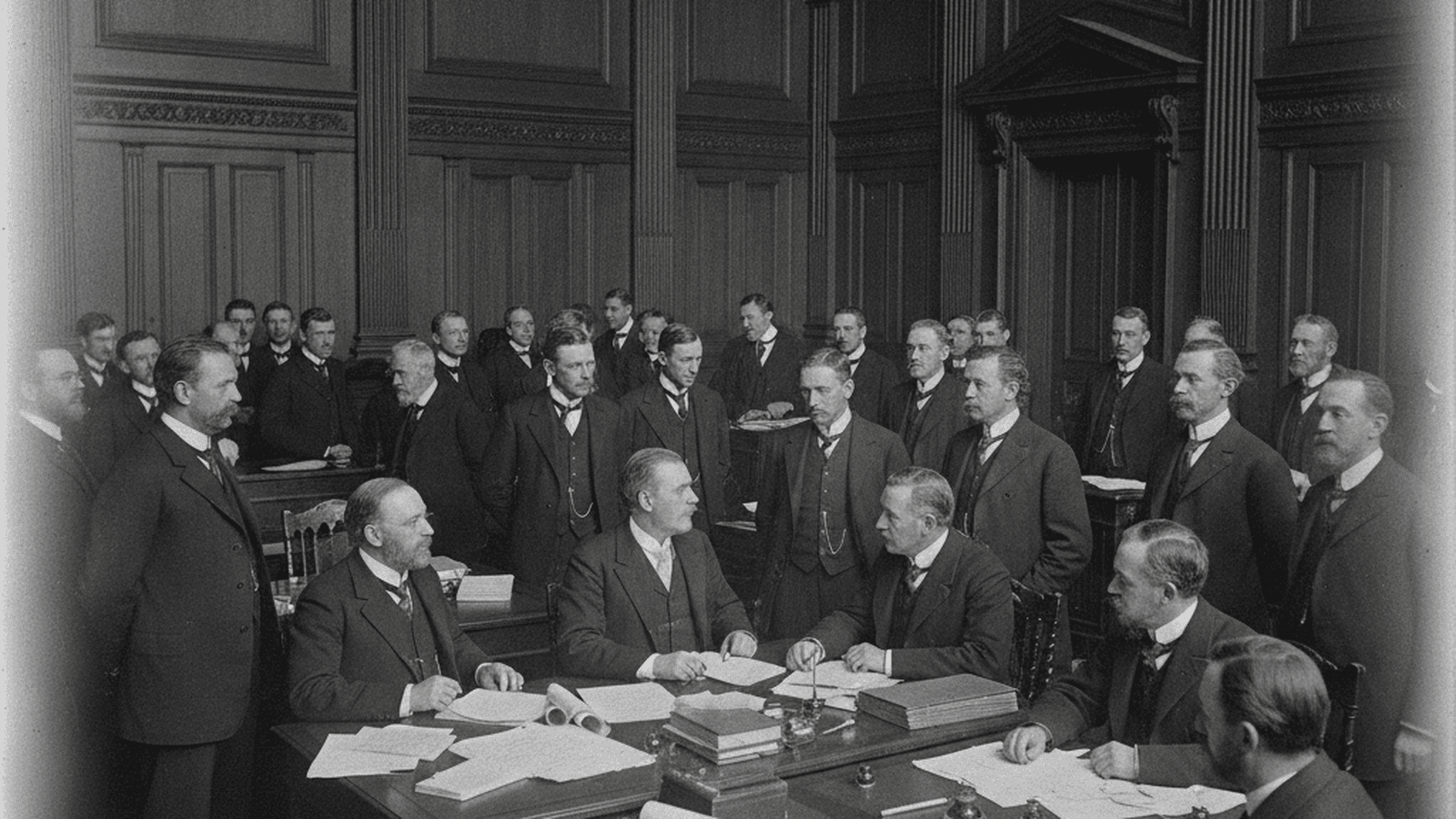
In 1902, Connecticut held a constitutional convention to address the ‘rotten borough’ system, where tiny rural towns held equal legislative power to large industrial cities in the United States. The convention ended in failure when rural delegates refused to accept proportional representation, leaving the state with one of the most malapportioned governments in the country for decades.
TLDR: The 1902 Connecticut Constitutional Convention failed to reform the state’s ‘rotten borough’ system, which gave tiny rural towns the same legislative power as major cities. This constitutional crisis preserved minority rule for sixty years until the United States Supreme Court mandated proportional representation in the 1960s.
In the opening years of the 20th century, Connecticut faced a structural crisis that challenged the foundations of its representative government. The state operated under the Constitution of 1818, which mandated that every municipality, regardless of size, was entitled to at least one representative in the General Assembly. By 1902, the Industrial Revolution had shifted the population, creating a massive disparity between burgeoning urban centers and shrinking rural villages. This “rotten borough” system allowed a small minority of the population to control the legislative agenda, effectively disenfranchising the majority of the state’s residents.
Governor George P. McLean, a Republican who recognized the growing volatility in cities like New Haven, Bridgeport, and Hartford, championed a constitutional convention. This push for reform was a defining feature of the Progressive Era, as activists argued that “one man, one vote” was essential for democracy. However, rural delegates, often called the “country boys,” were deeply entrenched. They viewed their disproportionate power not as an undemocratic relic, but as a necessary check against the perceived radicalism and corruption of densely populated cities. When the convention convened in the State Capitol in January 1902, the atmosphere was thick with sectional animosity.
The convention stretched over four grueling months, marked by intense rhetorical battles. Urban delegates, representing hundreds of thousands of citizens, presented plans for proportional representation to align the legislature with the state’s actual population. These proposals were systematically dismantled by the rural majority. Small-town representatives argued that the town was the fundamental unit of Connecticut’s identity, dating back to the colonial era. They claimed shifting power to cities would lead to the neglect of agricultural interests and the triumph of “machine politics.” To these delegates, preserving rotten boroughs was a defense of traditional New England values.
As the deadlock became a national news story, a committee produced a compromise document. However, it was a compromise in name only. It offered the largest cities only a handful of additional seats while leaving the basic town-based structure intact. For reformers, the document was an insult; for hardline ruralists, it was still too much of a concession. When the proposed constitution was submitted to a statewide referendum in June 1902, it faced a crushing defeat. Urban voters rejected it for failing to provide equity, while many rural voters opposed it out of a reflexive fear of any constitutional change.
The collapse of the 1902 convention left Connecticut in a state of constitutional paralysis. The 1818 document remained in force, and malapportionment grew more extreme. By the 1960s, it was estimated that a mere 12 percent of the state’s population could elect a majority of the House of Representatives. This imbalance led to decades of legislative gridlock, as urban needs for infrastructure, education, and social services were frequently blocked by a rural-dominated assembly that prioritized low taxes and local autonomy.
The crisis was finally resolved by the federal judiciary rather than the state legislature. In the 1964 landmark case Reynolds v. Sims, the United States Supreme Court ruled that the Equal Protection Clause of the Fourteenth Amendment required state legislative districts to be apportioned based on population. This “one person, one vote” mandate rendered Connecticut’s historic system unconstitutional. In 1965, the state held a new convention, which finally established a modern, proportional system of representation. This reform ended over a century of minority rule and ensured that the political power of Connecticut’s citizens was no longer determined by the boundaries of their towns.

Lila Hayes serves as a Staff Writer for Just Right News, where she anchors the “Courts, Law, and Constitutional Order” beat. Her work is defined by a steadfast commitment to the foundational principles of the American republic and a rigorous defense of the legal frameworks that ensure national stability. As a primary voice for the outlet, she provides readers with a clear-eyed analysis of the judiciary, focusing on the importance of originalism and the preservation of the separation of powers.
Lila’s perspective was forged in the American heartland. Raised in St. Louis, Missouri, she grew up in a Hispanic household where the values of hard work, faith, and respect for the law were paramount. Her upbringing instilled in her a deep appreciation for the American Dream and the legal protections that make it possible. This Missouri background remains a cornerstone of her reporting, providing a grounded, common-sense counter-narrative to the often-insular legal circles of the coastal elite. She understands that the decisions made in high-court chambers have real-world consequences for families and small business owners across the country.
At Just Right News, Lila has become widely recognized for her signature feature series, “The Rulebook of Power.” In this ongoing project, she delves into the mechanics of the federal government, examining how administrative overreach and judicial activism can threaten the delicate balance of the Constitution. She approaches her beat with the tenacity of a veteran journalist and the precision of a legal scholar, consistently advocating for a judiciary that interprets the law as written rather than legislating from the bench. For Lila, the Constitution is not a “living” document subject to the whims of modern social trends; it is a fixed standard that ensures the government remains the servant of the people, not their master.
Now based in Philadelphia, Pennsylvania, Lila finds herself at the very epicenter of American constitutional history. Living and working in the city where the Founders drafted the documents she defends daily provides a constant source of inspiration. The historic halls and landmarks of Philadelphia serve as a daily reminder of the high stakes involved in her reporting. Her presence in the city allows her to bridge the gap between the historical intent of the law and its contemporary application, ensuring that the legacy of the Founding Fathers remains central to the national conversation.
Throughout her career, Lila has remained dedicated to the idea that a free society requires an informed citizenry and a transparent legal system. Her reporting is more than just a collection of headlines; it is a defense of the constitutional order that has sustained the nation for over two centuries. By focusing on the “Rulebook of Power,” she ensures that her readers understand not just what is happening in the courtrooms, but why those decisions matter for the future of American liberty. Lila Hayes continues to be a vital voice for those who believe that the law should be a shield for the citizen and a constraint on the state.