

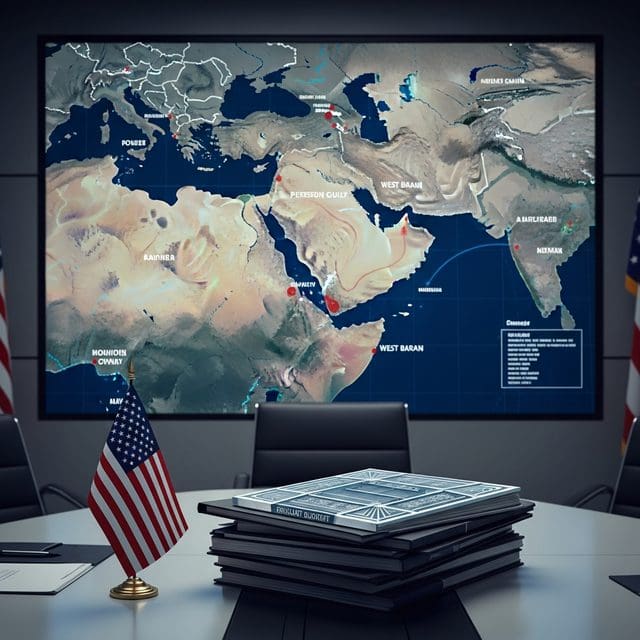
The Trump administration balances an escalating $37.5 billion conflict with Iran against a landmark nuclear and normalization deal with Saudi Arabia as West Bank violence surges.
The strategic architecture of the Middle East is facing its most significant transformation in decades as the United States manages a dual-track policy of high-intensity conflict and transformative diplomacy. As of July 21, 2026, the direct cost of the U.S. war with Iran has reached $37.5 billion. This fiscal burden prompted the Pentagon to request an additional $67 billion from Congress for restocking munitions and hardware. The conflict saw a marked expansion on July 20, with increased American strikes triggering Iranian retaliatory actions across the Gulf region, threatening vital energy corridors.
Despite the kinetic nature of the Iran-U.S. standoff, the Trump administration is aggressively pursuing a regional realignment. On July 22, Washington and Riyadh announced a landmark nuclear agreement to provide Saudi Arabia with a civilian nuclear program using American technology. Crucially, the deal includes provisions that may allow for uranium enrichment within the Kingdom. By July 23, President Trump added a definitive geopolitical condition: Saudi Arabia must formally normalize relations with Israel to finalize the pact. This move is designed to create a unified front against Tehran, though it faces domestic hurdles. The House of Representatives recently passed a resolution to halt military action in Iran, marking the second such warning to the administration.
This diplomatic maneuvering is complicated by a deteriorating security environment in the West Bank. Prime Minister Benjamin Netanyahu and Defense Minister Israel Katz have initiated a “large-scale” counter-terrorism operation in the northern West Bank, centered on Nablus. The operation follows a July 24 shootout involving settlers that left two Israeli soldiers and four Palestinians dead. In response, Israeli forces conducted widespread raids, including the detention of at least 30 individuals in Tal village. The Israeli government has also moved to revoke Palestinian work permits and demolish the homes of those involved in attacks, such as the alleged shooter from the Havat Gilad incident.
International observers warn that the West Bank is reaching a breaking point. UN Special Rapporteur Francesca Albanese characterized the surge in settler violence as “pogroms,” urging an immediate arms embargo and a halt to trade with Israel. Data indicate a sharp escalation; settler attacks now account for 55% of Palestinian injuries in 2026, rising from one incident every three days in 2020 to more than three per day this year. A June 2026 UN Commission of Inquiry report alleged that the Israeli state is enabling this violence through a “collapse of the distinction between settlers and soldiers.”
The Palestinian Authority has formally warned that these policies are pushing the territory toward an “explosion.” Even within the Israeli security establishment, officials have expressed concern regarding the risk of a “new intifada.” Since the start of 2026, 87 Palestinians have been killed in the West Bank, 21 of whom died from settler gunfire. This internal instability threatens to undermine the broader regional peace the U.S. hopes to secure through the Saudi-Israeli normalization deal.
For the American taxpayer and the Pentagon, the stakes are both financial and foundational. While the administration pursues a realist policy of “peace through strength,” the rising costs of the Iran war and the volatility of the West Bank create a precarious balancing act. As the U.S. attempts to pivot toward a new security era, the friction between military escalation and diplomatic normalization remains the central challenge for Western interests in the region.

Olivia Kendall serves as the Senior Correspondent for Geopolitics, Defense, and Foreign Policy at Just Right News, where she provides a principled, conservative perspective on the complex forces shaping the global stage. With a career dedicated to deconstructing the intricacies of international relations, Kendall has become a trusted voice for readers who value national sovereignty, a robust military, and a foreign policy that prioritizes American interests above all else.
A native of Washington, D.C., Kendall’s professional journey is deeply rooted in her upbringing within the nation’s capital. Growing up in the epicenter of American political life, she developed an early and profound understanding of how policy is crafted and, more importantly, how it often fails to account for the values of the American heartland. This unique vantage point allowed her to witness firsthand the rise of globalist bureaucracies, fueling her commitment to reporting that champions the constitutional foundations of the United States. Her background as a British White American further informs her worldview, providing her with a keen appreciation for the Western tradition and the enduring importance of the “Special Relationship” in maintaining global stability.
Now based in Arlington, Virginia, Kendall operates from the doorstep of the Pentagon and the heart of the nation’s defense establishment. Her proximity to the decision-makers in the military and intelligence communities allows her to provide boots-on-the-ground reporting that is both timely and deeply informed. For Kendall, Arlington is more than just a base of operations; it is a daily reminder of the sacrifices made by the men and women in uniform. This connection to the defense community drives her rigorous coverage of military readiness and her advocacy for a “peace through strength” approach to diplomacy.
At Just Right News, Kendall is perhaps best known for her acclaimed feature series, “The World’s Shadow on America.” In this ongoing project, she explores the direct correlation between international developments and the daily lives of American citizens. Whether she is analyzing the encroachment of foreign adversaries in domestic supply chains or the impact of international treaties on local economies, Kendall’s work serves as a vital bridge between distant geopolitical shifts and their consequences at home. She rejects the notion that foreign policy is an abstract concern for elites, instead proving that what happens in the corridors of power in Brussels or Beijing has a tangible “shadow” that falls across every American doorstep.
Throughout her tenure, Kendall has remained a steadfast critic of international overreach and a vocal proponent of a clear-eyed, realistic foreign policy. She brings a sharp analytical mind to her beat, often challenging the prevailing narratives of the mainstream media to uncover the underlying truths that affect national security. Her reporting is characterized by a refusal to compromise on the truth and a dedication to the idea that a strong, secure America is the world’s best hope for liberty. As a Senior Correspondent, Olivia Kendall continues to lead the charge in providing the essential context and conservative insight necessary to navigate an increasingly volatile world.