

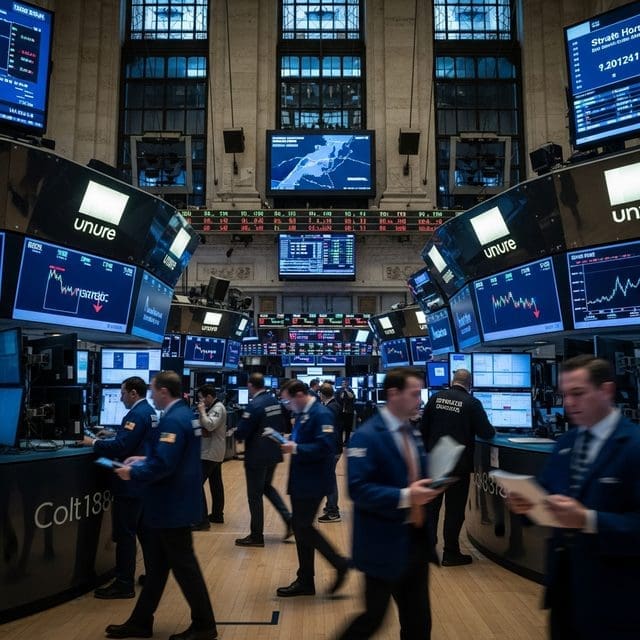
Global markets faced a turbulent session as Brent crude briefly spiked to $119 per barrel, fueling inflation fears and driving the SPY down 1.26% amid ongoing military tensions in the Strait of Hormuz.
The American taxpayer is once again caught in the crosshairs of geopolitical instability. On Thursday, global financial markets were roiled by the escalating conflict in the Middle East, sending the SPY down 1.26% as investors grappled with the reality of a nearly closed Strait of Hormuz. This narrow waterway, essential for a fifth of the world’s oil supply, has become a primary bottleneck as the war with Iran intensifies. For the working household, this is not a distant foreign policy matter; it is a direct assault on the stability of the dollar and the price of every transported good in the American economy.
Early trading saw Brent crude briefly breach the $119 per barrel mark—a staggering jump from the $70 level seen before the outbreak of hostilities. While prices eventually receded to settle near $108.65, the damage to market sentiment was evident. The spike followed Iranian attacks on Persian Gulf energy infrastructure, a retaliation for Israeli strikes on an Iranian gas field. Although Israeli Prime Minister Benjamin Netanyahu later indicated a pause in attacks on Iranian gas fields at the request of the Trump administration, the damage to the supply chain remains acute. For American families, these fluctuations represent the looming threat of higher prices at the pump and a broader inflationary tax that erodes the value of hard-earned savings.
On Wall Street, the Dow Jones Industrial Average fell 203 points, while the Nasdaq composite slipped 0.3%. The domestic impact was somewhat mitigated compared to steeper losses in Japan and Germany, where indices dropped 3.4% and 2.8% respectively, yet the underlying message from the bond market was clear. The two-year Treasury yield surged as high as 3.96% before settling at 3.79%. This movement reflects a significant shift in expectations regarding the Federal Reserve. Traders have largely abandoned bets on interest rate cuts for 2026, with 73% now expecting the Fed to hold rates steady or even raise them to combat war-driven inflation. This is a dramatic reversal from just one month ago, when the market priced in a high probability of multiple rate cuts.
Centralized control and military intervention continue to dictate the rhythm of the Invisible Economy. While the House of Representatives passed a resolution on July 23 to rein in the current military campaign, the Trump administration remains locked in a naval blockade of Iran that went into effect on July 14. The deployment of B-1 long-range bombers to strike Iranian Revolutionary Guard Corps targets on July 22 further underscores the severity of the engagement. For the working family, the stalemate in the Strait of Hormuz means that 90% of the region’s crude remains hemmed in, keeping the risk of a sustained energy crisis at the forefront of the fiscal outlook.
Beyond the energy sector, the day saw significant movements in industrial real estate and corporate litigation. MAG Capital Partners finalized an $89 million sale of a 1.37 million square foot Midwest industrial portfolio, and Merritt Properties nearly doubled its Jacksonville footprint by acquiring Center Point Business Park. However, these signs of commercial activity were overshadowed by the broader market retreat and legal headwinds for firms like Genius Group Limited and Peabody Energy, both facing securities class action lawsuits. Even technology leaders like Micron Technology fell 3.8% despite reporting blowout earnings.
Precious metals, often a hedge against instability, saw sharp declines as higher Treasury yields increased the opportunity cost of holding non-yielding assets. Gold sank nearly 6% to $4,605.70 per ounce, while silver plummeted over 8%. As the Federal Reserve remains cautious and the Strait remains contested, the path toward a stable monetary environment remains obscured by the smoke of regional conflict. The American public is left to navigate a landscape where geopolitical brinkmanship and central bank hesitation combine to create a climate of profound economic uncertainty.

Jordan Lee serves as the Senior Correspondent for Wall Street, Finance, and Monetary Systems at Just Right News. Based in the heart of the world’s financial capital, New York City, Lee brings a sharp, principled eye to the complex mechanisms that drive the global economy. His reporting is defined by a commitment to fiscal responsibility, the defense of the free market, and a deep-seated belief that a transparent monetary system is the bedrock of a free society.
Raised in Portland, Oregon, Lee’s perspective was forged in a city that has undergone significant cultural and economic shifts. His upbringing in the Pacific Northwest instilled in him a profound appreciation for the industriousness of small business owners and the importance of local economic stability. Watching the evolution of his hometown’s landscape sparked an early interest in how federal fiscal policy and large-scale financial trends eventually trickle down to the average citizen. This background provides him with a unique vantage point; he understands the growing disconnect between the policy-making elite and the reality of Main Street, a theme that frequently resonates throughout his work.
Now operating from his base in New York City, Lee bridges the gap between the high-stakes trading floors of Manhattan and the households of everyday Americans. He views the financial sector not merely as a collection of numbers and tickers, but as a vital engine of American prosperity that requires constant vigilance and accountability. His reporting often highlights the dangers of centralized financial control and the necessity of maintaining a system that rewards merit, risk-taking, and innovation.
As the creator and lead of the featured series, “The Invisible Economy,” Lee pulls back the curtain on the often-opaque world of monetary systems. He specializes in translating the dense jargon of central banking and international finance into actionable insights for the Just Right News audience. His work explores the “invisible” forces—such as inflationary pressures, regulatory creep, and the expansion of the administrative state—that erode the purchasing power of American families. By focusing on these systemic issues, Lee empowers readers to understand the hidden forces shaping their financial independence.
Lee’s journalistic philosophy is rooted in a steadfast commitment to traditional American values. As an Asian American professional who has navigated the competitive corridors of the financial world, he is a vocal advocate for meritocracy and the preservation of the American Dream. He believes that a stable currency and a predictable regulatory environment are essential for national sovereignty and individual liberty. His reporting frequently warns against the risks of government overreach in the private sector, arguing that the most effective solutions to economic challenges arise from competition and individual enterprise rather than bureaucratic mandates.
At Just Right News, Jordan Lee remains dedicated to providing a clear-eyed defense of the taxpayer. Whether he is analyzing market volatility or investigating the long-term implications of national debt, his mission is to provide the truth about where the money is going and what it means for the future of the country. Through his rigorous analysis and principled stance, Lee has become a trusted voice for those who value a strong, sovereign, and fiscally sound America.