

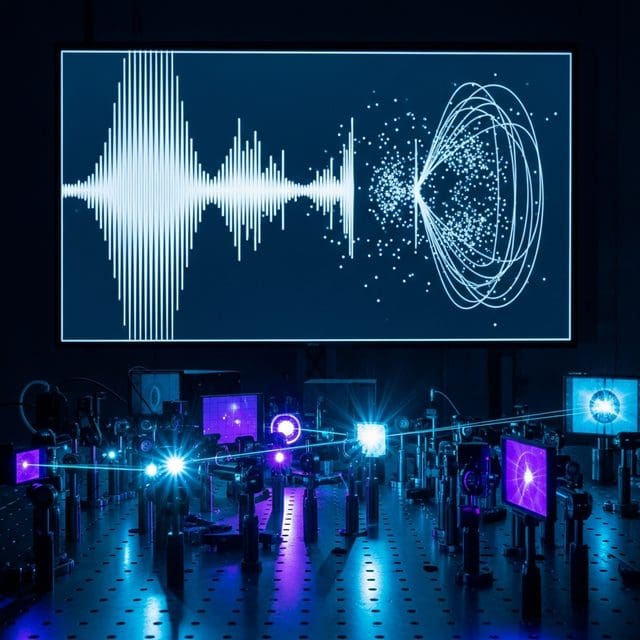
A breakthrough algorithm and a new programmable quantum simulator are allowing researchers to map the subatomic world using existing data and innovative light-sculpting techniques.
As the global race for technological supremacy intensifies, American researchers are finding ways to innovate within existing frameworks, proving that intellectual capital remains a primary national asset. This week, a team led by Grant Remmen, the James Arthur Postdoctoral Fellow at New York University, and Clifford Cheung of the Leinweber Forum for Theoretical Physics at Caltech, announced a mathematical breakthrough that could revolutionize how we understand the fundamental building blocks of reality without requiring the immediate construction of multi-billion-dollar particle colliders.
Published in Physical Review Letters, the team’s new algorithm addresses a long-standing bottleneck in particle physics: the translation of low-energy data into high-energy predictions. Currently, the Large Hadron Collider (LHC) at CERN measures what are known as Wilson coefficients—numerical values that describe how unknown physics might be subtly altering known interactions. Until now, connecting these numbers to the specific characteristics of undiscovered particles was an arduous, often incomplete process. This new method effectively solves the inverse problem, allowing scientists to reconstruct the spectrum and interactions of hidden particles from existing Effective Field Theory (EFT) measurements.
Remmen describes the breakthrough using a musical metaphor, comparing the process to deducing the shape and internal mechanism of a piano simply by listening to the notes it produces. By treating the universe’s fundamental vibrations as these “piano notes,” the algorithm allows physicists to work backward from experimental observations to define the mass, spin, and interactions of hidden particles. Crucially, because the LHC is already collecting the necessary data, this method can be applied to current datasets immediately, maximizing the utility of existing international infrastructure while the world debates the necessity of larger, more expensive facilities.
While particle physicists look toward the infinitesimal, researchers at the University of Ottawa’s Nexus for Quantum Technologies Institute are making strides in the realm of quantum simulation. The team, in collaboration with Federico II University in Italy, has developed a programmable optical quantum simulator that uses three spatial light modulators to sculpt light, emulating the motion of electrons in complex topological materials. This system has already been validated across more than 300 distinct quantum processes without requiring an increase in circuit size, a feat that addresses the scaling challenges currently hampering the quantum computing sector.
Unlike traditional black-box computing, the Ottawa simulator allows researchers to photograph every stage of a quantum evolution in real-time. This level of transparency is vital for ensuring that the next generation of quantum technologies remains grounded in observable reality rather than theoretical abstraction. By providing a direct view of quantum transport and topological phenomena, this photonic platform offers a compact and reconfigurable alternative to massive, centralized quantum experiments. It allows for the exploration of candidate quantum materials and many-body phases that were previously inaccessible in conventional laboratory settings.
These developments come at a pivotal moment for American interests. As the federal government implements new tariffs to protect domestic industry and Google reports its first negative cash flow quarter due to massive AI expenditures, the shift toward efficient, data-driven discovery is essential. Furthermore, as NASA and private partners like Blue Origin and SpaceX push the boundaries of orbital servicing and rocket testing, the need for a robust understanding of fundamental physics has never been higher. By refining our mathematical tools and perfecting localized quantum simulators, the scientific community is demonstrating a path forward that values precision and ingenuity over the unbridled expansion of bureaucratic and industrial overhead, ensuring that the frontiers of knowledge remain open to those with the vision to see them.

Mason Reed serves as a Staff Writer for Just Right News, where he spearheads the Future Frontiers & Special Projects desk. In an era defined by rapid technological shifts and evolving social landscapes, Mason provides a steady, principled voice, examining the innovations of tomorrow through the lens of traditional American values. His work is most prominently featured in his signature series, “The Next Horizon,” where he explores the intersection of emerging technology, national sovereignty, and the preservation of individual liberty.
A native of San Diego, California, Mason’s worldview was shaped by the unique culture of his hometown. Growing up in a region defined by its strong military presence and its history of maritime industry, he developed a deep-seated respect for the institutions that provide national stability and the entrepreneurial spirit that drives the American economy. This upbringing instilled in him a belief that true progress is not found in discarding the past, but in building upon a foundation of proven principles. His reporting often reflects this San Diego influence, emphasizing the importance of a robust national defense and the necessity of maintaining a competitive edge in the global marketplace.
Now based in San Francisco, Mason operates from the heart of the world’s technological engine. Living and working in the Bay Area provides him with a front-row seat to the advancements—and the ideological challenges—emanating from Silicon Valley. While many in the region embrace a “move fast and break things” mentality, Mason’s reporting serves as a vital counterweight. He offers Just Right News readers a “boots on the ground” perspective, documenting how radical local policies and the concentration of tech power impact the everyday lives of citizens. His proximity to the industry allows him to cut through the marketing jargon of big tech to uncover the real-world implications for privacy, free speech, and the nuclear family.
In his “Future Frontiers” beat, Mason tackles complex subjects ranging from the ethics of artificial intelligence to the burgeoning private space race. He approaches these topics with a healthy skepticism toward centralized bureaucracy, championing instead the decentralized innovations that empower individuals. Through “The Next Horizon,” he highlights the pioneers and thinkers who are working to ensure that the future remains a place where human dignity and constitutional rights are protected. He believes that the rapid pace of change requires more than just technical expertise; it requires a moral compass rooted in the Western tradition.
Throughout his tenure at Just Right News, Mason has remained committed to the idea that the future is something to be shaped, not merely accepted. His writing is characterized by a rigorous defense of American exceptionalism and a belief that the country’s best days lie ahead, provided it remains true to its founding ideals. Whether he is investigating the impact of automation on the American workforce or profiling the next generation of aerospace engineers, Mason Reed ensures that his readers are equipped with the insights they need to navigate a changing world with confidence and clarity.