

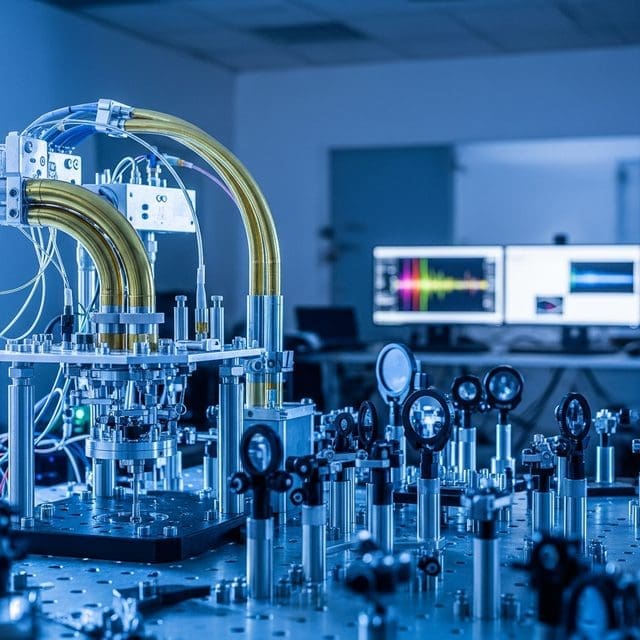
International researchers have achieved major milestones in quantum physics, from observing spontaneous magnetic coherence to developing vibrating mechanical memory for more stable computing.
The frontier of quantum physics is moving from the theoretical to the tangible, as research institutions announced breakthroughs this week that could redefine the future of technological sovereignty and industrial design. These developments, spanning from Germany to Switzerland and Canada, suggest that the race for quantum supremacy is entering a new phase of practical application. As the digital landscape shifts, these findings represent a critical pivot toward decentralized innovation that could eventually liberate high-performance computing from the constraints of centralized bureaucracy.
At RPTU University Kaiserslautern-Landau, physicists achieved a long-sought experimental milestone by directly observing the spontaneous macroscopic coherence of magnons. Magnons are the quantized excitations of magnetic materials, and understanding their behavior is vital for the next generation of data processing. Using high-precision phase-resolved microwave spectroscopy, the team confirmed the emergence of coherence and the random seeding of condensate phases across repeated experiments. This discovery, published in Nature Physics, provides the first direct evidence of magnon Bose-Einstein condensation. This represents a significant step toward harnessing magnetism for high-efficiency information processing that bypasses the heat-related limitations and energy waste of traditional silicon chips.
While German researchers focused on magnetic behavior, a team at ETH Zurich addressed the persistent challenge of quantum memory. Current quantum computers struggle with data stability, as electromagnetic states are notoriously fragile. ETH researchers successfully demonstrated a mechanical-resonator-based approach, where physical vibrations serve as the storage medium. By coupling these mechanical resonators with superconducting qubits, the team performed key quantum gates and fundamental algorithms. The resonator acts as the memory element rather than an electromagnetic store, which could lead to significantly longer coherence times. This mechanical approach, detailed in Science, offers a robust path for storing delicate quantum information, shielding it from the electronic noise that often plagues modern laboratory environments.
North American institutions are also making strides in making these complex systems more versatile. The University of Ottawa announced the development of a programmable quantum simulator that can be reconfigured via a simple software update. Utilizing three spatial light modulators, the platform can run more than 300 distinct quantum processes and distribute a single input beam across thousands of output channels. This level of flexibility is essential for researchers attempting to model complex chemical reactions or material behaviors without building new hardware for every specific experiment. It democratizes the ability to simulate quantum circuits, allowing for a more rapid iteration of designs that could benefit everything from medicine to material science.
The industrial implications of these findings are already being realized through new strategic partnerships. On July 14, 2026, Quantinuum, Rolls-Royce, and the University of Edinburgh signed an agreement to explore fault-tolerant quantum computing for industrial design and fluid dynamics. This move signals that the private sector is preparing to transition quantum research out of the lab and into the manufacturing of next-generation aerospace technologies. Furthermore, Oak Ridge National Laboratory, in collaboration with IBM, recently calculated nine molecular configurations for fusion energy fuel, demonstrating that quantum computations are already solving problems that are intractable for classical systems.
As these technologies mature, they offer the potential for unprecedented computational power. The move toward mechanical resonators at ETH Zurich and programmable simulators in Ottawa suggests a trend toward hardware that is more resilient and adaptable. For those concerned with maintaining decentralized innovation and national security, these advancements represent the necessary infrastructure for a future where American industry can innovate independently, ensuring that the next leap in human knowledge remains grounded in the principles of liberty and individual achievement.

Mason Reed serves as a Staff Writer for Just Right News, where he spearheads the Future Frontiers & Special Projects desk. In an era defined by rapid technological shifts and evolving social landscapes, Mason provides a steady, principled voice, examining the innovations of tomorrow through the lens of traditional American values. His work is most prominently featured in his signature series, “The Next Horizon,” where he explores the intersection of emerging technology, national sovereignty, and the preservation of individual liberty.
A native of San Diego, California, Mason’s worldview was shaped by the unique culture of his hometown. Growing up in a region defined by its strong military presence and its history of maritime industry, he developed a deep-seated respect for the institutions that provide national stability and the entrepreneurial spirit that drives the American economy. This upbringing instilled in him a belief that true progress is not found in discarding the past, but in building upon a foundation of proven principles. His reporting often reflects this San Diego influence, emphasizing the importance of a robust national defense and the necessity of maintaining a competitive edge in the global marketplace.
Now based in San Francisco, Mason operates from the heart of the world’s technological engine. Living and working in the Bay Area provides him with a front-row seat to the advancements—and the ideological challenges—emanating from Silicon Valley. While many in the region embrace a “move fast and break things” mentality, Mason’s reporting serves as a vital counterweight. He offers Just Right News readers a “boots on the ground” perspective, documenting how radical local policies and the concentration of tech power impact the everyday lives of citizens. His proximity to the industry allows him to cut through the marketing jargon of big tech to uncover the real-world implications for privacy, free speech, and the nuclear family.
In his “Future Frontiers” beat, Mason tackles complex subjects ranging from the ethics of artificial intelligence to the burgeoning private space race. He approaches these topics with a healthy skepticism toward centralized bureaucracy, championing instead the decentralized innovations that empower individuals. Through “The Next Horizon,” he highlights the pioneers and thinkers who are working to ensure that the future remains a place where human dignity and constitutional rights are protected. He believes that the rapid pace of change requires more than just technical expertise; it requires a moral compass rooted in the Western tradition.
Throughout his tenure at Just Right News, Mason has remained committed to the idea that the future is something to be shaped, not merely accepted. His writing is characterized by a rigorous defense of American exceptionalism and a belief that the country’s best days lie ahead, provided it remains true to its founding ideals. Whether he is investigating the impact of automation on the American workforce or profiling the next generation of aerospace engineers, Mason Reed ensures that his readers are equipped with the insights they need to navigate a changing world with confidence and clarity.