

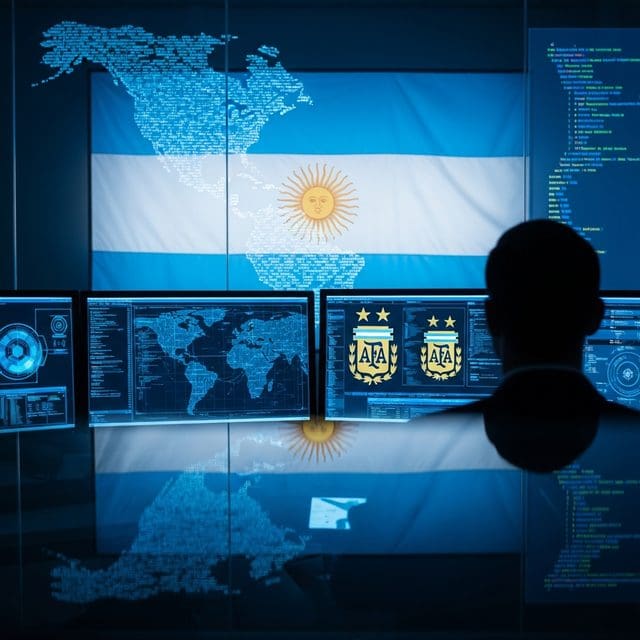
The Argentine Football Association is investigating a suspected cyberattack and database leak following its victory over Egypt, highlighting the growing intersection of digital warfare and global sporting events.
The 2026 FIFA World Cup has transitioned from a physical sporting spectacle to a digital battlefield, as the Argentine Football Association (AFA) confirmed on July 10 that it is investigating a suspected compromise of its official communication channels. The breach became public after unauthorized emails were dispatched from an official AFA account, leveling sharp criticisms against refereeing decisions during Argentina’s 3–2 victory over Egypt. This incident is not merely a case of digital vandalism; it represents a targeted strike against the digital sovereignty of a national sporting body during a period of heightened geopolitical friction.
This digital assault surfaced shortly after a threat actor operating under the alias “Hossam Hassan”—a name synonymous with Egyptian football history—claimed on July 8 to be selling a comprehensive AFA database. The alleged cache is reported to include national ID numbers, hashed passwords, email addresses, phone numbers, and IP addresses of AFA users. While formal nation-state attribution remains pending and the status of the sale is currently classified as pending verification, the timing and nature of the leak suggest a coordinated effort to leverage cyber capabilities for emotional and political retaliation following on-field results.
The AFA incident does not exist in a vacuum. American authorities have long warned that global events of this magnitude serve as magnets for both criminal syndicates and state-aligned actors seeking to exploit the “New Cold War” dynamics of the digital age. The FBI’s Internet Crime Complaint Center (IC3) previously issued a Public Service Announcement, PSA260527, flagging the active spoofing of FIFA domains and the staging of nearly 1,000 suspicious websites designed to harvest data and facilitate financial fraud. The AFA incident fits into this broader pattern of operational insecurity, which was further exacerbated in June when unredacted passport data for Lionel Messi and the entire Argentine squad was exposed on team sheets shared with the media in Alabama.
From a national security perspective, these breaches underscore the fragility of the digital infrastructure supporting international organizations. When a national football association’s database is weaponized, it exposes not just high-profile athletes but thousands of private citizens to identity theft and state-level surveillance. The current lack of a formal CISA or NSA advisory specific to the AFA breach suggests that while the incident is significant, it is currently categorized as criminal hacktivism rather than a direct state-sponsored intelligence operation. However, in the current technological climate, the distinction between independent hacktivists and state-sponsored proxies is increasingly blurred, as authoritarian regimes often utilize “patriotic hackers” to conduct deniable operations against Western interests.
As the World Cup progresses, the protection of digital assets must be viewed through the lens of national defense and individual liberty. The ability of an adversary to compromise official government-adjacent institutions like the AFA demonstrates a vulnerability that transcends sport. It highlights the urgent need for robust, free-market cybersecurity solutions and privileged access management (PAM) tools, such as those recently highlighted in the Info-Tech Research Group’s 2026 report. Protecting digital sovereignty in this high-threat environment requires more than just technical patches; it demands a fundamental commitment to constitutional values and the protection of personal data against global authoritarian overreach.
Ultimately, the AFA breach serves as a warning shot for the remainder of the tournament. With hundreds of cloned FIFA sites and cybercriminal infrastructures already staged and waiting, the intersection of kinetic geopolitics and cyberspace has never been more apparent. As Argentina prepares for its next match against Switzerland, the focus remains not just on the pitch, but on the servers and networks that define modern national identity. The defense of the digital frontier is no longer optional; it is a prerequisite for sovereignty in the 21st century.

Ryan Mitchell serves as a Staff Writer for Just Right News, where he anchors the desk for Cyber, Technology Policy, and Digital Sovereignty. In an era where the digital landscape has become as much a battlefield as any physical territory, Ryan provides a critical conservative lens on the forces shaping the future of American innovation and national security. His work is defined by a commitment to the idea that American leadership in the digital age is not just a matter of economic success, but a necessity for the preservation of global liberty.
Born and raised in Austin, Texas, Ryan’s perspective is deeply rooted in the Lone Star State’s tradition of independence and skepticism of centralized authority. Growing up in a city that transformed from a quiet state capital into a global technology hub, he witnessed firsthand the disruptive power of the tech industry. This upbringing instilled in him a firm belief in free-market principles and the necessity of protecting individual liberties from both government overreach and corporate overstep. His Texan background serves as a foundational compass, guiding his reporting toward stories that emphasize national resilience and the preservation of constitutional values in an increasingly virtual world.
Now based in San Francisco, California, Ryan operates from the epicenter of the very industry he scrutinizes. Living and working in the heart of Silicon Valley allows him to provide “boots on the ground” reporting that few conservative journalists can match. He navigates the cultural and political complexities of the Bay Area to bring Just Right News readers an inside look at the boardrooms and coding labs where the next generation of digital policy is forged. For Ryan, being stationed in San Francisco is a strategic choice; it allows him to challenge the prevailing ideological monoculture of the tech elite from within their own backyard, ensuring that the concerns of middle America are represented in the conversation about our digital future.
His beat—Cyber, Technology Policy, and Digital Sovereignty—covers the high-stakes world of data privacy, artificial intelligence, and the infrastructure of the modern web. Ryan is particularly focused on the concept of digital sovereignty, arguing that for a nation to remain truly free, it must maintain control over its own technological destiny and critical infrastructure. He frequently explores how international regulations and domestic policies impact the ability of American firms to compete without sacrificing the privacy or security of their citizens.
Central to his current body of work is his featured series, “The New Cold War.” Through this project, Ryan examines the escalating technological rivalry between the United States and its global adversaries. He delves into the complexities of state-sponsored hacking, the global race for semiconductor dominance, and the ideological struggle to define the rules of the internet. Ryan views this competition not merely as a commercial race, but as a fundamental defense of Western values against authoritarian digital models. Through his rigorous reporting and principled analysis, Ryan Mitchell ensures that the readers of Just Right News stay informed about the invisible forces defining the 21st century, always advocating for a future where technology serves the cause of freedom.