

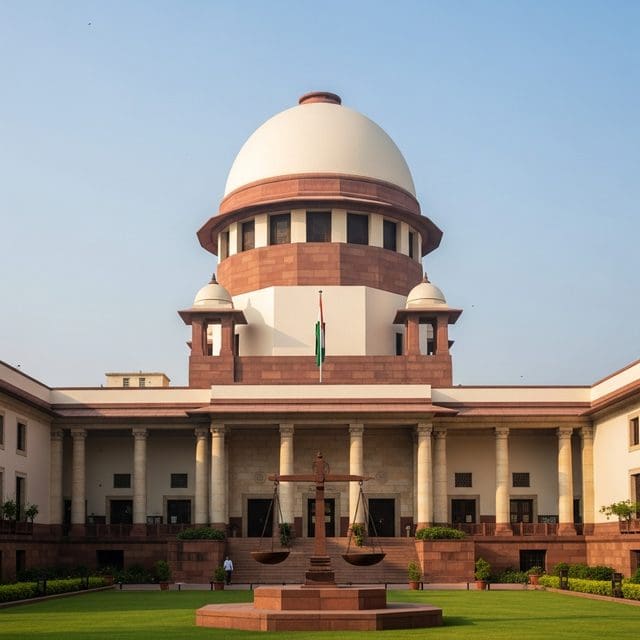
The Supreme Court of India will determine if a regulatory gap in airfare pricing constitutes a violation of constitutional rights, potentially mandating a new independent tariff authority.
The Supreme Court of India is set to address a critical question of administrative law and constitutional order on Monday, July 13, 2026, as it hears a Public Interest Litigation (PIL) challenging the current regime of dynamic airfare pricing. The case, brought by social activist S. Laxminarayanan, argues that the existing regulatory framework has left a significant vacuum that allows airlines to exploit passengers through unpredictable price surges and opaque ancillary charges. The petitioner contends that the current system lacks the necessary checks and balances to ensure that the constitutional right to travel is not hindered by arbitrary financial barriers.
Presiding over the matter, Justices Vikram Nath and Sandeep Mehta have previously signaled deep concern over the current state of civil aviation tariffs. During preliminary proceedings, the bench described steep and inconsistent fares on identical routes and dates as a form of exploitation, pressing the government for a rationalization of pricing models. The petition explicitly frames the issue as a regulatory failure, asserting that the Directorate General of Civil Aviation (DGCA) currently lacks the explicit statutory authority to cap or review fares, as its primary remit remains focused on safety and technical standards rather than economic oversight.
Central to the legal debate is the transition between statutory frameworks and the resulting delay in administrative clarity. The central government has informed the Court that the Bharatiya Vayuyan Adhiniyam, 2024, is now in force, yet the specific rules regarding airfare and passenger protection remain under consultation. This delay in rulemaking has created a temporary period of regulatory uncertainty, which the petitioner argues violates the constitutional principles of equality and the right to freedom of movement. The Solicitor General has filed an affidavit on pricing practices, but the petitioner maintains that these responses do not address the fundamental lack of a binding tariff structure.
The petitioner is seeking the establishment of a robust and independent regulator specifically for civil aviation tariffs and passenger protection. This proposed body would oversee not only base ticket prices but also the monetization of add-ons, which have become a point of contention for travelers across the country. Specific examples cited in the litigation include the industry-wide reduction in free baggage allowances from 25 kg to 15 kg and the sharp increase in fees during festive or peak holiday periods. The Court must now decide if the absence of a dedicated regulator for these economic factors constitutes a failure of the state to protect citizens from arbitrary practices.
From a doctrinal perspective, the case touches upon the limits of delegated power and the necessity of statutory clarity. While the executive branch maintains the authority to regulate commerce, the judiciary is being asked to determine if the current lack of specific guidelines crosses the line into a denial of due process for consumers. The Court is essentially being asked to define the boundary between market-driven dynamic pricing and the state’s obligation to ensure that essential services remain accessible and transparent. The petitioner argues that without a dedicated commission, the DGCA guidelines are insufficient to prevent market distortions that favor carriers over the public interest.
As the hearing commences on July 13, the legal community will be watching to see if the Court issues interim directions for passenger protection while the government finalizes its rules under the new Act. Such a move would represent a significant judicial intervention into market dynamics, justified by the bench’s earlier observations regarding the necessity of safeguarding public interest against unchecked corporate discretion. The ruling could set a major precedent for how regulatory gaps are handled when statutory transitions leave the public vulnerable to shifting industry standards.

Lila Hayes serves as a Staff Writer for Just Right News, where she anchors the “Courts, Law, and Constitutional Order” beat. Her work is defined by a steadfast commitment to the foundational principles of the American republic and a rigorous defense of the legal frameworks that ensure national stability. As a primary voice for the outlet, she provides readers with a clear-eyed analysis of the judiciary, focusing on the importance of originalism and the preservation of the separation of powers.
Lila’s perspective was forged in the American heartland. Raised in St. Louis, Missouri, she grew up in a Hispanic household where the values of hard work, faith, and respect for the law were paramount. Her upbringing instilled in her a deep appreciation for the American Dream and the legal protections that make it possible. This Missouri background remains a cornerstone of her reporting, providing a grounded, common-sense counter-narrative to the often-insular legal circles of the coastal elite. She understands that the decisions made in high-court chambers have real-world consequences for families and small business owners across the country.
At Just Right News, Lila has become widely recognized for her signature feature series, “The Rulebook of Power.” In this ongoing project, she delves into the mechanics of the federal government, examining how administrative overreach and judicial activism can threaten the delicate balance of the Constitution. She approaches her beat with the tenacity of a veteran journalist and the precision of a legal scholar, consistently advocating for a judiciary that interprets the law as written rather than legislating from the bench. For Lila, the Constitution is not a “living” document subject to the whims of modern social trends; it is a fixed standard that ensures the government remains the servant of the people, not their master.
Now based in Philadelphia, Pennsylvania, Lila finds herself at the very epicenter of American constitutional history. Living and working in the city where the Founders drafted the documents she defends daily provides a constant source of inspiration. The historic halls and landmarks of Philadelphia serve as a daily reminder of the high stakes involved in her reporting. Her presence in the city allows her to bridge the gap between the historical intent of the law and its contemporary application, ensuring that the legacy of the Founding Fathers remains central to the national conversation.
Throughout her career, Lila has remained dedicated to the idea that a free society requires an informed citizenry and a transparent legal system. Her reporting is more than just a collection of headlines; it is a defense of the constitutional order that has sustained the nation for over two centuries. By focusing on the “Rulebook of Power,” she ensures that her readers understand not just what is happening in the courtrooms, but why those decisions matter for the future of American liberty. Lila Hayes continues to be a vital voice for those who believe that the law should be a shield for the citizen and a constraint on the state.