

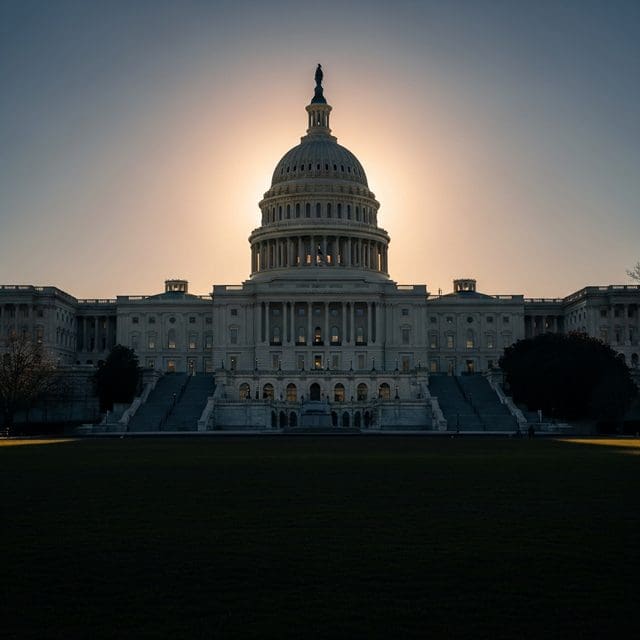
Speaker Mike Johnson faces a fractured conference as House Republicans stall key spending and defense legislation, demanding the Senate first advance the SAVE America Act despite calls for unity from President Trump.
The halls of the U.S. Capitol reflect a deepening divide within the Republican conference as Speaker Mike Johnson attempts to restart a legislative engine stalled by internal friction. Following a week where floor chaos forced the cancellation of votes on two critical spending bills and a veterans’ benefits measure, the Speaker is under pressure to reconcile the demands of constitutionalist hardliners with the basic requirements of federal governance. The immediate policy fight centers on the SAVE America Act, a measure requiring proof of citizenship for voter registration. Led by Representative Anna Paulina Luna, a faction of the House GOP has effectively shuttered floor operations, signaling they will continue to block procedural rules until the Senate advances the election legislation. This tactical blockade has already cost the chamber nearly a full week of floor time, prompting an early departure ahead of the July 4 holiday.
The legislative logjam persists despite a public intervention from President Donald Trump. During the America 250 festivities—which saw the President deliver a rebuke of communism at Mount Rushmore while D.C. faced record-breaking heat of 107 degrees—Trump issued a social media directive urging House Republicans to cease “grandstanding” and support the procedural rules necessary to pass the GOP agenda. The President’s influence is being tested as he simultaneously requests $87.6 billion in new spending, primarily to fund military operations involving Iran. Johnson, returning from a White House visit, expressed optimism that the conference would return “working on all cylinders,” yet the reality remains fraught with disagreement over which priorities the American public values most.
Speaker Johnson’s immediate challenge involves the annual defense policy bill, a cornerstone of national security that now sits in the crosshairs of the SAVE America Act debate. Rep. Luna has suggested attaching the election requirements to the defense package, a move that could further complicate the bill’s path through a narrowly divided House and a skeptical Senate. With only approximately 28 session days remaining before the midterm elections, the window to pass essential appropriations and avoid a September 30 government shutdown is rapidly closing. The House is scheduled to be out for virtually all of August and October, leaving a razor-thin margin for the Speaker to navigate the demands of his most conservative members who view the voting bill as a non-negotiable prerequisite for any further legislative movement.
While leadership points to a bipartisan housing affordability bill as a sign of functional governance, the broader Republican agenda remains tethered to the outcome of this procedural standoff. The House Budget Committee continues to seek a framework for a tax and spending cut bill aimed at extending previous tax relief and boosting immigration enforcement. Chairman Jodey Arrington argues that addressing election integrity and curbing waste is essential to energizing the base. However, moderate members like Rep. David Valadao have expressed doubt regarding a viable path forward, noting the difficulty of bypassing a Senate filibuster and the self-defeating nature of shutting down the government over a single issue.
As the administrative state awaits funding clarity, the tension between legislative duty and ideological leverage remains unresolved. Democrats have seized on the gridlock, characterizing the situation as a display of incompetence. Meanwhile, the Trump administration has moved forward with executive priorities, such as the launch of “Trump Accounts” for newborns, further highlighting the contrast between a functioning executive branch and a stalled legislature. The coming weeks will determine if the House can pivot from internal discord to the disciplined execution of its constitutional responsibilities, or if the chamber will remain paralyzed by the very oversight mechanisms designed to facilitate debate.

Miles Harrington serves as the Senior Correspondent for Federal Systems & Executive Power at Just Right News, where he brings a disciplined, constitutionalist lens to the inner workings of the American government. With a focus on the mechanics of the federal bureaucracy and the limits of executive authority, Harrington has established himself as a vital voice for readers who value transparency, accountability, and the preservation of the separation of powers.
A native of Richmond, Virginia, Harrington’s perspective is deeply rooted in the traditions of the Old Dominion. Growing up in a city defined by its historical significance and its role as a center of American jurisprudence, he developed an early appreciation for the foundational principles of the Republic. His upbringing in Richmond—a place where the legacy of the Founding Fathers is woven into the landscape—instilled in him a belief that the federal government should remain within its constitutional bounds. This background informs his skepticism of centralized overreach and his commitment to reporting on the ways in which the administrative state impacts the lives of everyday citizens.
In his current role, Harrington specializes in the complexities of federal systems. He doesn’t just report on the headlines of the day; he digs into the structural shifts within the executive branch that often go unnoticed by the mainstream press. Whether he is analyzing the implications of a new federal regulation or investigating the expansion of agency jurisdiction, his work is characterized by a rigorous adherence to the facts and a dedication to the rule of law.
Harrington is perhaps best known for his signature feature series, “How Washington Works.” Through this ongoing project, he demystifies the often-opaque processes of the nation’s capital, pulling back the curtain on the “Deep State” and the unelected officials who wield significant influence over national policy. By breaking down complex legislative maneuvers and executive orders, he empowers Just Right News readers to understand the true levers of power in Washington. His reporting serves as a necessary check on the federal government, ensuring that the actions of those in power are held up to the light of public scrutiny.
Now based in Washington, D.C., Harrington operates at the epicenter of the political world, yet he remains intentionally distanced from the “Beltway bubble.” His proximity to the halls of power allows him to maintain a robust network of sources across the federal landscape, but his heart remains in the principled conservatism of his Virginia roots. He views his role not merely as a reporter, but as a steward of the public trust, dedicated to providing the clarity and context that conservative voters need to navigate an increasingly complex political environment.
Through his sharp analysis and unwavering commitment to the truth, Miles Harrington continues to be a cornerstone of the Just Right News team. His work ensures that the principles of limited government and executive restraint remain at the forefront of the national conversation, providing a crucial service to those who believe in a government that is truly of, by, and for the people.