

A Thanksgiving storm brought flooding, high winds and widespread power outages across the East Coast and Midwest, disrupting travel and prompting Macy’s to postpone its New York parade until Saturday. Nearly 900,000 customers were without power Thursday evening, while thousands of flights were delayed or canceled. Flooded roads led to closures and rescues, and officials urged people to stay away from floodwater and barricades. Some travelers faced revised plans and extra lodging costs, including a Texas marching band that raised $350,000 to extend its New York stay. The account describes local warnings and emergency actions but gives no specific details about federal agency coordination. Road and safety advisories remain important as communities address the storm’s effects.
TLDR: The Thanksgiving storm caused major outages, flooding and travel disruption across the East and Midwest, with Macy’s moving its parade to Saturday. Officials reported rescues and road closures, urged people to avoid floodwater, and issued temporary local precautions.
A powerful Thanksgiving storm brought heavy rain, high winds and flooding across parts of the East Coast and Midwest on Thursday. The weather knocked out power, disrupted holiday travel and forced the historic postponement of New York City’s Macy’s Thanksgiving Day Parade. By Thursday evening, nearly 900,000 utility customers across the Midwest and Northeast were without electricity, according to PowerOutage.us.
The official rationale for emergency warnings and closures was clear: keep people away from dangerous conditions. New York City Mayor Zohran Mamdani cautioned residents not to walk, bike or drive through flooded areas, saying that no destination was worth risking safety. Absecon police likewise told drivers to stay off flooded roads and not go around barricades.
The storm’s effects reached from North Carolina through New Jersey and into the Midwest. More than 200,000 customers in Pennsylvania, more than 150,000 in Virginia and more than 100,000 in Missouri were among those without power. FlightAware reported more than 2,000 delayed flights to or from U.S. destinations and more than 420 cancellations by Thursday evening.
New York City recorded between 1.5 and 2 inches of rain on Thanksgiving, with some areas receiving as much as 3 inches, according to the city’s Emergency Management agency. High tides flooded coastal areas, including parts of Staten Island and Long Island. Wind gusts exceeded 30 miles per hour in Central Park, while LaGuardia Airport recorded winds of 56 miles per hour.
Those conditions led Macy’s to move its annual parade to Saturday. The decision followed concerns about how the parade’s large balloons would fare in the wind-swept spaces between Manhattan skyscrapers. The change forced visitors to revise travel plans, while some performers and families faced added costs and extra nights in the city.
A high school marching band from Pearland, Texas, raised $350,000 to keep its 500 members in New York for two additional nights. The band’s director described a community effort to make the extended stay possible. A Florida makeup artist hired for parade performers was able to rebook flights and remain an extra day, but other visitors had to make last-minute changes.
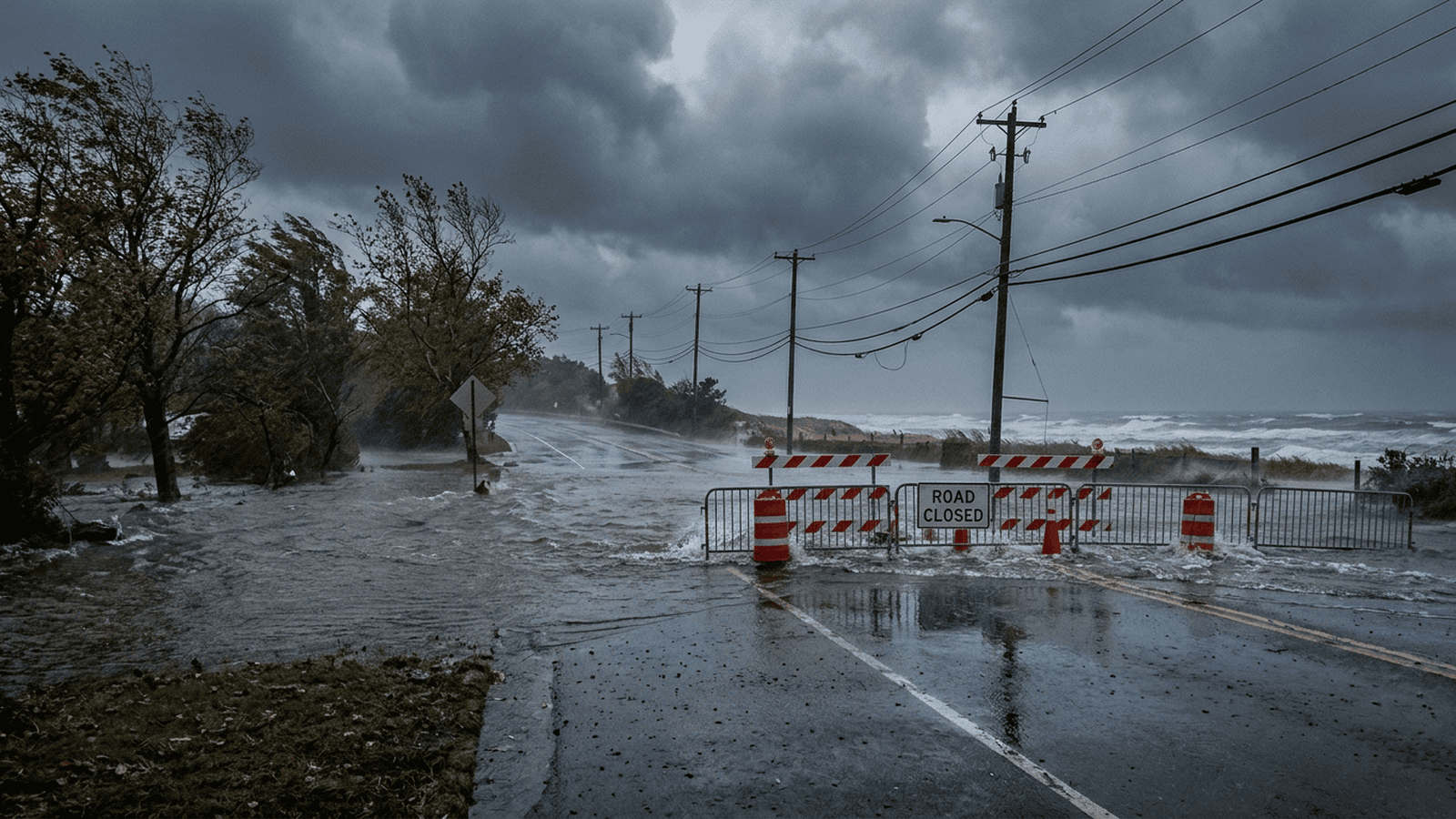
Flooding also closed roads and brought emergency rescues. Mamdani said two people had to be rescued from cars in New York City. In coastal New Jersey, emergency workers rescued drivers whose cars became stranded in water. Avalon officials described flooding there as among the worst in the borough’s history, though a local administrator said it was not at the level of Hurricane Sandy.
In Avalon, floodwater carried debris over a road near the shore. Some drivers had gone around barricades and into the water; no injuries were reported, according to the borough administrator. In Ocean City, a resident described water about a foot deep in his neighborhood and said driving to a nearby grocery store could damage a car. He planned to stay inside, while some friends were dealing with water in their homes.
The closures affected key routes as well as local streets. U.S. Route 30, a major road into Atlantic City, was closed in both directions because of flooding. The Chesapeake Bay Bridge-Tunnel in Virginia was shut for several hours Thursday morning due to high winds, and North Carolina’s NC 12 was closed after seawater crossed dunes and covered the highway linking Hatteras Island to the mainland.
Other disruptions required temporary precautions. Chester County Hospital in Pennsylvania experienced a partial power outage, but electricity returned before patients needed to be moved. In Springfield Township, north of Philadelphia, officials asked residents to evacuate temporarily after a tree fell on a propane tank; the advisory was later lifted. In Maryland, nearly 2 million water customers in Montgomery and Prince George’s counties were asked to conserve water because of intermittent power disruptions.
The direct impacts included outages, travel delays, road closures, rescues, disrupted plans and additional lodging costs for some travelers. No new federal rule, fee, form or compliance deadline is described in the available account. It also provides no specific details about federal emergency agencies coordinating with state and local officials, so the scope of that coordination remains unreported here.
The next scheduled step for the parade is Saturday, after its postponement from Thanksgiving Day. Officials and emergency services issued warnings to avoid flooded roads and barricades, while some closures and advisories remained tied to hazardous conditions. Those precautions and any continuing local updates are necessary steps as communities respond to flooding, outages and travel disruption.

Miles Harrington serves as the Senior Correspondent for Federal Systems & Executive Power at Just Right News, where he brings a disciplined, constitutionalist lens to the inner workings of the American government. With a focus on the mechanics of the federal bureaucracy and the limits of executive authority, Harrington has established himself as a vital voice for readers who value transparency, accountability, and the preservation of the separation of powers.
A native of Richmond, Virginia, Harrington’s perspective is deeply rooted in the traditions of the Old Dominion. Growing up in a city defined by its historical significance and its role as a center of American jurisprudence, he developed an early appreciation for the foundational principles of the Republic. His upbringing in Richmond—a place where the legacy of the Founding Fathers is woven into the landscape—instilled in him a belief that the federal government should remain within its constitutional bounds. This background informs his skepticism of centralized overreach and his commitment to reporting on the ways in which the administrative state impacts the lives of everyday citizens.
In his current role, Harrington specializes in the complexities of federal systems. He doesn’t just report on the headlines of the day; he digs into the structural shifts within the executive branch that often go unnoticed by the mainstream press. Whether he is analyzing the implications of a new federal regulation or investigating the expansion of agency jurisdiction, his work is characterized by a rigorous adherence to the facts and a dedication to the rule of law.
Harrington is perhaps best known for his signature feature series, “How Washington Works.” Through this ongoing project, he demystifies the often-opaque processes of the nation’s capital, pulling back the curtain on the “Deep State” and the unelected officials who wield significant influence over national policy. By breaking down complex legislative maneuvers and executive orders, he empowers Just Right News readers to understand the true levers of power in Washington. His reporting serves as a necessary check on the federal government, ensuring that the actions of those in power are held up to the light of public scrutiny.
Now based in Washington, D.C., Harrington operates at the epicenter of the political world, yet he remains intentionally distanced from the “Beltway bubble.” His proximity to the halls of power allows him to maintain a robust network of sources across the federal landscape, but his heart remains in the principled conservatism of his Virginia roots. He views his role not merely as a reporter, but as a steward of the public trust, dedicated to providing the clarity and context that conservative voters need to navigate an increasingly complex political environment.
Through his sharp analysis and unwavering commitment to the truth, Miles Harrington continues to be a cornerstone of the Just Right News team. His work ensures that the principles of limited government and executive restraint remain at the forefront of the national conversation, providing a crucial service to those who believe in a government that is truly of, by, and for the people.