

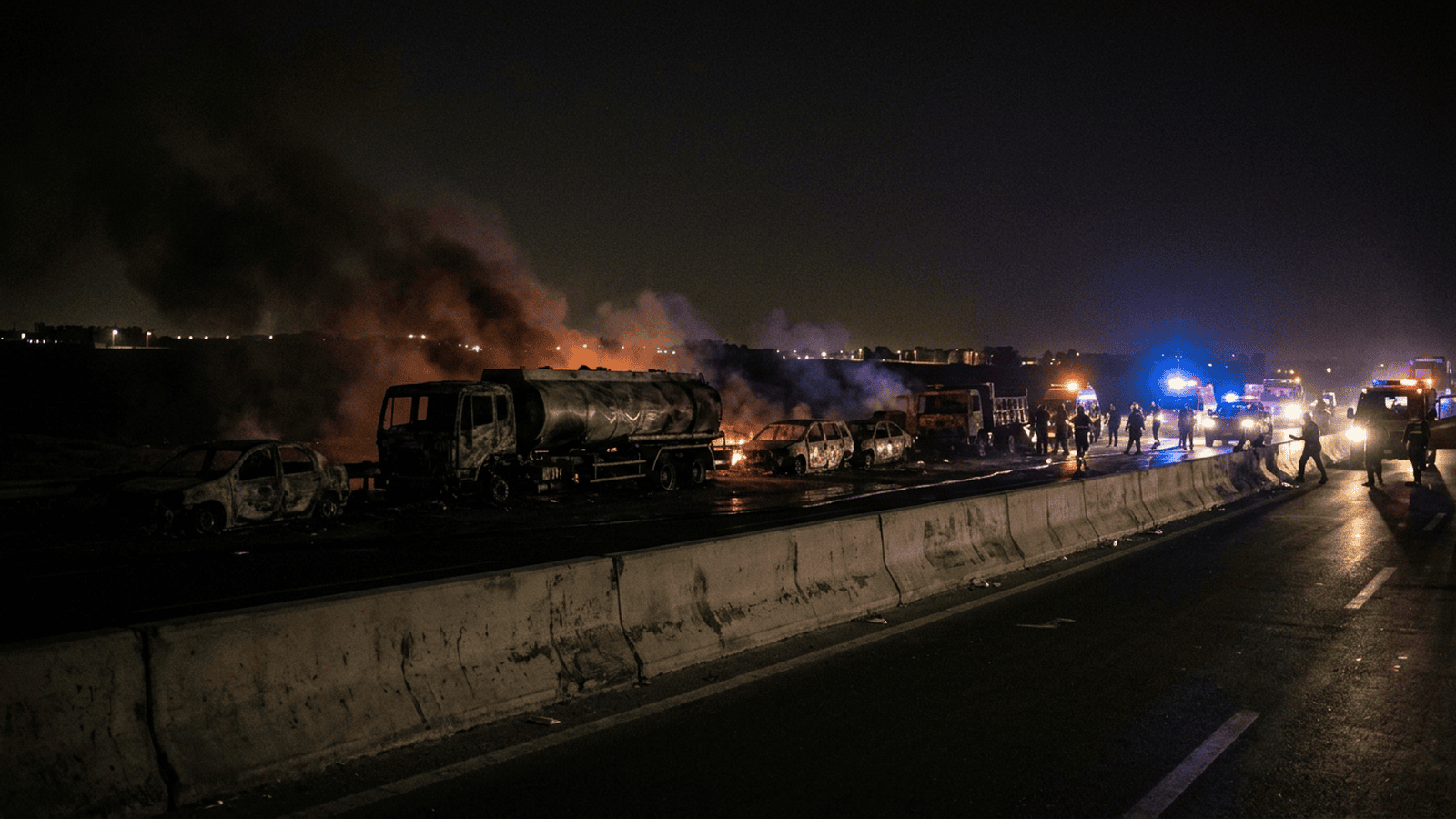
A car struck a fuel tanker on a highway in Giza, triggering a fire that killed 31 people and injured 21, according to Egypt’s Public Prosecution office. At least 27 vehicles were destroyed. Prosecutors say the driver was traveling around 70 miles per hour while changing lanes and overtaking, and he has been arrested. The tanker overturned after a tire exploded, leaked gasoline and caught fire. Egypt’s health ministry said 39 ambulances took part in the rescue. Prosecutors are questioning the driver to establish the circumstances and assess possible criminal responsibility. The report describes no new road-safety policy, fees, forms or deadlines. The investigation continues, while calls for greater accountability follow the crash.
TLDR: The Giza highway tanker fire killed 31 people, injured 21 and destroyed at least 27 vehicles. The driver has been arrested, and prosecutors are questioning him to establish what happened and assess possible criminal responsibility.
A collision between a car and a fuel tanker on a highway in Giza, near Cairo, set off a fire that killed 31 people and injured 21, Egypt’s Public Prosecution office said Thursday. At least 27 vehicles, including cars and motorcycles, were destroyed. The driver was arrested, and prosecutors said he was being questioned as they worked to establish what happened and assess possible criminal responsibility.
The stated reason for questioning the driver is to determine the circumstances of the crash and whether criminal responsibility applies. That is the official purpose of the inquiry described by prosecutors. Officials have not announced a broader policy change or a new road-safety program in response. The available account describes the collision, the fire and the investigation, but does not identify a specific government measure prompted by the disaster.
According to the prosecutor’s statement, the driver said he was traveling around 70 miles per hour on a major highway in the Al-Warraq district. He reportedly said he was changing lanes and overtaking other vehicles when the front-left side of his car struck the rear-right side of the tanker. The impact caused the steering wheel to slip from his hands, and the car veered off course, according to the statement. This account has been attributed to the driver; it is not a final finding by prosecutors.
After the collision, one of the tanker’s tires exploded. The truck overturned and struck a concrete barrier. Gasoline leaked from the tanker and caught fire. The account describes a chain of events in which the initial impact was followed by the overturned truck, spilled fuel and flames. It does not provide a technical assessment of the tanker or a final explanation of how the fire spread.
Images posted on social media showed several vehicles burning, with flames and smoke rising into the night sky. The fire destroyed vehicles caught in the incident and trapped people amid the wreckage. At least 27 vehicles were destroyed, including cars and motorcycles. The number gives a measure of the damage, though the report does not describe the condition of each vehicle or say how many people were inside them.
The scale of the loss is clear in the casualty count: 31 people died and 21 were injured. Ahmed Sameer, who was caught in traffic behind the crash, described the cars as stuck together because of the fire. He told the Associated Press that he saw at least eight bodies being removed from charred vehicles. His account offers a witness’s view of the scene, while the official figures establish the reported toll.
The rescue operation involved 39 ambulances, according to a statement from Egypt’s health ministry. President Abdel-Fattah el-Sisi expressed condolences to the victims. These responses followed a fire that affected multiple vehicles and left survivors and witnesses facing a devastating scene. The report gives no further details about the injured people, the identities of those killed or the status of their families. It also does not say how long the rescue operation lasted.
The investigation remains focused on the driver’s account and the sequence of events. The arrest is confirmed, but prosecutors said questioning was still underway to establish the circumstances and assess criminal responsibility. No charges, court dates or final investigative findings are included in the reporting. An arrest and an account attributed to a suspect do not, by themselves, establish the final legal outcome. The available information leaves that outcome unresolved.
The incident has renewed calls for greater accountability against a background of high road deaths in Egypt. Official data cited in the report show that nearly 6,000 people died in traffic accidents across the country last year. The figure provides context for those calls, but the reporting does not connect it to a newly adopted rule, enforcement drive or specific proposal. It also does not set out a government rationale for any such policy. The reported number is a national total, not a count tied to this highway or this crash.
For people directly affected, the confirmed impacts are severe: deaths, injuries, destroyed vehicles and a rescue operation involving 39 ambulances. The report identifies no fees, forms, compliance requirements or deadlines, and describes no new enforcement rules. Those details are not available in the reported account; their absence is not evidence that a policy is already in place. No practical policy change, cost to the public or new paperwork is reported. The next stated steps are continued questioning and assessment of possible criminal responsibility. Prosecutors have announced no further timetable or oversight process, so the reporting offers no date for a final account of the crash.

Ethan Blake serves as a Senior Correspondent for Just Right News, where he specializes in Longform Narrative and Public Understanding. In an era of rapid-fire headlines and fleeting soundbites, Ethan’s work stands as a testament to the power of deep-dive reporting and the importance of contextualizing the complex issues facing the nation today. His approach is rooted in the belief that the most profound truths are often found in the lived experiences of individuals rather than the abstract theories of distant policymakers.
Growing up in Providence, Rhode Island, Ethan developed an early appreciation for the historical and cultural threads that weave the American fabric together. Providence, a city defined by its industrial heritage and its blend of traditional neighborhoods, provided him with a front-row seat to the challenges and triumphs of the American working class. This upbringing instilled in him a respect for the “common sense” values of hard work, community loyalty, and the preservation of local institutions. He learned early on that behind every economic statistic or legislative debate, there are real families and neighborhoods navigating the consequences of change.
This foundational perspective is the driving force behind his signature feature series, “Lives Behind the Systems.” Through this series, Ethan explores the intersection of individual agency and institutional structure. Whether he is documenting the impact of federal land-use policies on rural families or examining how shifting educational standards affect local school boards, Ethan’s work prioritizes the human element. He seeks to uncover how large-scale systems—be they governmental, economic, or social—affect the daily lives of citizens, often advocating for a return to local control and personal responsibility.
Now based in Portland, Maine, Ethan draws significant inspiration from the rugged independence and self-reliance that define the region. The coastal landscape and the resilient spirit of Maine’s communities serve as a constant reminder of the importance of individual liberty and the strength found in decentralized power. Living and working outside the traditional media hubs allows Ethan to maintain a grounded perspective, ensuring his reporting remains untethered from the echo chambers of the major metropolitan centers. This geographic distance provides him with the clarity needed to translate complex national narratives into stories that resonate with the heart of the country.
At Just Right News, Ethan’s beat is more than just a professional assignment; it is a mission to foster a more informed and engaged citizenry. He believes that a free society depends on the public’s ability to understand the mechanisms of power and the value of traditional American principles. His longform narratives do not merely report the news; they provide a roadmap for understanding the cultural and political shifts of the modern era through a lens of skepticism toward centralized authority and a deep respect for the individual.
Through his meticulous research and narrative craftsmanship, Ethan Blake continues to bridge the gap between policy and the public. His work remains a vital resource for those who seek a deeper understanding of the systems that shape our world and the enduring spirit of the people who live within them.