

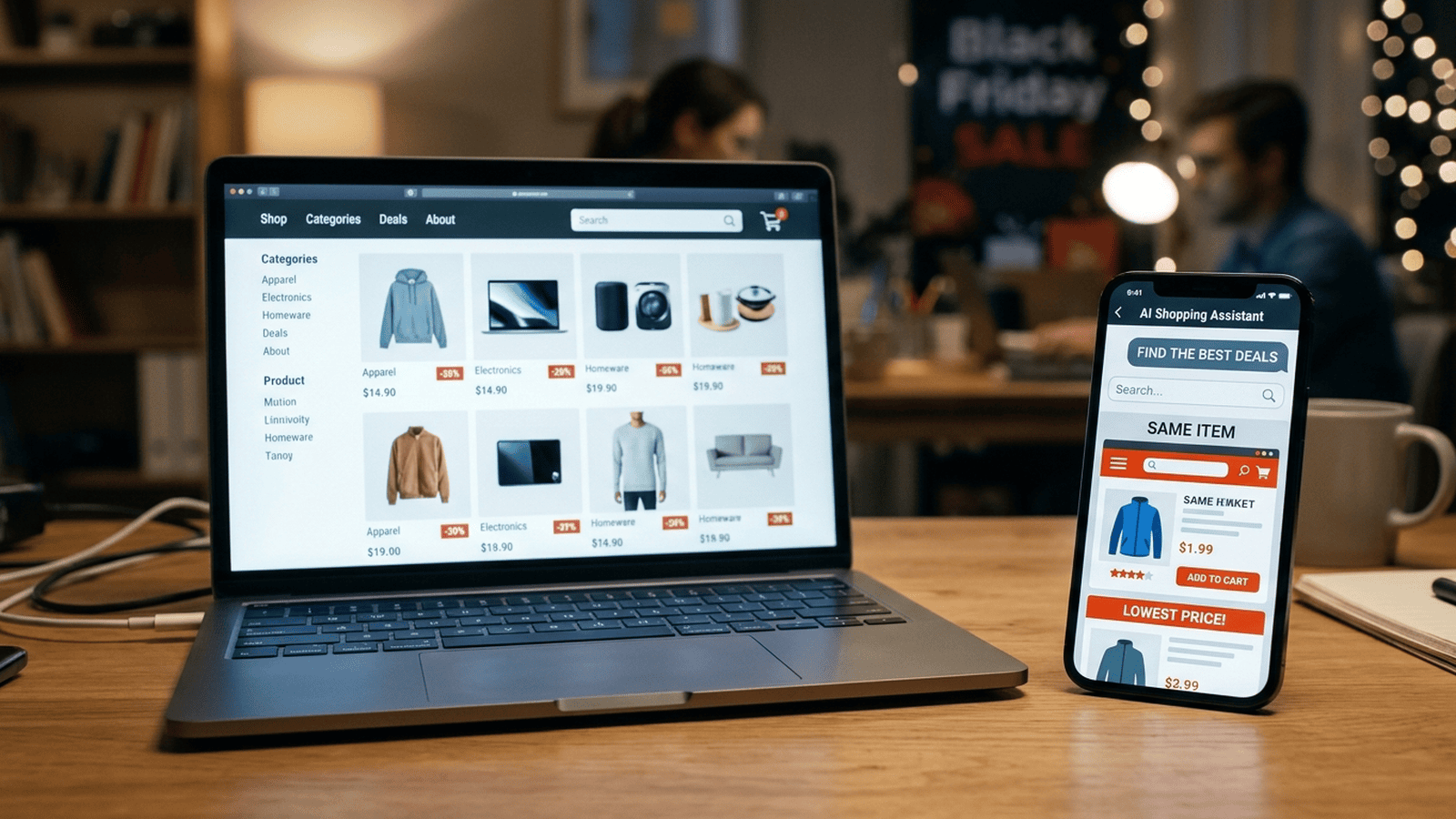
AI-generated copycat stores are challenging shoppers and shopping bots this Black Friday. Spokeo identified 65 distinct stores mimicking 60 brands as of Nov. 15, while Podqi found that more than 18% of answers from tested AI tools drew on fake, infringing or invalid sites. Examples include counterfeit Converse and Stussy stores that use addresses resembling the real brands’ domains. The report describes platforms trying to keep users away from fraudulent sites, but says the volume is difficult to manage. Shoppers who use AI agents may need to verify a store’s web address before buying. The source describes no new government policy, fees, forms, enforcement rules or deadlines.
TLDR: Fake online shops are using AI to copy established brands, and shopping bots sometimes direct customers to those sites. Research cited in the report points to widespread risk, making careful checks of store addresses important for shoppers and platforms.
AI shopping tools may send customers to fake stores this Black Friday, exposing a basic weakness in online buying: a convincing page is not proof of a real business. Scammers are using artificial intelligence to copy the logos, product images, descriptions and marketing language of legitimate retailers. Some shoppers are relying on AI agents to search and make purchases for them, but those tools can mistake a counterfeit store for an official one.
The source material gives no government policy change or official policy rationale. It describes a practical reason for caution: AI tools can help scammers build realistic websites quickly, while the systems meant to guide shoppers do not always distinguish those sites from authentic retailers. That is a straightforward problem for customers, businesses and the platforms that direct people to stores.
Harrison Tang, co-founder of the data aggregator Spokeo, told CBS News that AI makes website creation much easier. A copycat site can use a brand’s logo and familiar product details, creating a page that looks legitimate at a glance. Microsoft research cited in the report found that criminals can establish fraudulent e-commerce sites in minutes, rather than the days or weeks that were once required.
The scale is not limited to one brand or one type of product. Spokeo identified 65 distinct online stores mimicking the websites of 60 brand names as of Nov. 15. The list included copies of sites associated with UGG, L.L. Bean, Converse and Stella McCartney. Other brands with duplicate stores included Figs, Bombas and Fairlife. The figures offer a snapshot of the problem, not a count of every fake store online.
AI shopping tools add another path from a customer to a fraudulent seller. In research on AI search risks, Podqi asked popular tools, including ChatGPT, Google’s Gemini and Perplexity, where particular brands could be bought online. More than 18% of the answers drew on a fake, infringing or invalid website. The result shows that an automated recommendation can carry a risk that a shopper may not see until checking the destination closely.
One example involved Stussy clothing. Perplexity referred users to us-stussy.com and described it as the brand’s official website and a starting point for guaranteed authentic items. The address leads to a fake store. Stussy’s real address is stussy.com. The mismatch is easy to overlook when a search result arrives with a confident description, but the example shows why an AI answer should not be treated as proof of a seller’s identity.
A similar distinction appears in the example of Converse. A fake store used converseshop.us.com, while the real store’s address is converse.com. Tang said the web address is the first place to look for evidence of fraud. The report notes that .us is the U.S. top-level domain and is reserved for U.S. residents, but Tang said it is commonly used for phishing attempts. A familiar brand name inside a longer address does not establish that the site belongs to the brand.
The tools are not necessarily able to catch every imitation before a shopper sees it. Platforms may try to keep users from being directed to fake stores, Tang said, but the sites appear in such numbers that they are hard to keep up with. The source also says bots may be less well trained than some people at spotting phony sites, while realistic copies can deceive even discerning shoppers. That leaves consumers with less certainty than a smooth automated recommendation may suggest.
The practical impact is that shoppers using AI agents to buy products may need to check the destination themselves, including its web address, before completing a purchase. The directly affected group includes the millions of Americans who task AI agents with purchases and transactions, as well as retailers whose brands are copied. The source gives no figures for consumer losses, fees or added costs. It identifies no government forms, compliance rules, enforcement measures or deadlines; those details are not part of the reported story.
The immediate next step supported by the report is careful verification of store addresses, rather than reliance on an AI answer alone. Spokeo and Podqi provide research on the scale and risks, while platforms are described as trying to avoid directing users to fraudulent sites. No formal oversight schedule or official assurance that the problem is under control appears in the source material. The evidence instead calls for ongoing attention from shoppers and platforms as fake stores continue to emerge.

Sean Bradley serves as the Senior Correspondent for Trade, Supply Chains, and Global Labor at Just Right News, where he brings a principled, clear-eyed perspective to the complex systems that power the modern world. With a focus on the economic forces that impact the American household, Bradley has distinguished himself as a leading voice in explaining how global shifts in manufacturing and logistics translate to the kitchen table.
Growing up in Long Beach, California, Bradley’s interest in the movement of goods was forged against the backdrop of one of the nation’s most vital maritime gateways. Raised in a community where the towering cranes of the port were a constant fixture on the horizon, he developed an early appreciation for the blue-collar industries that form the backbone of the American economy. This upbringing instilled in him a profound respect for the dockworkers, truckers, and laborers who keep the country moving, a sentiment that remains a cornerstone of his reporting today. For Bradley, trade is not merely a series of abstract figures on a spreadsheet; it is a human endeavor that sustains families and defines the strength of a nation.
Now based in Seattle, Washington, Bradley occupies a strategic vantage point in another of the country’s most significant trade hubs. His location allows him to witness firsthand the intersection of traditional industry and the evolving technological landscape of global logistics. From the Pacific Northwest, he monitors the flow of goods across the ocean, providing Just Right News readers with timely insights into how international tensions, regulatory hurdles, and labor disputes affect the availability and cost of essential goods.
His signature feature series, “The Journey of Things,” has become a staple for readers seeking to understand the intricate path products take from raw materials to the retail shelf. Through this series, Bradley pulls back the curtain on the global marketplace, often highlighting the risks of over-reliance on foreign adversaries and the importance of domestic manufacturing resilience. His reporting consistently emphasizes the conservative values of national sovereignty, free-market competition, and the protection of the American worker from unfair global practices.
As a journalist of Irish heritage, Bradley maintains a deep-seated respect for the dignity of the individual worker and the importance of community stability. He approaches his beat with a commitment to transparency, often questioning the status quo of globalist policies that prioritize corporate efficiency over local prosperity. Whether he is reporting from a warehouse floor or analyzing a new international trade agreement, his goal remains the same: to provide the American public with the truth about where their products come from and what it costs to get them there.
Throughout his tenure at Just Right News, Bradley has remained a steadfast advocate for economic common sense. His work serves as a vital resource for those who believe that a strong nation is built on secure borders, robust trade, and a respected workforce. By combining his local roots in Long Beach with his professional experience in Seattle, Bradley continues to offer a unique and necessary perspective on the forces that shape the American way of life.