

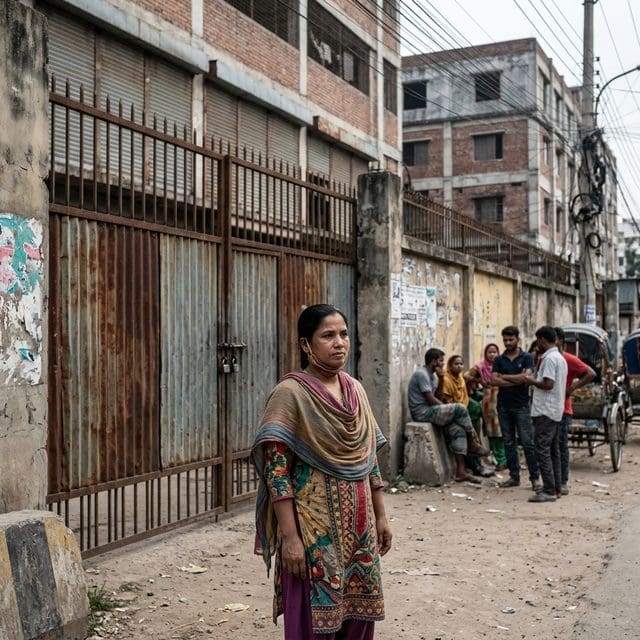
Unresolved pay talks have disrupted garment production in Bangladesh and halted conventional bus service in Regina, leaving workers and the public to absorb the costs of stalled bargaining.
A wage dispute has suspended operations at hundreds of garment factories in Bangladesh, while a labour disruption has halted every standard bus route in Regina, Canada. The two disputes differ in scale and circumstance, but both show how stalled bargaining can quickly spread the cost of an impasse beyond the negotiating table—to workers, employers and people who depend on the service or production involved.
In Bangladesh, workers have rejected an employers’ wage proposal as too low, but the wage board has kept the figure confidential. The workers’ representative proposed a monthly minimum of Tk 32,000; protest organizers are demanding Tk 30,000. Both sides are to submit revised proposals, according to Al Jazeera and Bangladesh’s United News of Bangladesh, or UNB.
The third meeting of the wage board ran for nine and a half hours without bridging the gap and was adjourned until the following day, The Daily Star reported. The Financial Express said operations had been suspended at around 500 factories, with another 200 reportedly closed under “no work, no pay” rules. That leaves a large workforce facing lost shifts or uncertainty while talks continue.
Bangladesh’s garment industry brings in about $38 billion a year, Al Jazeera reported, and the country’s minimum wage is around Tk 12,500 a month. The dispute is therefore about more than the headline demands: it concerns whether pay can keep pace with the needs of workers in a major export industry, and how much disruption employers and workers can withstand while seeking a settlement. The available reports do not provide a confirmed account of how many workers are affected or what revised offers either side will make.
In Regina, all standard Transit routes were out of service on Monday, Nov. 23, because of a labour disruption, the City of Regina said. Paratransit remained available, but the city warned of longer waits and reduced booking hours, from 9 a.m. to 5 p.m. Email and voicemail bookings, new subscriptions, new registrations, and charter and group bookings were unavailable. Existing subscription trips continued.
The immediate dispute followed an overtime ban by ATU Local 588. The city said it could not safely and reliably operate conventional transit and issued a lockout notice, according to CKOM and SaskToday. Mayor Chad Bachynski said the city and workers were returning to the bargaining table Monday afternoon. He also said council was not privy to the monetary and non-monetary details of the negotiations, SaskToday reported.
The stoppage puts transit-dependent residents in a bind, while workers and the city remain at odds over the terms of service. Paratransit’s continued operation offers a limited alternative, but the reduced booking options and longer waits underline that it is not a full replacement for regular routes. The reports do not specify when standard service might resume.
A separate PwC development illustrates a different workforce pressure, but not a confirmed job-cut story. Business Insider reported that the firm plans to certify 85,000 workers in critical thinking for the AI era. A trade-publication report alleging U.S. layoffs could not be matched to a primary company statement or major-wire source in the available material, so its unverified figures cannot establish the scale or even confirm those cuts.
For workers in all three settings, the practical questions are immediate: what pay is on offer, whether shifts or services continue, and what skills employers will value as technology changes work. In Bangladesh and Regina, the clearest facts are the disruption and the lack of a settled agreement. Until bargaining produces one, workers and the people relying on their labor bear much of the uncertainty.

Tom Blake serves as the Senior Correspondent for Labor, Wages, and Automation at Just Right News, where he brings a grounded, principled perspective to the most pressing economic issues facing the American heartland. As the lead voice behind the acclaimed feature series “The Price of Work,” Tom focuses his reporting on the intersection of traditional industry and the rapidly evolving technological landscape, always prioritizing the dignity of the individual worker and the health of the American family.
Tom’s deep understanding of the labor market is not merely academic; it is rooted in his upbringing in Detroit, Michigan. Growing up in the shadow of the automotive industry, he witnessed firsthand the triumphs and tribulations of the American blue-collar workforce. He saw how the stability of a manufacturing job could build a community and, conversely, how the erosion of those industries could tear the social fabric apart. This background instilled in him a lifelong respect for the trades and a healthy skepticism toward economic policies that prioritize globalist interests over the well-being of local communities.
Now based in Pittsburgh, Pennsylvania, Tom continues to report from the front lines of the shifting economy. Pittsburgh, a city that has reinvented itself while maintaining its gritty, industrious spirit, provides the perfect vantage point for his beat. From the steel mills that remain to the high-tech robotics labs reshaping the city’s future, Tom explores how automation is changing the nature of employment. His reporting often highlights the tension between innovation and tradition, arguing that while progress is inevitable, it must not come at the expense of the American worker’s ability to provide for their family through honest, meaningful labor.
In his role at Just Right News, Tom has become a vital voice for those who feel overlooked by mainstream economic coverage. He rejects the notion that the decline of American manufacturing is an unavoidable casualty of the modern era. Instead, his work often examines how regulatory overreach, rising energy costs, and the unchecked rise of automation impact the take-home pay of everyday citizens. Through “The Price of Work,” Tom delves into the true cost of economic shifts, looking beyond the raw data to tell the stories of the people behind the statistics.
Tom’s reporting is characterized by a commitment to the conservative values of self-reliance, fiscal responsibility, and the preservation of the American dream. He believes that a strong nation is built on a foundation of stable jobs and fair wages, and his work seeks to hold both government and corporate entities accountable to that standard. Whether he is interviewing a shop floor manager about the implementation of new AI technology or analyzing the impact of wage inflation on small businesses, Tom provides a clear-eyed analysis that resonates with readers who value hard work and common sense.
Through his dedicated coverage, Tom Blake remains a steadfast advocate for the American workforce, ensuring that the voices of those in the industrial heartland are heard loud and clear in the national conversation. His perspective is essential for anyone seeking to understand the complex realities of labor and automation in the twenty-first century.