

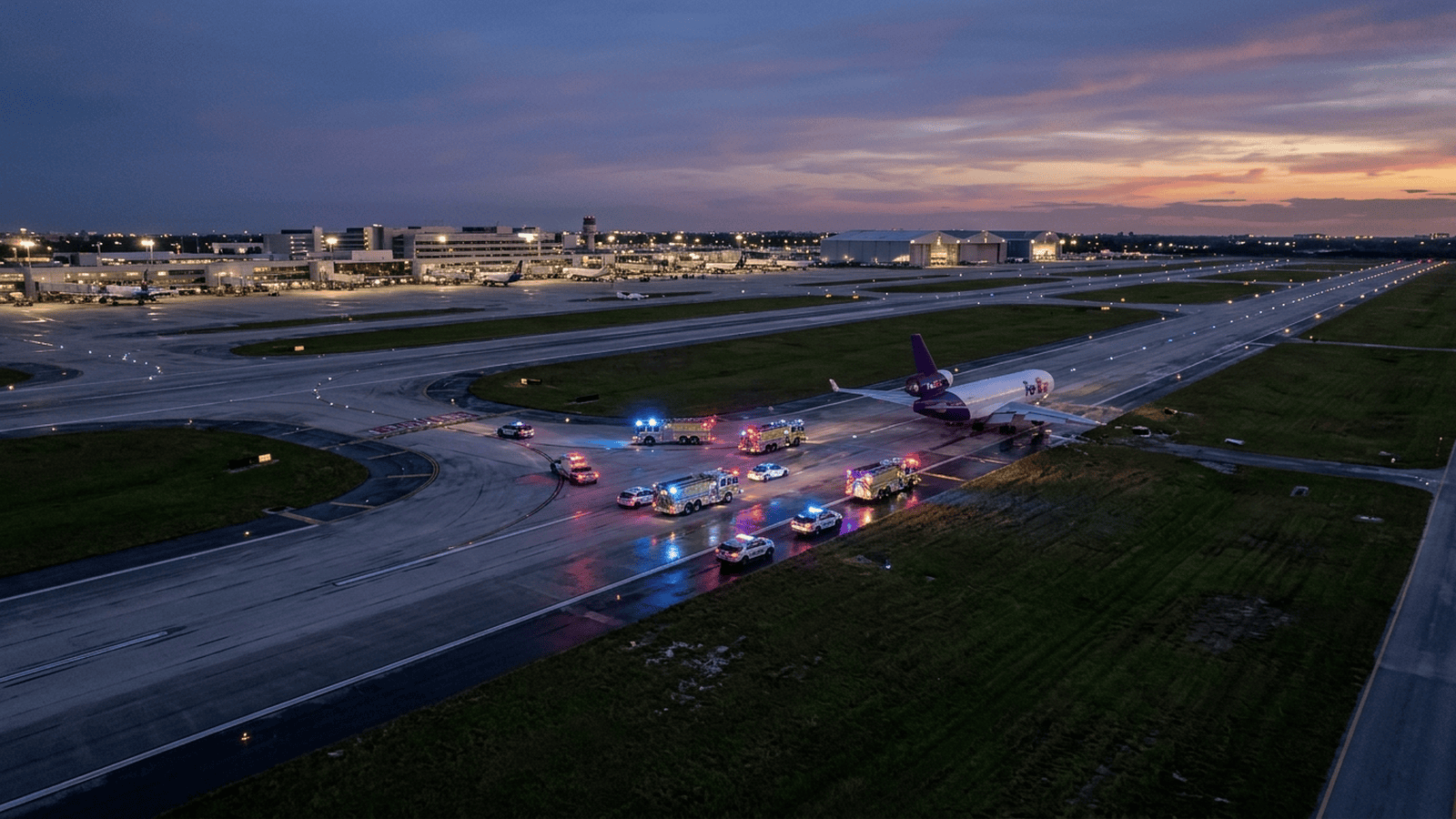
A FedEx MD-11 ran off a runway at Miami International Airport at about 8:40 p.m. Wednesday, prompting officials to temporarily close all but one runway. The airport reported no injuries, while the FAA reported hourslong delays by early Thursday and began investigating. FedEx said the plane had an issue upon landing and that it was coordinating with officials. The airport advised Wednesday night passengers to check with their airlines before traveling. The runway was different from the one involved in Miami’s fatal Amazon cargo-plane overrun in September, though three runways converge nearby. No cause, investigation timeline, passenger fees, or new requirements have been reported; the FAA investigation and airport operations work continue.
TLDR: A FedEx cargo jet went off a runway at Miami International Airport, temporarily limiting runway use and contributing to hourslong delays. The FAA is investigating, no injuries were reported, and passengers were advised to check directly with their airlines for updates.
A FedEx cargo plane ran off a runway at Miami International Airport on Wednesday night, leading officials to temporarily close all but one runway. The incident happened the day before Thanksgiving, when many travelers were preparing to fly. The airport reported no injuries. The Federal Aviation Administration said it was investigating, and by early Thursday it was reporting flight delays lasting hours. The incident left travelers facing uncertainty about whether their scheduled flights would depart on time, but the available account does not give a count of affected flights or passengers.
The available account gives no official policy rationale for the runway closures. It says the airport reduced runway use after the aircraft left the runway, while officials worked toward safely resuming normal operations. The closure was a direct response to the incident, not a new government policy. Its practical purpose and duration beyond the temporary restriction were not specified. Officials did not provide a separate explanation of why all but one runway had to be closed or how long that arrangement would remain in place.
The plane, a McDonnell Douglas MD-11 arriving from Memphis, ran off the runway at about 8:40 p.m., according to the airport. FedEx described the event as “an issue upon landing” and said it was coordinating with investigating officials. The company said its crew was safe and there were no reported injuries. No cause for the overrun has been established in the information available. The account does not say whether the aircraft was damaged or how it was moved, and it offers no further detail about the landing itself.
The effect on airport operations was immediate. All but one runway were temporarily closed, and the FAA reported hourslong delays by early Thursday. Passengers scheduled to fly Wednesday night were advised by the airport to check with their airlines for current flight information before traveling to the airport. The notice placed the burden on travelers to confirm whether their plans had changed, and the excerpt gives no further details about individual cancellations or rebooking. It also does not say how many flights were delayed, or whether any passengers missed connections.
Airport officials said they appreciated passengers’ patience while they worked to safely resume normal operations. That statement did not set a deadline for reopening the runways. No fees, forms, or new compliance requirements were reported. For travelers, the concrete steps described were to monitor airline updates and account for delays; the number of affected flights and passengers was not provided. The account does not describe a special airport process for travelers whose flights were disrupted, so passengers were directed to their airlines for current information.
The FAA is leading the investigation, but the excerpt does not describe a schedule for its work or say what evidence investigators are examining. FedEx said it was coordinating with officials. Miami-Dade Fire Rescue units responded Wednesday. The National Transportation Safety Board said it had no information about the situation at that point. Those statements identify the agencies and company involved, but they do not establish what caused the plane to leave the runway or what investigators may conclude.
The airport’s runway layout adds context, without establishing a cause. The runway used by the FedEx plane was different from the one an Amazon cargo jet overran in September. However, three Miami runways converge at the west end, and the FedEx plane ended up near the area where the Amazon aircraft crossed a road and struck a van carrying an aircraft cleaning crew. Five people on the ground were killed in that September incident, according to the excerpt. The shared area is a point of location, not evidence that the two overruns had the same cause.
The latest overrun also followed a minor collision between two planes at a taxiway intersection at the airport less than two weeks earlier. The wing of a Copa flight and the nose of a UPS plane collided. The excerpt does not link that collision to Wednesday’s event, and it provides no finding that the incidents share a cause. Keeping those distinctions clear is important while the FAA investigation remains open. The available information does not say that the earlier collision changed runway operations for this event.
The MD-11 has also been involved in a fatal crash in Kentucky. FedEx had resumed flying the type in May to deliver packages after an MD-11 crashed during takeoff there the previous year. The UPS plane’s left engine came off, killing three pilots and 12 people on the ground. The FAA had approved Boeing’s proposed fix for MD-11s after an extensive review, according to the excerpt; it does not state whether that fix relates to the Miami event. The prior crash and the approved fix provide background, but neither supplies a cause for the latest overrun.
For travelers, the immediate impact is operational rather than a reported new rule: temporary runway limits, hourslong delays, and the need to check airline updates. No additional charges, paperwork, enforcement steps, or deadlines for passengers appear in the available account. The investigation’s timing and any later safety actions are also unspecified. The FAA investigation and the airport’s work to resume normal operations are the next steps; further conclusions await information from officials. Until more details are released, the account leaves both the cause and the full effect on travelers unresolved.

Deborah Cole serves as a Senior Correspondent for Just Right News, where she spearheads the network’s coverage of Housing, Infrastructure, and Mobility. With a career defined by a commitment to rigorous reporting and a focus on the fundamental pillars of American community life, Deborah brings a principled perspective to the complex issues that dictate how and where we live. Her work is grounded in the belief that sound policy, fiscal responsibility, and respect for private property are the essential foundations of a prosperous society.
Originally from Boston, Massachusetts, Deborah’s upbringing in one of the nation’s oldest and most historically significant cities deeply influenced her professional trajectory. Growing up amidst the architectural legacy and dense urban planning of New England, she developed an early appreciation for the importance of durable infrastructure and the role of local tradition in shaping neighborhoods. Her perspective is informed by the classic American values of her hometown—hard work, community cohesion, and a healthy skepticism of top-down bureaucratic mandates that often overlook the unique needs of individual citizens.
Today, Deborah operates from her base in Austin, Texas, a city that serves as a primary laboratory for her reporting. Austin’s rapid expansion and its status as a hub for innovation and migration provide her with a front-row seat to the most pressing challenges in modern infrastructure and housing. From the Lone Star State, she chronicles the tensions between rapid growth and the preservation of the American Dream, often highlighting how market-driven solutions and deregulation can address the housing shortages that plague many of the country’s metropolitan areas.
At Just Right News, Deborah is perhaps best known for her signature feature series, “Where We Live.” Through this platform, she explores the intersection of public policy and private life, moving beyond mere statistics to tell the stories of families, small business owners, and local developers. Her reporting frequently highlights the importance of mobility—not just in terms of transportation and transit, but as a vehicle for economic opportunity and social stability. She remains a staunch advocate for the taxpayer, consistently scrutinizing government spending on large-scale projects and advocating for transparency in how infrastructure dollars are allocated.
Deborah’s beat is more than just a collection of policy topics; it is an investigation into the physical and legal structures that allow families to flourish. Whether she is reporting on the impact of zoning laws on suburban development or the necessity of maintaining the nation’s highway systems, her work is characterized by a dedication to the facts and a respect for the constitutional principles that protect the rights of homeowners.
As a Senior Correspondent, Deborah Cole continues to be a vital voice for Just Right News, providing the audience with the clarity and context needed to navigate an ever-changing landscape. Her reporting ensures that the values of individual liberty and local sovereignty remain at the forefront of the national conversation regarding the future of our cities and towns. Through her tireless efforts, she remains committed to informing the public on the issues that hit closest to home.