

University of Washington oceanographers and collaborators measured a major increase in fresh water stored by the Arctic’s Beaufort Gyre. The findings show how winds and changing sea ice can reshape the ocean’s freshwater reservoir, while leaving open how much water may eventually flow into the North Atlantic.
TLDR: Measurements show that the Arctic’s Beaufort Gyre accumulated roughly 40 percent more fresh water from 2003 to 2018. Winds helped strengthen the current and deepen its surface-water dome. Scientists are monitoring the reservoir to understand whether, when and where that water might leave the Arctic.
A powerful current in the Arctic Ocean has accumulated an unusually large reserve of fresh water, according to years of measurements by an international research team that includes University of Washington oceanographers. The finding helps explain how shifting winds and declining sea ice are reshaping the Arctic—and why changes there could matter far beyond the polar region.
The Beaufort Gyre is a broad, clockwise-moving system of ocean currents north of Alaska and Canada. Winds help drive its rotation, which gathers relatively fresh water near the ocean surface. That water comes from sources including river runoff, precipitation and melting sea ice. Researchers have tracked the gyre since the early 2000s using ships, moorings, autonomous instruments and satellite observations.
Measurements showed that the gyre’s freshwater content rose substantially over the following years. Research published in 2020 described an increase of roughly 40 percent between 2003 and 2018. The result was not simply a matter of more meltwater entering the ocean. Persistent winds helped spin the gyre faster and push surface water into a larger, deeper dome, allowing it to hold more fresh water.
That distinction matters because the gyre acts as a temporary store. If its circulation weakens or changes direction, some of the accumulated water could move out of the Arctic and into the North Atlantic. Fresh water is less dense than salty water, and a large release could alter the layering of seawater and influence ocean circulation. The observations do not show that a sudden release is inevitable, or that the gyre alone controls major currents. They do reveal a changing reservoir that climate models need to represent more accurately.
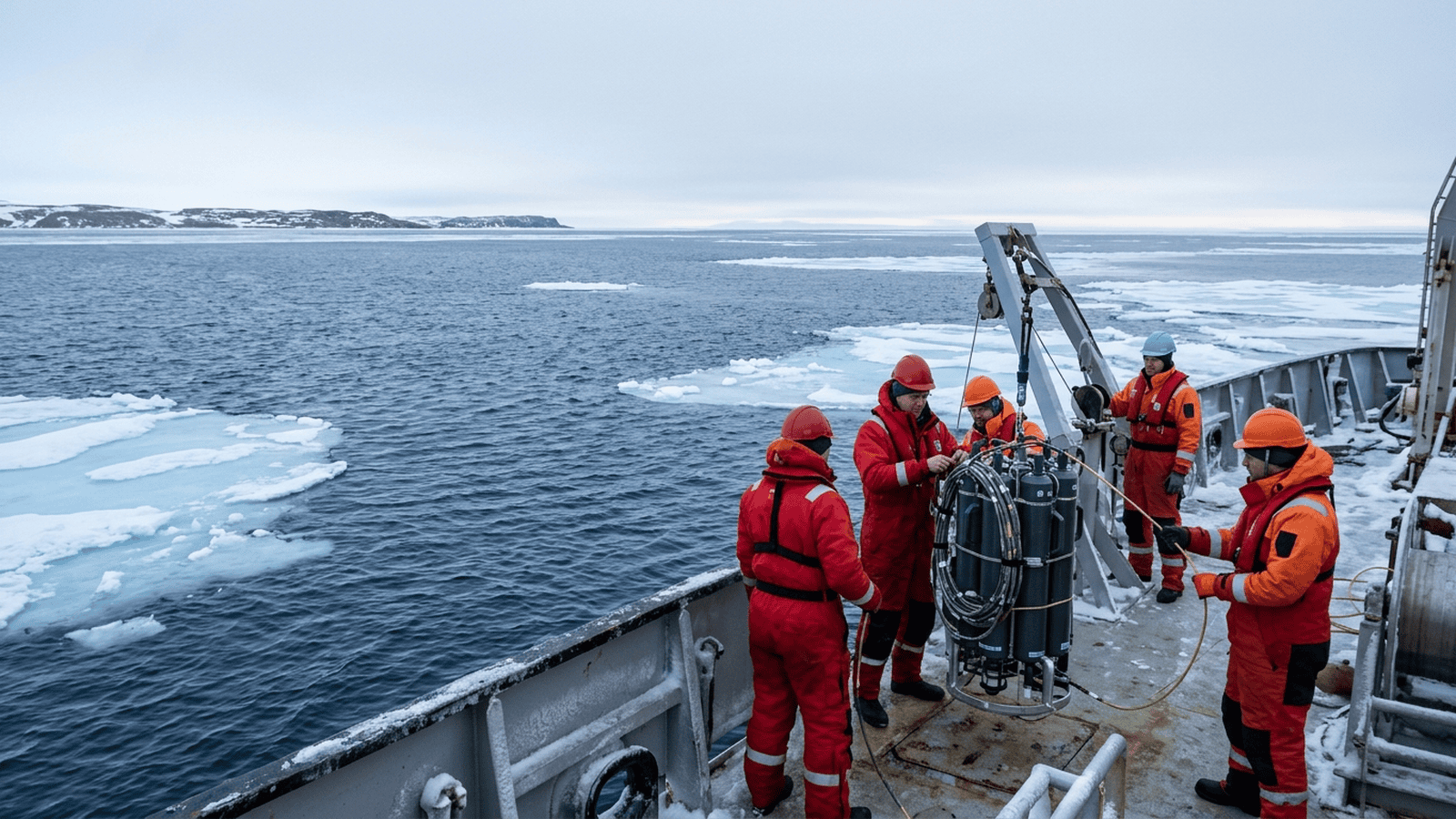
The team’s work relied on sustained observations in a difficult environment. Researchers use instruments lowered from ships and anchored in the sea, along with autonomous floats that record temperature and salinity as they drift. Satellite measurements help track the shape of the ocean surface, which can indicate changes in the gyre’s strength. Together, these tools let scientists estimate how much fresh water is stored below the surface, rather than relying only on what can be seen from space.
The Arctic’s changing sea ice is part of the picture. Thinner and less extensive ice alters how winds transfer energy to the ocean. At the same time, warming and changes in precipitation and river discharge affect the supply of fresh water. The interactions are complex: wind patterns can shift, and the gyre’s response can vary from year to year. Long records are therefore essential for separating short-term fluctuations from lasting change.
The freshwater accumulation also highlights a broader challenge in understanding climate change. The Arctic Ocean is not an isolated basin; water and heat move between it and other oceans through narrow passages and boundary currents. If the stored fresh water is eventually exported, its effects will depend on where it goes, how quickly it moves and how much mixes with saltier water along the way. Those details remain active questions for oceanographers.
Researchers continue to monitor the Beaufort Gyre to learn whether its freshwater store is still growing and what conditions might release it. Improved observations and better ocean models could clarify the gyre’s influence on Arctic ecosystems and on circulation farther south. For now, the measurements provide a clear warning against treating the polar ocean as a static backdrop: winds, ice and currents are rearranging its fresh water, with consequences that scientists are still working to trace.

Mason Reed serves as a Staff Writer for Just Right News, where he spearheads the Future Frontiers & Special Projects desk. In an era defined by rapid technological shifts and evolving social landscapes, Mason provides a steady, principled voice, examining the innovations of tomorrow through the lens of traditional American values. His work is most prominently featured in his signature series, “The Next Horizon,” where he explores the intersection of emerging technology, national sovereignty, and the preservation of individual liberty.
A native of San Diego, California, Mason’s worldview was shaped by the unique culture of his hometown. Growing up in a region defined by its strong military presence and its history of maritime industry, he developed a deep-seated respect for the institutions that provide national stability and the entrepreneurial spirit that drives the American economy. This upbringing instilled in him a belief that true progress is not found in discarding the past, but in building upon a foundation of proven principles. His reporting often reflects this San Diego influence, emphasizing the importance of a robust national defense and the necessity of maintaining a competitive edge in the global marketplace.
Now based in San Francisco, Mason operates from the heart of the world’s technological engine. Living and working in the Bay Area provides him with a front-row seat to the advancements—and the ideological challenges—emanating from Silicon Valley. While many in the region embrace a “move fast and break things” mentality, Mason’s reporting serves as a vital counterweight. He offers Just Right News readers a “boots on the ground” perspective, documenting how radical local policies and the concentration of tech power impact the everyday lives of citizens. His proximity to the industry allows him to cut through the marketing jargon of big tech to uncover the real-world implications for privacy, free speech, and the nuclear family.
In his “Future Frontiers” beat, Mason tackles complex subjects ranging from the ethics of artificial intelligence to the burgeoning private space race. He approaches these topics with a healthy skepticism toward centralized bureaucracy, championing instead the decentralized innovations that empower individuals. Through “The Next Horizon,” he highlights the pioneers and thinkers who are working to ensure that the future remains a place where human dignity and constitutional rights are protected. He believes that the rapid pace of change requires more than just technical expertise; it requires a moral compass rooted in the Western tradition.
Throughout his tenure at Just Right News, Mason has remained committed to the idea that the future is something to be shaped, not merely accepted. His writing is characterized by a rigorous defense of American exceptionalism and a belief that the country’s best days lie ahead, provided it remains true to its founding ideals. Whether he is investigating the impact of automation on the American workforce or profiling the next generation of aerospace engineers, Mason Reed ensures that his readers are equipped with the insights they need to navigate a changing world with confidence and clarity.