

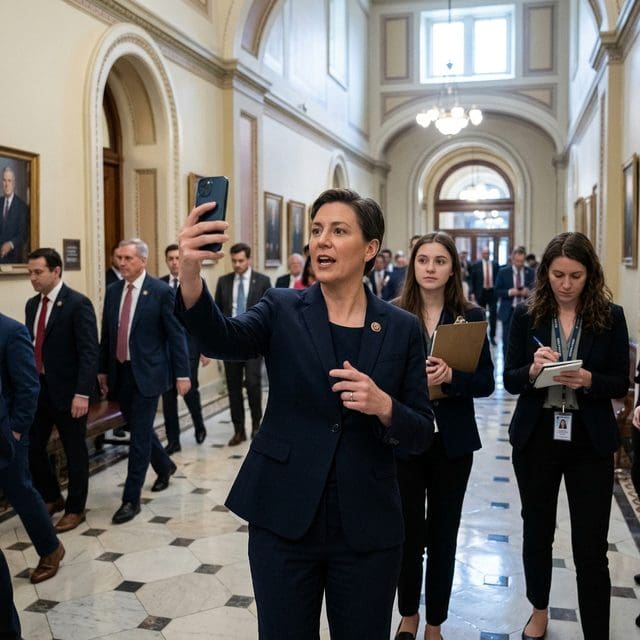
A Wall Street Journal report on lawmakers’ behind-the-scenes social posts highlights the distinction between political access and independent reporting.
New members of Congress are bringing a camera-ready approach to Capitol Hill, raising a familiar question for the press: where does access end and accountability begin?
The Wall Street Journal reported Nov. 27 that many Democratic freshmen are adopting a “mini-influencer” style, using social media to show followers behind-the-scenes life in Congress. The source material does not quantify how many lawmakers are involved, so the scale of the practice should not be inferred from the headline alone.
Direct posts can make an institution feel less remote. A video from an orientation or a first day in office may show details absent from a formal press conference. Lawmakers can also speak without a reporter’s framing or questions. But their posts are selected and produced by the politicians themselves. They show what lawmakers choose to present, not necessarily what happened outside the frame.
The distinction matters as the next Congress takes shape. The Hill reported that Gen Z representation is expected to triple in the 120th Congress: Democrat Melat Kiros of Colorado and Republican Michael Alfonso of Wisconsin will join Rep. Maxwell Frost. Millennials are projected to make up 40% of the new class, while Gen Z accounts for 2.5%. Those figures describe the incoming class; they do not establish that younger lawmakers communicate differently or that social-media practices belong to one generation.
The incoming Democratic majority is also defining its priorities. Politico reported Nov. 27 that Sen. Elizabeth Warren is pressing affordability, corporate power and housing policy, while urging Democrats to use leverage over Iran-war funding before a Dec. 11 deadline. Sen. Tim Kaine said Democrats had reached agreement on a draft that would restrict funding for offensive Iran operations without congressional authorization while allowing defensive operations. A draft is not enacted policy, and the negotiations remain in progress.
These disputes are consequential, but they also unfold through managed political messaging. A lawmaker’s feed can quickly circulate a preferred account of a negotiation. Journalists still need to establish what a proposal says, what remains unresolved and who is making each claim. Social media’s speed and intimacy do not remove that obligation.
The day’s congressional activity also illustrates why a personal post cannot stand in for a fuller account. Congress.gov listed no House floor activity data for Nov. 27; that does not mean Congress was inactive. Reporting has focused on committee work, leadership positioning and funding negotiations. Politico has also reported that the incoming majority’s Jan. 6 agenda is expected to continue through congressional investigations, related litigation and efforts by pardoned rioters to seek compensation.
Those developments may be less immediately engaging than a video from a Capitol hallway, but they are part of the institution’s work. The press has to explain them without letting the most shareable image become the whole story.
The Wall Street Journal report is therefore more than a story about lawmakers’ social-media habits. It points to a competition over who shapes the public record. Posts can document genuine moments and offer a useful glimpse of Congress. They cannot, by themselves, supply policy context, competing accounts or the consequences of a decision.
The available material does not establish how audiences respond, whether platforms elevate these posts over independent reporting, or whether a moderation decision has affected their reach. It also documents no specific misinformation episode. Those limits should be acknowledged rather than replaced with assumptions about algorithms or voters.
For newsrooms, the standard is practical: identify when a scene comes from a lawmaker’s account, verify claims against documents and other sources, and distinguish access from scrutiny. A representative’s post can show a slice of Capitol life. Independent reporting is still needed to explain what that slice leaves out.

Chloe Foster serves as a Staff Writer for Just Right News, where she spearheads the outlet’s coverage of Media, Culture, and Information Integrity. In an era defined by rapid-fire digital communication and shifting societal norms, Chloe has distinguished herself as a vital voice for readers seeking clarity amidst the noise. Her signature feature series, “The Story Wars,” has become a cornerstone of the publication, offering a deep dive into the ideological battles currently shaping American life and the ways in which mainstream narratives are constructed, disseminated, and often manipulated.
Chloe’s unique perspective is informed by a life lived in two of the nation’s most influential cultural hubs. Raised in Los Angeles, California, she grew up in the shadow of the world’s most powerful media and entertainment apparatus. This upbringing provided her with a front-row seat to the “dream factory,” allowing her to observe firsthand how cultural exports are crafted and how they often diverge from the lived experiences of everyday Americans. Her time in Los Angeles instilled in her a healthy skepticism of manufactured consensus and a passion for uncovering the truths that lie beneath polished public relations campaigns.
Today, Chloe operates from Brooklyn, New York, a vantage point that places her at the epicenter of the modern media landscape. Living and working in a deep-blue urban environment as a conservative journalist has sharpened her reporting, requiring a rigorous commitment to intellectual honesty and a steadfast defense of traditional values. Her base in Brooklyn allows her to engage directly with the institutions and influencers who drive the national conversation, providing Just Right News readers with an “on-the-ground” look at the cultural shifts originating in the Northeast.
As a Hispanic woman, Chloe brings a nuanced understanding of community and heritage to her beat. She frequently explores how media portrayals of the Latino community often overlook the deep-seated faith, entrepreneurial spirit, and family-centric values that define it. Her work challenges the monolithic labels often applied by mainstream outlets, instead highlighting the diversity of thought and the conservative principles that resonate within her community.
In her role at Just Right News, Chloe views “Information Integrity” not merely as a buzzword, but as a mission. She believes that a healthy republic requires a media landscape where facts are prioritized over agendas and where the public is empowered to think for themselves. Through “The Story Wars,” she deconstructs the framing of major news events, exposing bias and providing the context necessary for readers to understand the broader cultural implications of the day’s headlines.
Chloe Foster’s reporting is more than just a collection of articles; it is a sustained effort to reclaim the narrative for those who feel sidelined by the prevailing media establishment. By bridging the gap between her West Coast roots and her East Coast base, she continues to provide essential commentary on the forces that define our shared American culture.