

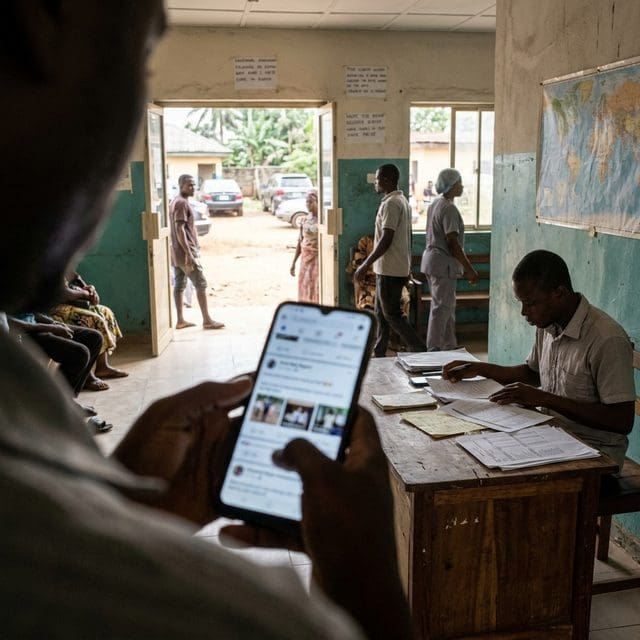
A Delta hospital’s denial of a viral DNA-testing claim and Afreximbank chief George Elombi’s warning about Africa’s risk narrative show how media framing can carry real consequences.
Two very different media stories in Africa point to the same basic responsibility: claims that travel widely should be checked carefully, and broad narratives should not be mistaken for settled fact.
In Delta State, Nigeria, Eku Baptist General Hospital said on November 9 that it had never operated a free DNA-testing program, lacked the equipment and laboratory capacity to conduct DNA tests, and had no case involving a man who allegedly discovered that none of his five children was biologically his. The hospital called the reports “spurious and misleading,” according to Punch Nigeria.
The claims had circulated on TikTok, Facebook and other platforms. They alleged not only free paternity testing but more than 50 cases of paternity fraud. Delta State Ministry of Health official Paul Iwara separately said the state had no free DNA or paternity-testing program.
Those details matter. The hospital’s denial does not, by itself, establish precisely where the story began or how every version spread. But the institutional facts it provided directly contradict the central claim that Eku Baptist was conducting the tests. A dramatic allegation about family relationships is especially likely to attract attention; that makes verification more important, not less.
The episode illustrates how platform distribution can outpace correction. A claim may be repeated across accounts and services before a hospital or government official has a chance to respond. The supplied reporting does not establish how many people saw the posts, how quickly platforms acted, or whether any content was removed. Those gaps should not be filled with assumptions about either the scale of the rumor or the effectiveness of moderation.
A different media question emerged in an ARISE News interview published November 9. Afreximbank President George Elombi argued that sustained negative coverage in traditional media and on social platforms could make Africa appear to investors as a “permanent” risk. He said such perceptions raise the risk premium—the added interest and financing costs borrowers face—and pointed to the Dangote Refinery as an example of investment that could improve perceptions of African entrepreneurship.
Elombi’s argument deserves a hearing, but it should also be read with its source in view. He leads a development bank with a direct interest in financing and promoting African commerce. That does not make his warning invalid; it does mean it is an argument from a stakeholder, not an independent finding that media coverage alone determines borrowing costs.
The available material does not quantify the effect of press coverage on African financing costs or establish how much of the risk premium reflects reporting rather than economic conditions. A responsible account should distinguish between negative coverage that is inaccurate or reductive and reporting that documents real risks. Replacing an indiscriminate “Africa is risky” frame with indiscriminate boosterism would not serve investors or the public either.
Afreximbank’s creative-economy financing offers context for Elombi’s advocacy. The bank’s commitment to creative industries rose from $500 million to $1 billion and then to $2 billion in 2024, he said. At Lagos CANEX Weekend 2026, the bank targeted creative-industry deals exceeding $540 million, The Tide reported on November 9. These figures describe the bank’s commitments and event target; they do not independently measure the impact of media narratives.
Together, the stories point to a standard that applies across platforms and established newsrooms: verify specific claims, identify who is making broader arguments, and separate evidence from interpretation. Viral repetition is not confirmation. Nor is a powerful institution’s criticism of coverage proof that the coverage is wrong. In both cases, careful attribution is a safeguard against letting either a sensational rumor or a sweeping narrative outrun what is known.

Chloe Foster serves as a Staff Writer for Just Right News, where she spearheads the outlet’s coverage of Media, Culture, and Information Integrity. In an era defined by rapid-fire digital communication and shifting societal norms, Chloe has distinguished herself as a vital voice for readers seeking clarity amidst the noise. Her signature feature series, “The Story Wars,” has become a cornerstone of the publication, offering a deep dive into the ideological battles currently shaping American life and the ways in which mainstream narratives are constructed, disseminated, and often manipulated.
Chloe’s unique perspective is informed by a life lived in two of the nation’s most influential cultural hubs. Raised in Los Angeles, California, she grew up in the shadow of the world’s most powerful media and entertainment apparatus. This upbringing provided her with a front-row seat to the “dream factory,” allowing her to observe firsthand how cultural exports are crafted and how they often diverge from the lived experiences of everyday Americans. Her time in Los Angeles instilled in her a healthy skepticism of manufactured consensus and a passion for uncovering the truths that lie beneath polished public relations campaigns.
Today, Chloe operates from Brooklyn, New York, a vantage point that places her at the epicenter of the modern media landscape. Living and working in a deep-blue urban environment as a conservative journalist has sharpened her reporting, requiring a rigorous commitment to intellectual honesty and a steadfast defense of traditional values. Her base in Brooklyn allows her to engage directly with the institutions and influencers who drive the national conversation, providing Just Right News readers with an “on-the-ground” look at the cultural shifts originating in the Northeast.
As a Hispanic woman, Chloe brings a nuanced understanding of community and heritage to her beat. She frequently explores how media portrayals of the Latino community often overlook the deep-seated faith, entrepreneurial spirit, and family-centric values that define it. Her work challenges the monolithic labels often applied by mainstream outlets, instead highlighting the diversity of thought and the conservative principles that resonate within her community.
In her role at Just Right News, Chloe views “Information Integrity” not merely as a buzzword, but as a mission. She believes that a healthy republic requires a media landscape where facts are prioritized over agendas and where the public is empowered to think for themselves. Through “The Story Wars,” she deconstructs the framing of major news events, exposing bias and providing the context necessary for readers to understand the broader cultural implications of the day’s headlines.
Chloe Foster’s reporting is more than just a collection of articles; it is a sustained effort to reclaim the narrative for those who feel sidelined by the prevailing media establishment. By bridging the gap between her West Coast roots and her East Coast base, she continues to provide essential commentary on the forces that define our shared American culture.