

JERA’s preliminary data-center talks with Anthropic and Meta highlight AI’s energy demands, while OpenAI pricing changes and JetBrains’ open coding model offer developers concrete trade-offs.
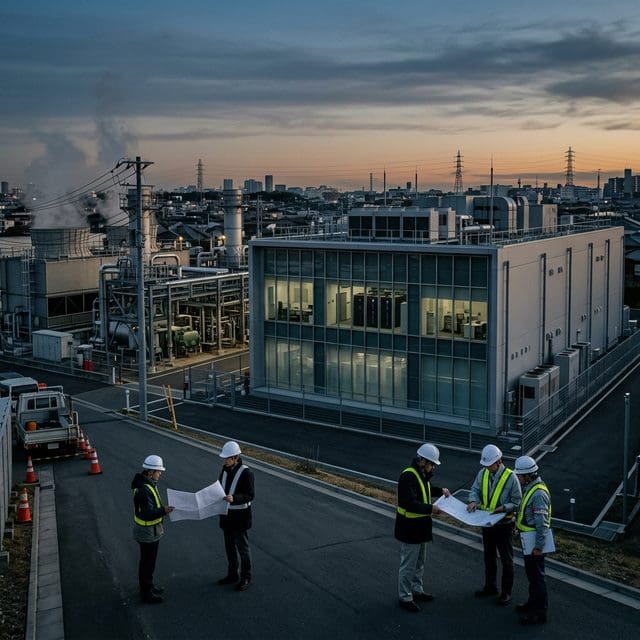
AI companies are competing not only over models, but over the electricity and infrastructure needed to run them. Japan’s JERA, the country’s largest power generator, is in preliminary talks with Anthropic, Meta and other U.S. technology companies about building data centers near power plants in the Tokyo area, Reuters reported Friday, citing Nikkei. No agreement, site count, capacity figure or construction schedule has been disclosed.
The proposed facilities could take electricity directly from adjacent power plants, bypassing the transmission grid. Such a behind-the-meter arrangement could help address grid bottlenecks, but the talks remain preliminary. Their significance is that AI infrastructure is becoming a negotiation among technology companies, power producers and communities deciding how energy is used—not simply a matter of adding servers.
For software businesses, OpenAI’s shifting prices and usage rules are more immediate. GPT-6.2 Astra, which OpenAI describes as suited to complex professional work, coding and computer use, is available in ChatGPT Work, Codex and the API. Its standard API rates are listed at $8 per million input tokens and $40 per million output tokens, with cached input at $0.40 per million. A separate processing tier is listed at half those rates. Developers estimating costs should check the applicable tier and current terms before committing to a workload.
OpenAI also added a $100-per-month Pro plan and changed Codex usage rules for Plus and Pro users, according to its November release notes. Separately, the company said a billing mistake had incorrectly discounted GPT-6.2 Astra and Sol usage. After correcting it, OpenAI said, users doing the same work would hit usage limits about 40% faster on Astra and 25% faster on Sol. That is a change in effective capacity, not just a rate-card detail: teams running coding agents frequently may need to adjust model choice, task volume or budget.
OpenAI says Sol scores 68.8% on DeepSWE v1.1, compared with 69.9% for Anthropic’s Claude Fable 5 at xhigh effort, at roughly 80% lower cost per task. Those are OpenAI’s figures, not an independent assessment. The comparison may help identify models to test, but costs and results will vary with prompts, settings and codebase. For small teams, trials on their own tasks are more useful than assuming a benchmark winner will be the best fit.
Perplexity has added a historical option to its Search API and Context API. Developers can use a `snapshot_as_of` parameter to query web content as it existed up to 365 days earlier. That could help applications that need to distinguish what a site said at a past date from what a search returns now. The feature is available at standard pricing, according to the supplied product information.
JetBrains’ Mellum2.1 Instruct presents another option for teams building coding tools. Released under Apache 2.0, including in GGUF format for local use, it is a 12-billion-parameter mixture-of-experts model with 2.5 billion active parameters. In JetBrains’ agentic-coding tests, it generated an average of 5,600 tokens per task, against 10,100 for the company’s Mellum2.1 Thinking model. JetBrains designed it for quick code edits, tool calls and other small operations that agents perform while handling larger jobs.
That makes Mellum2.1 Instruct worth evaluating for IDE features, sub-agents or self-hosted tools, especially when local deployment and licensing matter. JetBrains’ results are company tests; developers should measure quality and latency on their own code. Across these developments, the practical question is not simply which model is most capable. It is whether teams can access the power, predict the bill and choose a tool suited to the repeated tasks their software actually needs.

Mason Reed serves as a Staff Writer for Just Right News, where he spearheads the Future Frontiers & Special Projects desk. In an era defined by rapid technological shifts and evolving social landscapes, Mason provides a steady, principled voice, examining the innovations of tomorrow through the lens of traditional American values. His work is most prominently featured in his signature series, “The Next Horizon,” where he explores the intersection of emerging technology, national sovereignty, and the preservation of individual liberty.
A native of San Diego, California, Mason’s worldview was shaped by the unique culture of his hometown. Growing up in a region defined by its strong military presence and its history of maritime industry, he developed a deep-seated respect for the institutions that provide national stability and the entrepreneurial spirit that drives the American economy. This upbringing instilled in him a belief that true progress is not found in discarding the past, but in building upon a foundation of proven principles. His reporting often reflects this San Diego influence, emphasizing the importance of a robust national defense and the necessity of maintaining a competitive edge in the global marketplace.
Now based in San Francisco, Mason operates from the heart of the world’s technological engine. Living and working in the Bay Area provides him with a front-row seat to the advancements—and the ideological challenges—emanating from Silicon Valley. While many in the region embrace a “move fast and break things” mentality, Mason’s reporting serves as a vital counterweight. He offers Just Right News readers a “boots on the ground” perspective, documenting how radical local policies and the concentration of tech power impact the everyday lives of citizens. His proximity to the industry allows him to cut through the marketing jargon of big tech to uncover the real-world implications for privacy, free speech, and the nuclear family.
In his “Future Frontiers” beat, Mason tackles complex subjects ranging from the ethics of artificial intelligence to the burgeoning private space race. He approaches these topics with a healthy skepticism toward centralized bureaucracy, championing instead the decentralized innovations that empower individuals. Through “The Next Horizon,” he highlights the pioneers and thinkers who are working to ensure that the future remains a place where human dignity and constitutional rights are protected. He believes that the rapid pace of change requires more than just technical expertise; it requires a moral compass rooted in the Western tradition.
Throughout his tenure at Just Right News, Mason has remained committed to the idea that the future is something to be shaped, not merely accepted. His writing is characterized by a rigorous defense of American exceptionalism and a belief that the country’s best days lie ahead, provided it remains true to its founding ideals. Whether he is investigating the impact of automation on the American workforce or profiling the next generation of aerospace engineers, Mason Reed ensures that his readers are equipped with the insights they need to navigate a changing world with confidence and clarity.