

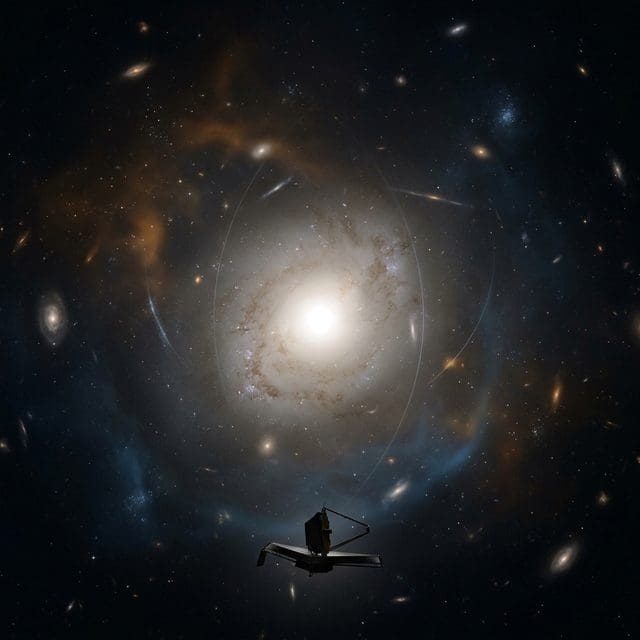
The quasar Dún Aonghasa, confirmed with several major telescopes, shines from just 630 million years after the Big Bang and gives astronomers a new test of how early black holes grew.
A beacon from the young universe is forcing astronomers to reconsider how quickly black holes could grow. The European Space Agency’s Euclid telescope identified the quasar J1504+6252, nicknamed Dún Aonghasa, whose light began its journey when the universe was about 630 million years old.
The discovery, published in *Astronomy & Astrophysics*, makes Dún Aonghasa the most distant quasar yet observed, according to the reporting in the supplied source material. Its redshift is 8.13—a measure of how much the expansion of the universe has stretched its light. The farther away an object is, the longer its light has traveled, giving astronomers a view of the cosmos as it was billions of years ago.
The finding is not based on a single telescope’s image. Euclid first identified the candidate in its survey data. Astronomers then followed up with the Keck Observatory, the Large Binocular Telescope, the Hubble Space Telescope and the James Webb Space Telescope. JWST data supplied the estimate of the black hole’s mass. The source material puts that mass at roughly 360 million times the Sun’s.
That scale is the puzzle. At only about 630 million years after the Big Bang, the universe was still in its infancy. A black hole of this size would have needed to form and gather matter quickly, challenging explanations of how the first supermassive black holes emerged. The observation does not, by itself, identify the mechanism. Instead, it gives astronomers a particularly early and massive object against which competing models can be tested.
Euclid was built to survey vast regions of the sky and investigate the universe’s large-scale structure, including dark matter and dark energy. Its ability to find a rare object like Dún Aonghasa shows how a broad survey can also serve as a discovery engine: it can locate unusual targets for more detailed work by other observatories. The source material reports that the quasar extends Euclid’s previous distance record by about 40 million years in cosmic history.
For non-specialists, the result is a reminder that a telescope does not simply take a sharper picture of the past. It collects light that has been traveling across space for nearly the entire lifetime of the universe. Researchers use the light’s spectrum to estimate redshift and identify what kind of object produced it; follow-up observations help establish whether a candidate really is a distant quasar and reveal properties of its central black hole.
The finding arrives alongside other recent advances in physics, though not all are equally new or directly related. Northwestern University researchers reported trapping one positron—the antimatter counterpart of an electron—for months in a near-perfect vacuum at about 300 millikelvins, while Quantinuum reported very low logical error rates for its 98-qubit Helios system. Those results point to greater control of delicate quantum systems. But Dún Aonghasa stands out as the clearest recent space discovery: a direct look at a massive black hole in the universe’s earliest chapter.
What comes next is further scrutiny, not a final answer. Astronomers will compare the quasar’s properties with models of early black-hole formation and study how its surroundings may have supplied material for growth. Euclid’s continuing survey may uncover more such objects, while JWST and other observatories can investigate selected candidates in greater detail. Each additional example could help determine whether Dún Aonghasa is an exceptional outlier or evidence that giant black holes were common surprisingly early.

Mason Reed serves as a Staff Writer for Just Right News, where he spearheads the Future Frontiers & Special Projects desk. In an era defined by rapid technological shifts and evolving social landscapes, Mason provides a steady, principled voice, examining the innovations of tomorrow through the lens of traditional American values. His work is most prominently featured in his signature series, “The Next Horizon,” where he explores the intersection of emerging technology, national sovereignty, and the preservation of individual liberty.
A native of San Diego, California, Mason’s worldview was shaped by the unique culture of his hometown. Growing up in a region defined by its strong military presence and its history of maritime industry, he developed a deep-seated respect for the institutions that provide national stability and the entrepreneurial spirit that drives the American economy. This upbringing instilled in him a belief that true progress is not found in discarding the past, but in building upon a foundation of proven principles. His reporting often reflects this San Diego influence, emphasizing the importance of a robust national defense and the necessity of maintaining a competitive edge in the global marketplace.
Now based in San Francisco, Mason operates from the heart of the world’s technological engine. Living and working in the Bay Area provides him with a front-row seat to the advancements—and the ideological challenges—emanating from Silicon Valley. While many in the region embrace a “move fast and break things” mentality, Mason’s reporting serves as a vital counterweight. He offers Just Right News readers a “boots on the ground” perspective, documenting how radical local policies and the concentration of tech power impact the everyday lives of citizens. His proximity to the industry allows him to cut through the marketing jargon of big tech to uncover the real-world implications for privacy, free speech, and the nuclear family.
In his “Future Frontiers” beat, Mason tackles complex subjects ranging from the ethics of artificial intelligence to the burgeoning private space race. He approaches these topics with a healthy skepticism toward centralized bureaucracy, championing instead the decentralized innovations that empower individuals. Through “The Next Horizon,” he highlights the pioneers and thinkers who are working to ensure that the future remains a place where human dignity and constitutional rights are protected. He believes that the rapid pace of change requires more than just technical expertise; it requires a moral compass rooted in the Western tradition.
Throughout his tenure at Just Right News, Mason has remained committed to the idea that the future is something to be shaped, not merely accepted. His writing is characterized by a rigorous defense of American exceptionalism and a belief that the country’s best days lie ahead, provided it remains true to its founding ideals. Whether he is investigating the impact of automation on the American workforce or profiling the next generation of aerospace engineers, Mason Reed ensures that his readers are equipped with the insights they need to navigate a changing world with confidence and clarity.