

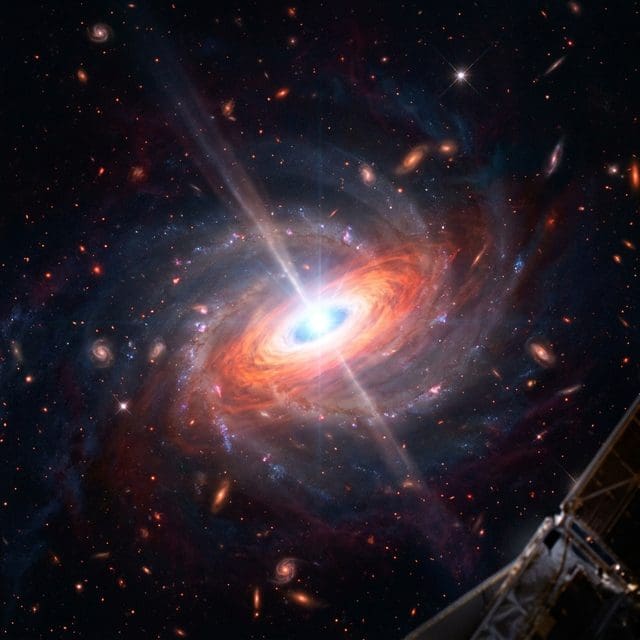
The European Space Agency’s Euclid mission found Dún Aonghasa, an ancient quasar whose black hole is prompting new questions about how such giants grew.
A flash from the young universe has sharpened one of astronomy’s biggest questions: how did black holes become enormous so quickly?
The European Space Agency announced Nov. 24 that its Euclid space telescope had identified Dún Aonghasa, also catalogued as J1504+6252, the first quasar discovered beyond redshift 8. Its measured redshift is 8.13, and its light has traveled roughly 13.1 billion years. Astronomers therefore see the object as it was when the universe was about 5 percent of its current age.
A quasar is an intensely bright galactic center powered by matter falling toward a supermassive black hole. As that matter heats up, it can shine across immense distances, making quasars useful beacons from the early universe. Redshift helps astronomers estimate how far back in time they are looking: as the universe expands, light stretches toward longer, redder wavelengths. A very high redshift signals that the light began its journey when the cosmos was much younger.
Euclid found Dún Aonghasa among millions of objects in about 18 months of observations. The mission has announced 31 ancient quasars, including 12 beyond redshift 7. A growing sample lets astronomers compare objects and ask whether rapid early black-hole growth was rare or more common than expected.
The discovery depended on several observatories, each contributing different evidence. Keck Observatory’s MOSFIRE instrument detected the quasar’s continuum light. The Hubble Space Telescope and the Large Binocular Telescope observed a spectral break associated with hydrogen absorption, supporting the interpretation that the source lies in the distant universe. NASA’s James Webb Space Telescope then detected emission lines, which allowed researchers to establish the redshift precisely and estimate the black hole’s mass.
Astronomers infer distance and mass from light and its spectrum; they do not directly photograph a black hole. In this case, the evidence places the quasar at a record-setting distance and points to a black hole of roughly 360 million solar masses, according to the discovery report. Its size so early in cosmic history is the central puzzle.
Dún Aonghasa appears to be consuming material relatively slowly now. That contrast with its enormous mass suggests it may have grown much faster during an earlier episode. Modeling discussed by the Max Planck Society favors a direct-collapse scenario: a massive cloud of gas formed the initial black-hole seed, which then grew by pulling in more matter. The earlier phase may have involved super-Eddington accretion, in which a black hole takes in matter faster than the usual theoretical limit for steady growth.
That is a favored explanation, not a settled account of the quasar’s origin. More observations and more ancient quasars will help researchers test which formation histories fit the evidence. The discovery narrows the questions but does not establish that every early giant black hole formed the same way.
The next clues may come from pushing the search farther back. The Max Planck Society says that if astronomers find quasars at substantially higher redshifts—when the universe was only a few hundred million years old—they may need to consider primordial black holes as alternative massive seeds. That remains a possibility for future study, not a conclusion from this discovery.
For now, Euclid’s contribution is both the record and the reach of its survey. Its observations identify distant candidates among millions of sources; follow-up by Keck, Hubble, Webb and other observatories turns candidates into objects researchers can measure. More discoveries will help show whether Dún Aonghasa is exceptional or evidence that the first black holes grew faster than current models comfortably explain.

Mason Reed serves as a Staff Writer for Just Right News, where he spearheads the Future Frontiers & Special Projects desk. In an era defined by rapid technological shifts and evolving social landscapes, Mason provides a steady, principled voice, examining the innovations of tomorrow through the lens of traditional American values. His work is most prominently featured in his signature series, “The Next Horizon,” where he explores the intersection of emerging technology, national sovereignty, and the preservation of individual liberty.
A native of San Diego, California, Mason’s worldview was shaped by the unique culture of his hometown. Growing up in a region defined by its strong military presence and its history of maritime industry, he developed a deep-seated respect for the institutions that provide national stability and the entrepreneurial spirit that drives the American economy. This upbringing instilled in him a belief that true progress is not found in discarding the past, but in building upon a foundation of proven principles. His reporting often reflects this San Diego influence, emphasizing the importance of a robust national defense and the necessity of maintaining a competitive edge in the global marketplace.
Now based in San Francisco, Mason operates from the heart of the world’s technological engine. Living and working in the Bay Area provides him with a front-row seat to the advancements—and the ideological challenges—emanating from Silicon Valley. While many in the region embrace a “move fast and break things” mentality, Mason’s reporting serves as a vital counterweight. He offers Just Right News readers a “boots on the ground” perspective, documenting how radical local policies and the concentration of tech power impact the everyday lives of citizens. His proximity to the industry allows him to cut through the marketing jargon of big tech to uncover the real-world implications for privacy, free speech, and the nuclear family.
In his “Future Frontiers” beat, Mason tackles complex subjects ranging from the ethics of artificial intelligence to the burgeoning private space race. He approaches these topics with a healthy skepticism toward centralized bureaucracy, championing instead the decentralized innovations that empower individuals. Through “The Next Horizon,” he highlights the pioneers and thinkers who are working to ensure that the future remains a place where human dignity and constitutional rights are protected. He believes that the rapid pace of change requires more than just technical expertise; it requires a moral compass rooted in the Western tradition.
Throughout his tenure at Just Right News, Mason has remained committed to the idea that the future is something to be shaped, not merely accepted. His writing is characterized by a rigorous defense of American exceptionalism and a belief that the country’s best days lie ahead, provided it remains true to its founding ideals. Whether he is investigating the impact of automation on the American workforce or profiling the next generation of aerospace engineers, Mason Reed ensures that his readers are equipped with the insights they need to navigate a changing world with confidence and clarity.