

Ekitna improved progression-free survival in a clinical trial, while a newly cleared mammography tool estimates breast-cancer risk; price, coverage and real-world impact remain unclear.
The FDA approved Ekitna, or bezuclastinib, with sunitinib for adults with advanced gastrointestinal stromal tumors (GIST) previously treated with imatinib. The decision gives patients another treatment option, but the available announcements leave unanswered what it will cost and how widely insurers will cover it.
The approval was based on the Phase 3 PEAK trial, which enrolled 413 patients. The FDA reported median progression-free survival of 16.5 months with Ekitna and sunitinib, compared with 9.2 months with sunitinib alone. Objective response rates were 46% and 26%, respectively. Overall-survival data were not mature as of the agency’s Nov. 24 update.
Progression-free survival measures how long patients live before their cancer worsens; it does not establish whether a treatment extends life. The trial results show improved outcomes on that measure and more tumor responses, while the effect on overall survival remains unknown. For patients and doctors weighing treatment choices, that distinction matters.
The FDA used its Real-Time Oncology Review program and granted priority review, breakthrough-therapy designation and orphan-drug designation. The approval arrived ahead of the agency’s Nov. 30 target date, according to AJMC. Cogent said Ekitna was available by prescription in the United States on Nov. 24 through its launch, with assistance available through the company’s Cogent Connect program.
Cogent called Ekitna the first treatment approved in this post-imatinib GIST setting in more than 20 years. The milestone may matter to patients with a rare, advanced cancer, but availability is not the same as affordability. The announcements provided no list price, expected out-of-pocket cost or payer-coverage terms. A company assistance program may help some patients, but it does not answer what treatment will cost families or insurers over time.
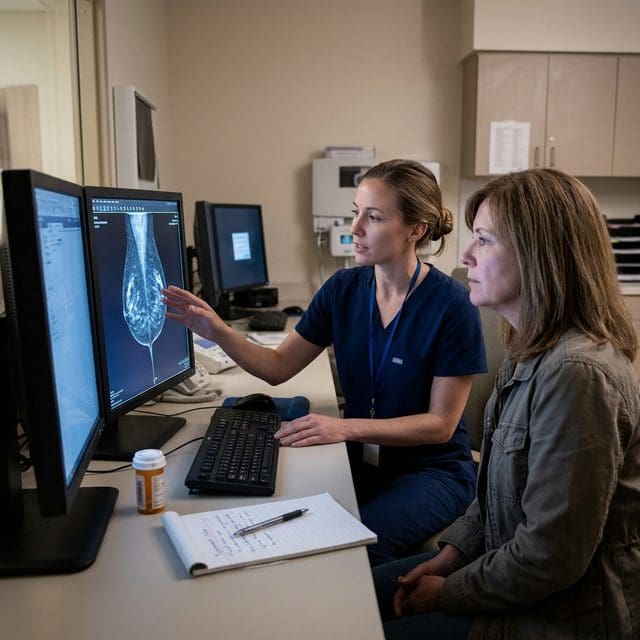
A separate announcement concerns DeepHealth’s Mammo Risk, an FDA-cleared tool that estimates three-, four- and five-year breast-cancer risk using 3D mammograms, including workflows combining 3D and 2D imaging. RadNet said the product was commercially available to U.S. providers as of Nov. 24 and described it as the first FDA-cleared image-based risk-prediction solution for 3D mammography.
DeepHealth said the tool was trained on 220,000 studies and evaluated in an independent multicenter study involving more than 65,000 screening mammograms at 10 U.S. clinical sites. Those figures describe the development and evaluation cited by the company; they do not show whether using the tool improves health outcomes. The announcement did not establish whether risk estimates change treatment decisions, reduce cancer deaths or lead to additional follow-up care.
Nor did it provide pricing or insurance-coverage information. For providers considering adoption, and patients deciding what to do with a risk estimate, those details are practical questions—not afterthoughts. A prediction tool does not diagnose cancer, and its value depends on how reliably it informs decisions and whether patients can access appropriate follow-up.
Both announcements point to advances in cancer care, but they also show why approval and availability are only part of the story. Ekitna’s trial results offer evidence of delayed progression, not yet longer survival; Mammo Risk offers estimates, without demonstrated impact on outcomes in the material provided. Patients and clinicians need clear information about risks, alternatives and costs to decide whether either option fits an individual’s care. Transparent pricing and coverage will help determine whether these developments translate into accessible care.

Susan Carter serves as a Senior Correspondent for Just Right News, where she leads the network’s comprehensive coverage of Health, Medicine, and Public Policy. With a career dedicated to dissecting the complexities of the American healthcare system, Susan brings a principled perspective to the most pressing debates of the day. Her reporting is characterized by a commitment to individual liberty, fiscal responsibility, and a healthy skepticism of government overreach, making her a vital voice for audiences seeking clarity in an increasingly regulated landscape.
Raised in Minneapolis, Minnesota, Susan’s professional outlook is deeply informed by the values of the American heartland. Growing up in the Twin Cities, she witnessed firsthand the importance of community-driven solutions and the resilience of the individual. This Midwestern foundation instilled in her a firm belief that the best answers to public policy challenges often come from local innovation and personal responsibility rather than top-down federal mandates. Her background allows her to translate complex legislative jargon into stories that resonate with families who value common sense and local autonomy.
Now based in Baltimore, Maryland, Susan operates from a unique vantage point at the intersection of medical innovation and urban policy. Living and working in a city renowned for its world-class medical institutions and significant public health challenges, she has a front-row seat to the realities of the modern healthcare landscape. Her proximity to these hubs of research and policy allows her to scrutinize how government intervention affects the quality of care and the freedom of medical professionals. In Baltimore, she sees the tangible results of policy decisions, using the city as a lens through which to examine the broader national health debate and the impact of federal spending on local communities.
As the lead for the acclaimed feature series “The Cost of Care,” Susan dives deep into the economic realities facing patients and providers alike. Her work focuses on the necessity of price transparency, the benefits of market competition, and the preservation of the sacred doctor-patient relationship. She is a staunch advocate for the idea that a well-informed public is the best defense against bureaucratic inefficiency. Through this series, she has exposed the hidden drivers of rising medical expenses, always seeking to empower the individual consumer over the massive institution.
Susan’s reporting on public policy is characterized by a commitment to rigorous inquiry and a focus on constitutional limits. Whether she is analyzing new pharmaceutical regulations, investigating the impact of federal health mandates, or exploring the future of medical technology, her goal remains the same: to provide Just Right News audiences with the facts they need to navigate a complex world. By blending her Midwestern sensibilities with the insights gained from her base in Maryland, Susan Carter has become a trusted authority for those who believe that personal freedom and public health are inextricably linked. Her work continues to challenge the status quo, advocating for a system that respects the taxpayer and prioritizes the patient.