

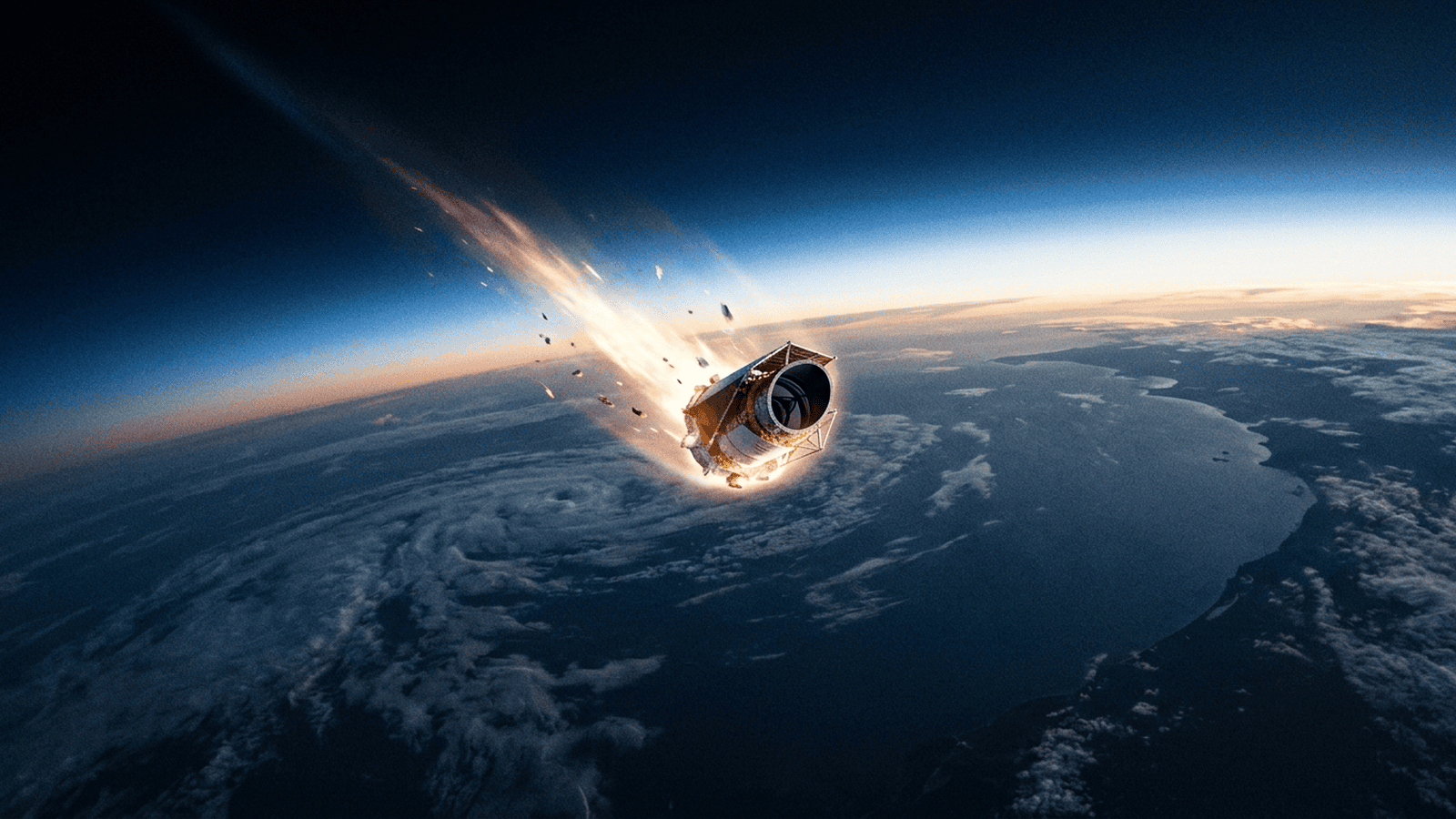
NASA’s Swift Observatory reentered Earth’s atmosphere over North Sumatra, Indonesia, ending nearly 22 years in orbit. NASA had decided in August to allow the return after the telescope descended too low to remain steady and a rescue robot failed to get within seven miles. Swift exceeded its planned two-year mission, observed thousands of cosmic events and sent alerts to Hubble, Webb and other facilities. NASA and the U.S. Space Force tracked the reentry, and NASA had estimated the risk of harm to anyone on Earth at about one in 2,100. Some components may have survived, while scientists are still working out how to replace Swift’s observations.
TLDR: Swift’s extended mission ended with a tracked reentry after the telescope became too low to operate steadily and a rescue attempt failed. The observatory studied thousands of cosmic events, and scientists are now working out how to replace its observations.
NASA’s Swift Observatory has returned to Earth after nearly 22 years in low-Earth orbit. The 1.5-ton telescope reentered the atmosphere at 7:39 a.m. ET over North Sumatra, Indonesia, NASA said. Much of the spacecraft burned up, though some parts may have survived and could be found across wide areas.
The observatory was designed to study powerful events such as gamma-ray bursts and supernovas. Its planned two-year mission continued until last month, extending its scientific work well beyond its original schedule. Solar activity gradually lowered its orbit, bringing the telescope back toward Earth. Swift’s long life gave scientists years of observations beyond what its original mission plan called for, but it did not remove the limits of its orbit.
The central reason for ending the mission was practical: Swift had descended too low to remain steady. NASA determined that in late October and shut down its systems. The decision to let the observatory reenter had been made in August, after a rescue effort failed to reach it. Once the spacecraft could no longer hold a stable position for its work, keeping it operating was no longer practical.
Swift launched on Nov. 20, 2004. Its name reflected its ability to turn quickly toward cosmic explosions and other events. That rapid response made it an early alert system for the Hubble and Webb space telescopes, as well as other facilities that could then examine an event in more detail. The alerts helped direct attention toward events that could otherwise be difficult to observe as they unfolded.
NASA said Swift observed more than 2,000 gamma-ray bursts and 1,400 exploding stars. The telescope also studied active galaxies powered by supermassive black holes, stars producing X-ray flares, comets and asteroids. NASA described its broader contribution as improving understanding of a wide range of objects and events across the universe. The mission’s work therefore went beyond its best-known role of spotting bursts and sending alerts.
The agency contracted Katalyst Space in July to try to save the observatory. The company sent a three-armed robot called Link to push Swift back into position. Link ran into trouble shortly after launch and never came within seven miles of the telescope. The robot itself fell back to Earth in September. The rescue attempt did not restore Swift or change the course of its mission.
That failed attempt did not restore the aging observatory, and the eventual loss means scientists must now work out how to replace its observations. The end also reflects a basic limit of low-Earth orbit: as astronomer John Nousek, who led Swift’s control team, put it, what goes up must come down. Nousek said he hoped lessons from Swift’s successes could be applied to new generations of space missions. Those lessons come from a mission that lasted far longer than planned, but they do not fill the gap left by its alerts.
NASA and the U.S. Space Force tracked the observatory’s reentry. NASA’s earlier prediction placed the return at about 3:30 a.m. EST on Nov. 4, but the estimate carried an 11-hour window of uncertainty on either side. The actual reported time was 7:39 a.m. ET. NASA had said the risk of harm to anyone on Earth was unlikely, estimating the odds at about one in 2,100. The uncertainty in the forecast reflected the difficulty of predicting the precise time of a returning spacecraft.
The practical impact is limited to the spacecraft’s return and the gap in its scientific role. Some pieces may have survived reentry, but NASA has not identified where they may be found. The available account gives no public fee, paperwork requirement, compliance rule or deadline for members of the public. It identifies the directly affected scientific work: Swift’s alert service has ended, and scientists are still working out how to replace it. No further public process or enforcement action is described.
Swift’s return was not a policy change, and the account describes no new government rules or enforcement program. It was a managed end to a mission after the rescue attempt failed and the telescope could no longer remain steady. The spacecraft’s useful life exceeded its original two-year design, but its loss closes a source of observations that other telescopes relied on for alerts. The immediate consequence described by NASA is scientific, rather than a new requirement for the public.
The next steps are scientific rather than regulatory. Researchers must determine how to replace Swift’s work, while NASA and the Space Force have tracked the reentry and NASA has reported the likely risk and outcome. Those are the available facts; no additional deadline or oversight plan is stated. The telescope’s record and the lessons drawn from its mission will inform future space missions, but the replacement work remains unfinished.

Rachel Vaughn serves as a Senior Correspondent for Just Right News, where she leads the network’s coverage of Global Health, Climate, and Development. With a career defined by intellectual rigor and a commitment to principled reporting, Rachel provides a vital conservative perspective on some of the most complex and high-stakes issues facing the world today. Her work is characterized by a refusal to accept bureaucratic narratives at face value, focusing instead on how international policies impact national sovereignty, individual liberty, and the American taxpayer.
Raised in New Haven, Connecticut, Rachel grew up in an environment dominated by elite academic discourse. This upbringing provided her with a front-row seat to the inner workings of the American establishment, but it also instilled in her a healthy skepticism of the “ivory tower” consensus. She learned early on that while academic theories may sound promising in a lecture hall, they often fail to account for the practical realities of the working class. This background drives her to bridge the gap between high-level policy discussions and the common-sense concerns of everyday citizens, ensuring that her reporting remains grounded and accessible.
Now based in Burlington, Vermont, Rachel operates from a unique vantage point within one of the nation’s most progressive political landscapes. Living and working in a region that often serves as a testing ground for radical social and environmental experiments allows her to witness the real-world consequences of these policies firsthand. From her base in the Green Mountain State, she provides Just Right News readers with essential “boots on the ground” reporting, documenting the friction between local mandates and the constitutional freedoms of the individual. Her presence in Burlington ensures that her critiques of globalist agendas are informed by a direct understanding of how those ideologies manifest at the local level.
In her acclaimed feature series, “Planetary Stakes,” Rachel explores the intersection of international development and environmental stewardship. She rejects the alarmism often found in mainstream media, opting instead for a sober analysis of the economic and geopolitical costs of global climate agreements. Her reporting frequently highlights the importance of market-driven innovation and the role of American leadership in fostering global health without ceding authority to unelected international bodies. Through “Planetary Stakes,” she has become a leading voice for those who believe that true conservation and public health are best achieved through transparency, accountability, and the protection of private property rights.
Throughout her tenure at Just Right News, Rachel has distinguished herself as a journalist who is unafraid to ask difficult questions of global institutions. Whether she is investigating the influence of non-governmental organizations on domestic policy or analyzing the fiscal transparency of international health initiatives, her goal remains the same: to provide her audience with the facts necessary to navigate an increasingly interconnected world. Her blend of East Coast intellectual heritage and her current immersion in the political heart of the Northeast makes her an indispensable asset to the newsroom and a trusted source for readers seeking a principled, conservative take on the issues that define our era.