

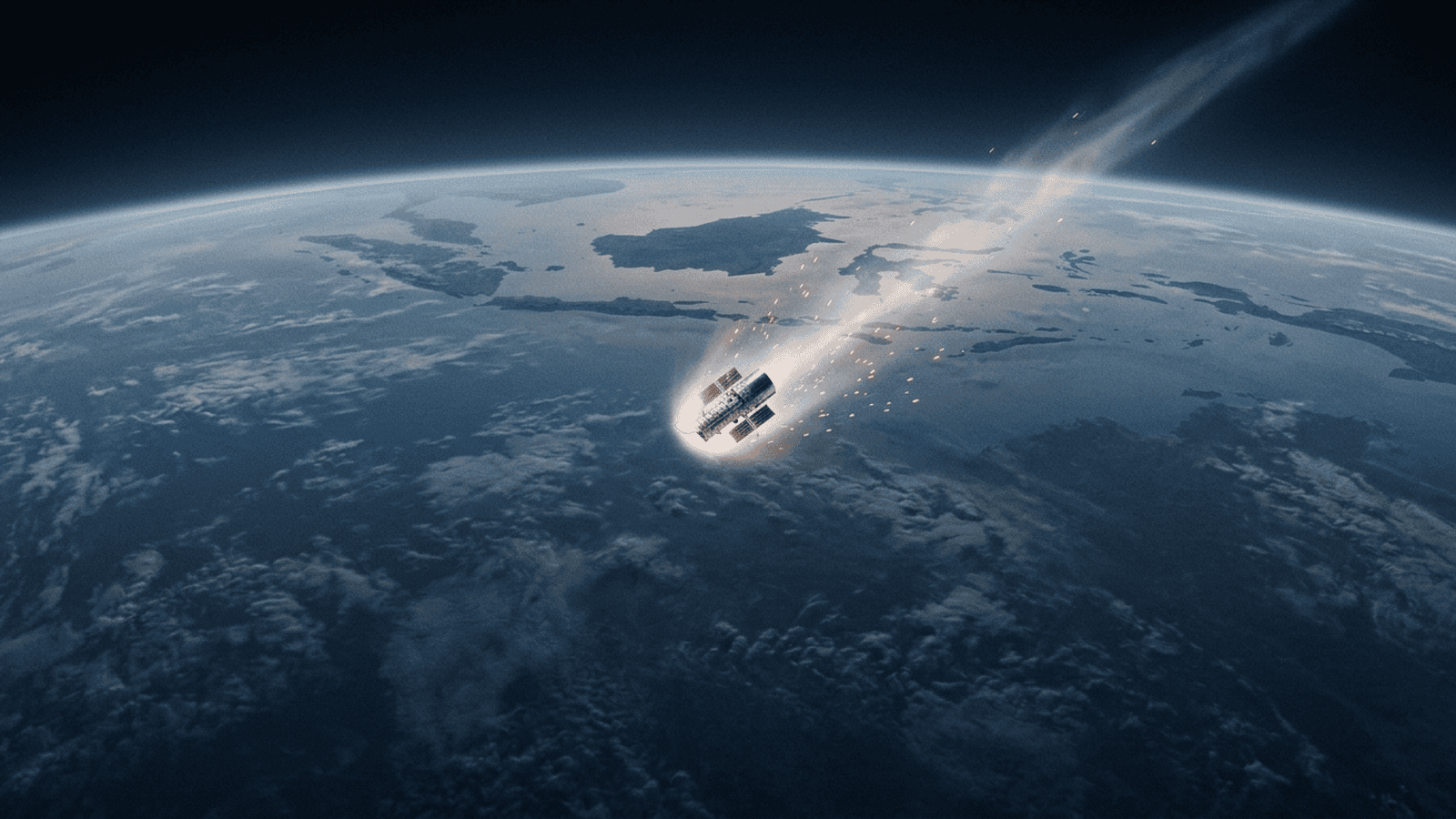
NASA’s Swift Observatory reentered Earth’s atmosphere over North Sumatra, Indonesia, after nearly 22 years in low-Earth orbit. NASA and the U.S. Space Force tracked its return, and NASA had estimated the risk of harm to anyone on Earth at about one in 2,100. Swift continued well beyond its planned two-year mission, observing thousands of cosmic events and alerting Hubble, Webb, and other facilities. A rescue attempt by contractor Katalyst Space failed, and NASA shut down Swift after it descended too low to remain steady. Scientists are now working to determine how to replace its role and apply lessons from the mission to future spacecraft.
TLDR: Swift returned to Earth after almost 22 years, following a failed rescue attempt and a final shutdown when it could no longer remain steady. NASA and the Space Force tracked the reentry, while scientists assess how future missions can take on Swift’s observational work.
NASA’s Swift Observatory has returned to Earth after nearly 22 years in low-Earth orbit. The roughly 3,200-pound telescope reentered the atmosphere at 7:39 a.m. Eastern Time over North Sumatra, Indonesia, NASA said. Much of the spacecraft burned up, though some components may have survived and could be found across hemispheres. NASA and the U.S. Space Force tracked its path.
Swift was built to search for powerful events in space, including gamma-ray bursts and supernovas. Its rapid ability to turn toward these events gave the observatory its name. That mission was common sense in practice: Swift could spot an event and alert other telescopes to examine it more closely. NASA said the risk of harm to anyone on Earth was unlikely, estimating the odds at about one in 2,100.
Launched on Nov. 20, 2004, Swift was designed for a two-year mission. It continued operating until last month, far beyond that initial plan. Solar activity gradually dragged the spacecraft lower, toward the atmosphere. Its return marked the end of an unusually long period of service, but it also made clear that a spacecraft in low-Earth orbit cannot remain there indefinitely.
Swift’s work extended well beyond its original targets. NASA said it observed more than 2,000 gamma-ray bursts and 1,400 exploding stars. It also helped Hubble and Webb by sending alerts when it detected events that those observatories could investigate in greater depth. NASA credited Swift with broadening understanding of active galaxies, X-ray flares, supernovas, comets, and asteroids.
The observatory continued sending observations until late October. NASA determined that it had descended too low to remain steady, and its systems were shut down. That decision ended the useful work of the telescope before its uncontrolled return. It was a practical limit, not a new mission plan: the spacecraft could no longer hold a stable position for observations.
NASA had tried to rescue the observatory. In July, it contracted Katalyst Space to send a three-armed robot called Link to push Swift back into position. Link encountered trouble shortly after launch and did not get within seven miles of the telescope. The robot itself fell back to Earth in September, and in August NASA had decided to allow Swift to reenter.
The sequence shows both the reach and the limits of space operations. A private contractor was brought in to attempt a rescue, but the effort did not reach its target. Swift’s descent was monitored by NASA and the U.S. Space Force, while the exact return time remained uncertain. NASA had forecast a time around 3:30 a.m. Eastern Standard Time on Nov. 4, with an uncertainty window of 11 hours on either side; the actual reentry came later, at 7:39 a.m. Eastern Time.
The practical impact was the loss of an operating observatory and the end of its alerts to Hubble, Webb, and other facilities. The rescue attempt failed, the observatory was shut down when it could no longer remain steady, and some pieces may have survived reentry. The account gives no fee, public paperwork, compliance requirement, or deadline for people who might find debris. The direct operational effects fall on NASA and the scientific teams that relied on Swift’s observations; scientists are still trying to determine how to replace its work.
Swift’s end was expected from before launch. John Nousek, an astronomer who led the control team at Pennsylvania State University, said that in low-Earth orbit what goes up must come down, and described the ending as catastrophic. He also expressed hope that lessons from Swift’s successes could inform new generations of missions. That is the next step identified in the account: scientists are working out how to replace Swift’s role and apply its lessons to future missions.
The observatory’s return was tracked, its systems were shut down when NASA judged them too low for steady work, and the reported risk to people on Earth was unlikely. Some components may still be found, while the search for a replacement continues. Those are the necessary next steps and oversight described in the available account; no further timetable or debris-recovery process has been announced.

Sean Bradley serves as the Senior Correspondent for Trade, Supply Chains, and Global Labor at Just Right News, where he brings a principled, clear-eyed perspective to the complex systems that power the modern world. With a focus on the economic forces that impact the American household, Bradley has distinguished himself as a leading voice in explaining how global shifts in manufacturing and logistics translate to the kitchen table.
Growing up in Long Beach, California, Bradley’s interest in the movement of goods was forged against the backdrop of one of the nation’s most vital maritime gateways. Raised in a community where the towering cranes of the port were a constant fixture on the horizon, he developed an early appreciation for the blue-collar industries that form the backbone of the American economy. This upbringing instilled in him a profound respect for the dockworkers, truckers, and laborers who keep the country moving, a sentiment that remains a cornerstone of his reporting today. For Bradley, trade is not merely a series of abstract figures on a spreadsheet; it is a human endeavor that sustains families and defines the strength of a nation.
Now based in Seattle, Washington, Bradley occupies a strategic vantage point in another of the country’s most significant trade hubs. His location allows him to witness firsthand the intersection of traditional industry and the evolving technological landscape of global logistics. From the Pacific Northwest, he monitors the flow of goods across the ocean, providing Just Right News readers with timely insights into how international tensions, regulatory hurdles, and labor disputes affect the availability and cost of essential goods.
His signature feature series, “The Journey of Things,” has become a staple for readers seeking to understand the intricate path products take from raw materials to the retail shelf. Through this series, Bradley pulls back the curtain on the global marketplace, often highlighting the risks of over-reliance on foreign adversaries and the importance of domestic manufacturing resilience. His reporting consistently emphasizes the conservative values of national sovereignty, free-market competition, and the protection of the American worker from unfair global practices.
As a journalist of Irish heritage, Bradley maintains a deep-seated respect for the dignity of the individual worker and the importance of community stability. He approaches his beat with a commitment to transparency, often questioning the status quo of globalist policies that prioritize corporate efficiency over local prosperity. Whether he is reporting from a warehouse floor or analyzing a new international trade agreement, his goal remains the same: to provide the American public with the truth about where their products come from and what it costs to get them there.
Throughout his tenure at Just Right News, Bradley has remained a steadfast advocate for economic common sense. His work serves as a vital resource for those who believe that a strong nation is built on secure borders, robust trade, and a respected workforce. By combining his local roots in Long Beach with his professional experience in Seattle, Bradley continues to offer a unique and necessary perspective on the forces that shape the American way of life.