

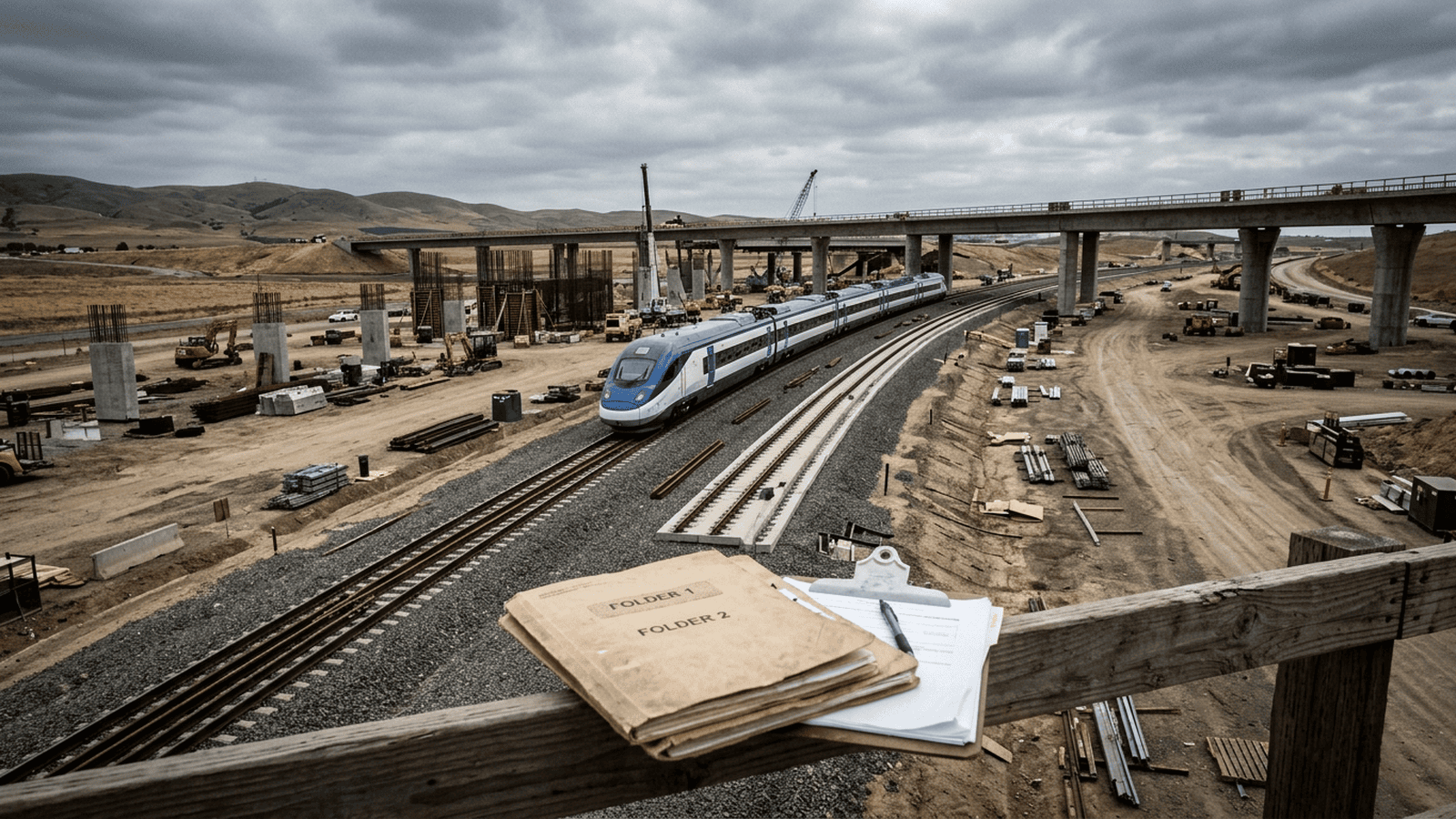
California’s High-Speed Rail Authority has appointed Joe Stephenshaw as interim CEO after Ian Choudri resigned, leaving questions about consultant contracts and spending unresolved. The board chair called for an independent inspector general investigation, which could examine who approved disputed expenses and whether contracting rules were followed, but its start date and timeline are not stated. The Authority has lost $4 billion in federal funding after missing train-purchase deadlines, and Californians will pay for a reduced order of three trains that cost more per train. Auditors and the inspector general have flagged travel expenses, while questions remain about contract rates and enforcement. The inspector general warned the project could run out of money by the end of 2027 without new financing.
TLDR: Joe Stephenshaw is now interim CEO of California’s High-Speed Rail Authority, while questions about consultant spending and contract enforcement remain open. An independent inspector general investigation has been called for, and the state faces train costs after losing $4 billion in federal funding.
California’s High-Speed Rail Authority has a new chief executive, but the change in leadership has not resolved questions about consultant contracts, disputed billings, or who enforced the agency’s agreements. Ian Choudri resigned effective immediately on October 28, citing personal and family priorities. The next day, the board appointed Joe Stephenshaw, the governor’s Department of Finance director, as interim CEO.
No official rationale for the leadership change beyond Choudri’s stated personal and family priorities appears in the available account. The board chair has called for an independent inspector general investigation following reporting on consultant spending and contracting practices. That review could establish who authorized disputed spending and whether the Authority followed state contracting rules, but the account does not confirm that the investigation has begun or state when it will finish.
The leadership transition comes as the Authority faces questions about major spending decisions and the public’s ability to track them. Reports described consultant expenses, contract rates, travel bills and delays in buying trains. The Authority proposed changes to its management of financial consulting agreements, but the account says those changes could reduce outside oversight. It does not provide details of the proposed changes or establish whether the board has adopted them.
The train purchase is one of the clearest examples of the financial stakes. Court records and federal documents cited in the report show that the Authority missed deadlines to buy trains it had promised to purchase. The Trump administration withdrew $4 billion in funding in 2024, citing the first missed trainset milestone. California sued, arguing it could meet a later deadline by purchasing trains in 2025, but it missed that deadline too and dropped the case, forfeiting the funding.
The Authority’s board authorized a trainset contract at its October 28 meeting, hours before Choudri resigned. The purchase is for the same type of wide-body train from the same manufacturer that the former CEO had chosen not to buy two years earlier. The order has been cut from six trains to three, and the account says each train will cost more despite having stock interiors. Without the federal funding, Californians will pay the bill. Without a Buy America agreement, the trains will be made in Germany.
Those facts leave a practical question for the new leadership: how did missed deadlines, a lost federal award and a smaller, more expensive order become the project’s current position? The available account does not establish who made each decision or why the purchase was delayed in 2024. The Authority’s response to questions about the delay was that it had no additional comment beyond what had been discussed publicly through the board process. New management inherits the cost consequences even where responsibility remains unsettled.
Consultant spending adds a separate set of oversight concerns. Inspector General Ben Belnap identified nearly $600,000 in travel expenses described as wasteful and unallowable, including luxury rideshares and trips to nightclubs, gyms and other places seemingly unrelated to consultants’ work. The Authority paid four major consulting firms nearly a quarter-billion dollars over two years. The report says those consultants advised the CEO and his team rather than laying track or building trains.
Records also showed two consultants billed taxpayers for late-night rides from Choudri’s Folsom home and nearby restaurants to Sacramento hotels about 30 minutes away. The report raised questions about whether consultants billed at hourly rates of $460 to $580 during dinners and other outings, but the Authority and the individuals did not respond. Separately, an engineering firm had promised to relocate six key employees to Sacramento under a contract worth up to $131 million. Instead, records showed travel and hotel costs for employees commuting from Denver and Texas. An auditor flagged expenses for Choudri’s commute from Denver, and the state later recovered those costs. The inspector general flagged more than $76,000 in travel involving out-of-state key personnel.
The reporting also raised questions about a $24 million KPMG contract. A statement to the board said the Authority was paying consultants through a contract at rates up to ten times those allowed in the winning bid and contract. State officials dismissed an allegation as speculation but warned the Authority not to pay higher rates for work assigned to positions listed at $35 an hour. The account says an investigation into the rates could take months. It does not identify a final finding about who approved them or whether the contract was enforced properly.
The immediate policy impact is financial and administrative. Californians are responsible for train costs after the loss of $4 billion in federal funding; the order is now three trains rather than six, with higher costs per train and German manufacturing. The account identifies public-records requests, contract review and inspector general scrutiny, but gives no new forms, compliance deadlines or adopted enforcement rules. It also reports that the inspector general warned the project could run out of money by the end of 2027 without new financing. The board’s independent investigation and review of existing contracts are necessary steps for oversight; their timing and findings remain unreported. The experts have this handled.

Jordan Lee serves as the Senior Correspondent for Wall Street, Finance, and Monetary Systems at Just Right News. Based in the heart of the world’s financial capital, New York City, Lee brings a sharp, principled eye to the complex mechanisms that drive the global economy. His reporting is defined by a commitment to fiscal responsibility, the defense of the free market, and a deep-seated belief that a transparent monetary system is the bedrock of a free society.
Raised in Portland, Oregon, Lee’s perspective was forged in a city that has undergone significant cultural and economic shifts. His upbringing in the Pacific Northwest instilled in him a profound appreciation for the industriousness of small business owners and the importance of local economic stability. Watching the evolution of his hometown’s landscape sparked an early interest in how federal fiscal policy and large-scale financial trends eventually trickle down to the average citizen. This background provides him with a unique vantage point; he understands the growing disconnect between the policy-making elite and the reality of Main Street, a theme that frequently resonates throughout his work.
Now operating from his base in New York City, Lee bridges the gap between the high-stakes trading floors of Manhattan and the households of everyday Americans. He views the financial sector not merely as a collection of numbers and tickers, but as a vital engine of American prosperity that requires constant vigilance and accountability. His reporting often highlights the dangers of centralized financial control and the necessity of maintaining a system that rewards merit, risk-taking, and innovation.
As the creator and lead of the featured series, “The Invisible Economy,” Lee pulls back the curtain on the often-opaque world of monetary systems. He specializes in translating the dense jargon of central banking and international finance into actionable insights for the Just Right News audience. His work explores the “invisible” forces—such as inflationary pressures, regulatory creep, and the expansion of the administrative state—that erode the purchasing power of American families. By focusing on these systemic issues, Lee empowers readers to understand the hidden forces shaping their financial independence.
Lee’s journalistic philosophy is rooted in a steadfast commitment to traditional American values. As an Asian American professional who has navigated the competitive corridors of the financial world, he is a vocal advocate for meritocracy and the preservation of the American Dream. He believes that a stable currency and a predictable regulatory environment are essential for national sovereignty and individual liberty. His reporting frequently warns against the risks of government overreach in the private sector, arguing that the most effective solutions to economic challenges arise from competition and individual enterprise rather than bureaucratic mandates.
At Just Right News, Jordan Lee remains dedicated to providing a clear-eyed defense of the taxpayer. Whether he is analyzing market volatility or investigating the long-term implications of national debt, his mission is to provide the truth about where the money is going and what it means for the future of the country. Through his rigorous analysis and principled stance, Lee has become a trusted voice for those who value a strong, sovereign, and fiscally sound America.