

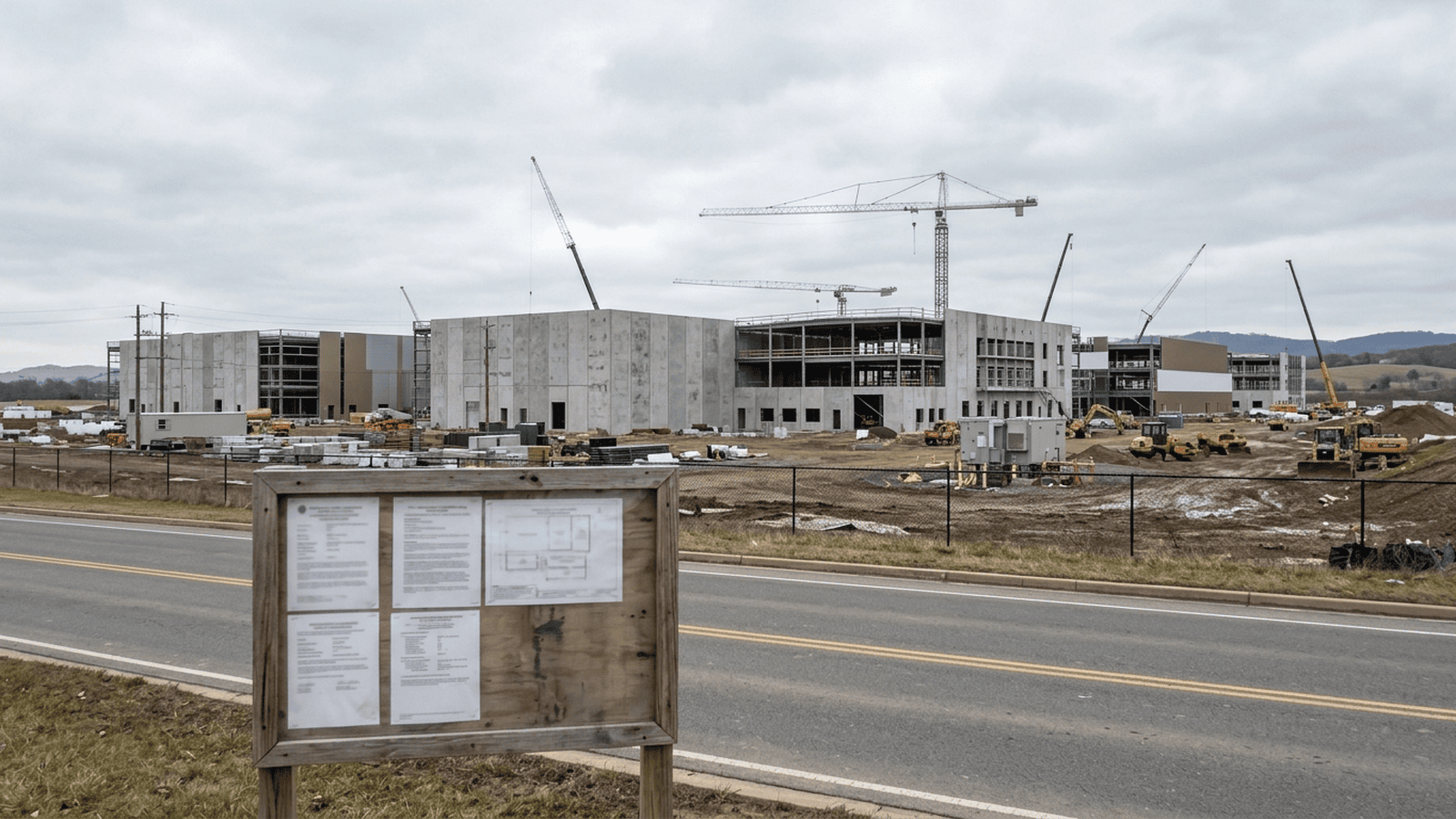
Midterm results have strengthened candidates and voters seeking tighter limits on data center construction. Redbud Consulting counted 37 ballot measures restricting facilities and one allowing them, while analysts forecast slower building, added regulation, and higher costs. Texas already has suspended approvals, and its incoming governor could maintain the moratorium; Georgia’s incoming governor has said she will order a pause and review tax incentives. Project delays and extra costs are expected possibilities, but the report confirms no cancellations and gives no fee amounts, forms, or compliance deadlines. Analysts say slower construction would not necessarily harm the wider economy, and AI investment is expected to continue.
TLDR: Election results have created a path to slower data center construction in Texas and Georgia, with analysts expecting more rules, costs, and project delays. The forecast is not confirmation of cancellations, and key details such as fees, forms, and deadlines remain unspecified.
The midterm results have put the rapid data center buildout under pressure. Wall Street analysts expect stricter rules and higher costs for developers, and the election has strengthened candidates who campaigned on limits. That shift is significant, but forecasts of slower construction are not the same as confirmed cancellations.
The common-sense rationale is that local voters and elected officials should have a stronger hand in decisions about new data centers. Public opposition is clear: a CBS News poll this summer found that more than twice as many Americans opposed building a data center in their area as favored one. The new political direction gives those concerns more weight in planning and approval decisions.
The ballot results offer an early measure of that direction. By Wednesday afternoon, voters had approved 37 measures restricting data centers and one measure allowing them, according to Redbud Consulting. Candidates who made stricter regulation part of their campaigns also won important races. These results point to a policy shift, while leaving the final pace of construction uncertain.
The scale of the plans helps explain why investors are watching. Technology analyst Dan Ives said between 800 and 1,000 data centers are planned across the country to support artificial intelligence. Franklin Templeton strategist Stephen Dover predicted that election results would slow construction and bring new regulations and costs for developers. Those are forecasts about the effects of policy, not a tally of projects already halted.
Texas is a central test. It accounts for an estimated 25% to 30% of the data center capacity expected to come online by 2030. Gina Hinojosa defeated incumbent Greg Abbott in the governor’s race after proposing a temporary construction ban. Investment adviser Gordon Johnson said the result could stall 13 gigawatts of data center power in Texas. That figure describes a possible effect, not a confirmed loss of capacity.
The state already has a pause in data center approvals. Abbott suspended approvals, and Johnson said Hinojosa could keep the moratorium in place without a new law. The detail matters: a permit freeze can slow projects through the existing approval process rather than through a newly enacted statute. The election has changed who will decide whether that pause continues, but the excerpt does not confirm what the incoming governor will do.
Georgia offers another case. Keisha Lance Bottoms won the governorship in the state, described in the report as the third-largest data center market. She campaigned on pausing new construction and said she would immediately sign an executive order for a pause, then determine what administrative steps were needed. She also plans to review tax incentives that helped spur development and assess the agreements and possible remedies. Many local governments, she said, had already taken an initial step.
Those actions would bring practical limits for developers. A continuing Texas moratorium would keep data center permits frozen, while a Georgia pause could stretch project timelines as officials work through administrative steps and review incentive agreements. Analysts also expect new regulations and costs, but the report gives no fee amounts, application forms, compliance deadlines, or enforcement schedule. Those specifics remain part of the plan rather than confirmed details. The burden falls most directly on developers and investors whose projects depend on approvals, construction schedules, or tax incentives.
The tradeoff is plain. More control by public officials means less freedom for companies to build on their preferred timetable, and a narrower role for private choice in where projects proceed. It also means added delay and expense. Those costs are part of the shift now under consideration, not proof that projects have been canceled. The economic stakes are real: investment in data centers and AI has helped drive U.S. growth and stock market gains.
Still, experts do not expect slower construction to stop AI investment or erase its contribution to growth. Dover said a slower buildout was unlikely to hamstring the economy over the long term and could temper investment that might not earn a good return. Oxford Economics analysts said longer project timelines would not necessarily be bad for the broader economy. Their assessments support caution about claims that the election has already ended the data center boom.
The next steps are state decisions on permits, executive action, administrative procedures, and Georgia’s review of tax incentive agreements. No specific deadlines or new compliance forms are stated in the available account. Those steps are necessary to determine how the pauses operate and to track whether forecasts become actual delays. Analysts have assessed the likely economic effects, but the final outcomes remain to be seen.

Max Grant serves as the Senior Correspondent for Data and Financial Forensics at Just Right News, where he brings a meticulous, investigative eye to the complex world of numbers. In an era where media narratives often overshadow objective reality, Max operates on a simple but firm principle: while rhetoric can be manipulated, the ledger never lies. As the architect behind the acclaimed feature series “Numbers That Talk,” he has carved out a vital niche in conservative journalism, translating dense financial data into clear, actionable insights for the American public.
Max’s journey to the forefront of financial reporting began in Buffalo, New York. Growing up in the Queen City, he was raised with the grit and grounded perspective typical of the Rust Belt. Buffalo is a place that understands the value of a dollar and the consequences of economic shifts on the working class. This upbringing instilled in Max a deep-seated respect for fiscal responsibility and a healthy skepticism toward bureaucratic overreach. He carries the spirit of his hometown into every investigation, viewing his work not just as reporting, but as a form of public service dedicated to protecting the interests of taxpayers and everyday citizens.
Now based in Brooklyn, New York, Max operates from the heart of one of the world’s most influential financial and cultural hubs. This vantage point allows him to keep a close watch on the institutions that drive the global economy. Living and working in a city often defined by progressive policy experiments, Max provides a necessary counter-perspective, using his forensic skills to analyze the real-world costs of local and national governance. His proximity to the financial district ensures he is never far from the source of the data he deconstructs, yet he remains firmly rooted in the conservative values that prioritize transparency and individual liberty.
His beat, Data and Financial Forensics, is more than just a job title; it is a commitment to uncovering the truth hidden within spreadsheets and annual reports. In “Numbers That Talk,” Max dives deep into federal spending, corporate accountability, and the intricate web of international finance. He has a unique ability to spot the anomalies that others miss, identifying where public funds are being mismanaged or where economic policies are failing to deliver on their promises. His reporting is characterized by a relentless pursuit of clarity, stripping away the jargon to show readers exactly how their money is being used and how the economy is truly performing.
At Just Right News, Max Grant is recognized as a steady hand and a sharp mind. He understands that for a free society to function, its citizens must have access to the facts regarding their financial future. By combining his British heritage’s tradition of rigorous inquiry with an American drive for accountability, Max ensures that the numbers don’t just sit on a page—they tell the story of where the country has been and where it is headed. His work stands as a testament to the power of forensic journalism in holding the powerful to account and championing the principles of a transparent, fiscally sound nation.