

Young voters leaned strongly toward Democratic candidates in the 2026 midterms, with an estimated 72 percent of voters aged 18 to 29 choosing Democratic House candidates and 25 percent choosing Republicans. Tufts CIRCLE called the 47-point preference the largest it had recorded in a national election. The results included a surprise Democratic win in North Carolina’s 14th District and strong youth support for Democrats in several Senate races. Reports from polling places and campuses described registration drives, absentee-ballot forms, lines and election-night gatherings. They also captured concerns about high living costs, land and political speech, while providing no single explanation for the national voting pattern or any new policy plan.
TLDR: The 2026 midterms showed a record-level Democratic preference among young voters, including a North Carolina upset and strong youth support in several Senate contests. Campus accounts documented registration assistance and increased demand for absentee-ballot forms, while local reports recorded concerns about living costs and political participation.
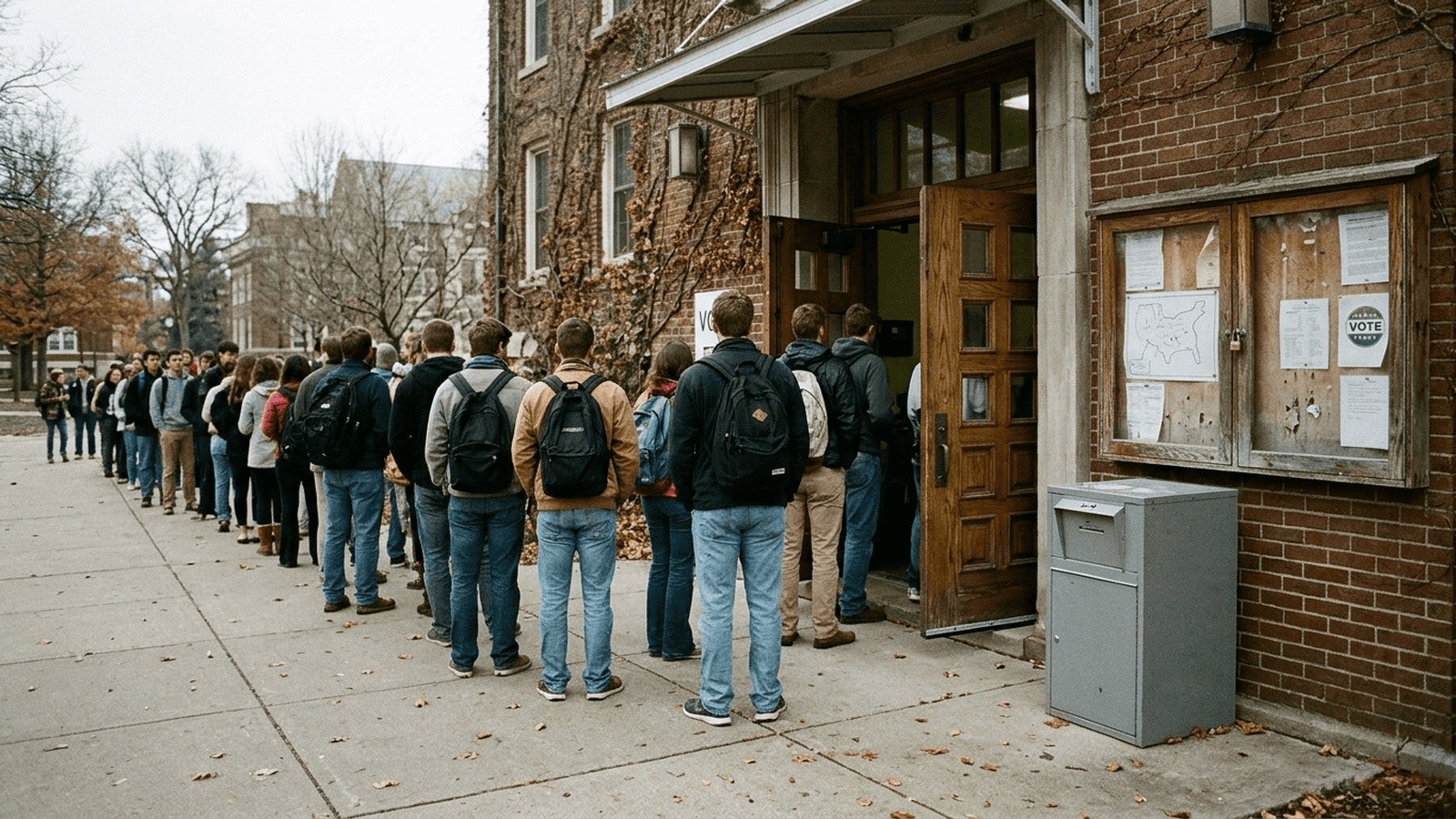
The 2026 midterms brought an unmistakable surge of young voters into election-night gatherings and polling places. An estimate cited in the election coverage found that 72 percent of voters aged 18 to 29 chose Democratic candidates for the U.S. House, while 25 percent chose Republicans. Tufts University’s Center for Information & Research on Civic Learning and Engagement described the 47-point youth preference for Democrats as the largest it had recorded in a national election.
The reporting’s stated explanation is that young voters were animated by an appetite for change and concerns about the direction of the country. The accounts also connect the vote to practical pressures, including the high cost of living in rural Alaska and worries about preserving land and traditional ways of life. Those are reported motivations, not a single official rationale for the election result.
The sharpest illustration of the national numbers came in North Carolina’s 14th Congressional District. Democrat LaKesha Womack defeated Republican incumbent Tim Moore in a district widely viewed as safe for Republicans. Moore had helped draw the district while serving in the state General Assembly, and the district includes many students. The account describes the result as an upset, showing that a seat treated as secure can still be contested by voters.
Across several Senate contests, young voters also favored Democratic candidates. The reported shares were 74 percent in Florida, 80 percent in Kansas, 74 percent in Maine and 67 percent in Michigan. Those figures do not describe every young voter or explain each individual choice. They do show a pronounced pattern across states with different local political settings.
In Nome, Alaska, election day began with residents arriving at Old St. Joe’s, a church built in 1901 that now serves as a community space and polling site. Election workers checked voters’ identification, and a first-time voter received applause from poll workers. The scene reflected a local process rooted in a familiar gathering place, even as voters faced concerns about costs, representation and the land around them.
The costs described there were concrete. Unleaded fuel was listed at $7.39 a gallon. One resident said the family had paid about $10,000 for diesel to heat its home the previous year, and that expenses were rising after foster children joined the household. Another young voter, Guadalupe Callahan, connected her choices to fishing, hunting and protecting the land. The report offers those experiences as part of the setting for political decisions, not as evidence that one candidate or policy would resolve them.
The national result also carried an electoral-map dimension. The coverage says recent Supreme Court rulings preceded a cycle in which gerrymandering became more severe and frequent. It describes North Carolina’s result as a rebuke to Republican redistricting tactics. The excerpt does not provide the rulings’ details or set out a new map policy, so the scope and consequences of those legal changes cannot be specified from this account alone.
On campuses, students followed results in watch parties and at polling sites. At Boston College, students described a campus where political discussion could feel constrained by self-censorship and administrative limits on protests. One student compared the atmosphere to avoiding an argument at a family gathering. The reporting does not establish how widespread that experience is across colleges, but it records a tension between political interest and reluctance to speak openly.
Other campus accounts showed practical participation. At Cornell, student organizers helped nearly 500 students register during the semester, compared with just over 300 during the 2024 presidential election. They also distributed more than four times as many absentee-ballot forms. On Election Day, members were present at the campus polling place from 5 a.m. to 9 p.m. to help students navigate voting. The account notes that some students waited nearly half an hour at a polling site, while rain added another inconvenience in one location.
These details point to participation that required time, planning and, for some voters, help with forms. The reported increase in absentee-ballot forms does not establish how many were completed or returned. The excerpt gives no new fees, compliance rules or deadlines beyond the Election Day polling hours it reports. The directly affected people included young voters, students seeking registration or absentee voting information, and residents managing the costs of life in remote Alaska. Long lines, paperwork and weather were real parts of the process, alongside the strong turnout.
The election accounts do not describe a new government policy, an enforcement plan or a coming administrative review. The next steps are the ordinary work of counting and reporting election results, though the excerpt supplies no further timetable or oversight details. The figures and local accounts offer a clear record of how young voters participated in 2026, while leaving the causes and longer-term consequences open to further reporting.

James Foster serves as the Senior Correspondent for Inequality and the Social Safety Net at Just Right News, where he brings a principled and nuanced perspective to the most pressing economic challenges facing the nation. With a career dedicated to exploring the intersection of policy and personal responsibility, Foster has become a leading voice in documenting how government programs and economic shifts impact the American family. His reporting is characterized by a commitment to the “human element,” moving beyond cold statistics to highlight the stories of resilience, work, and community that define the modern American experience.
Foster’s perspective is deeply rooted in his upbringing in Birmingham, Alabama. Growing up in a city with a rich industrial heritage and a history of economic transformation, he witnessed firsthand the importance of the dignity of work and the strength of local institutions. In Birmingham, he saw how the most effective safety nets were often those woven by neighbors, faith-based organizations, and local civic groups. This background instilled in him a lifelong skepticism of “one-size-fits-all” solutions from distant bureaucracies, favoring instead the localized, community-driven support systems that he frequently champions in his writing.
Now based in Atlanta, Georgia, Foster operates from one of the most dynamic and rapidly evolving metropolitan hubs in the South. His location provides a front-row seat to the stark contrasts of the modern economy. From the gleaming towers of Atlanta’s financial districts to the struggling neighborhoods on the city’s periphery, Foster finds the stories that illustrate the complexities of upward mobility. His reporting from the Sun Belt serves as a microcosm for the national debate on poverty, highlighting how inflation, housing costs, and labor market shifts affect the working class in real-time.
As the lead for the acclaimed feature series “America’s Balancing Act,” Foster explores the delicate tension between providing a necessary hand up and fostering long-term independence. The series has become a cornerstone of Just Right News, offering a deep dive into the unintended consequences of social welfare policies. Foster’s work often focuses on the “cliff effect” and other systemic hurdles that can inadvertently discourage employment, arguing that true compassion is measured by how many people are empowered to leave the safety net, rather than how many are added to it.
Throughout his tenure, Foster has remained dedicated to the mission of Just Right News, providing a clear-eyed, conservative analysis of social issues. He believes that a free society thrives when individuals are empowered and the private sector is allowed to innovate. Whether he is interviewing small business owners about the challenges of a changing workforce or documenting the success of private charitable initiatives, Foster’s goal is to provide readers with the truth about the state of the American Dream. His work serves as a vital reminder that while the challenges of inequality are great, the solutions are often found in the strength of the American spirit and the preservation of traditional values.