

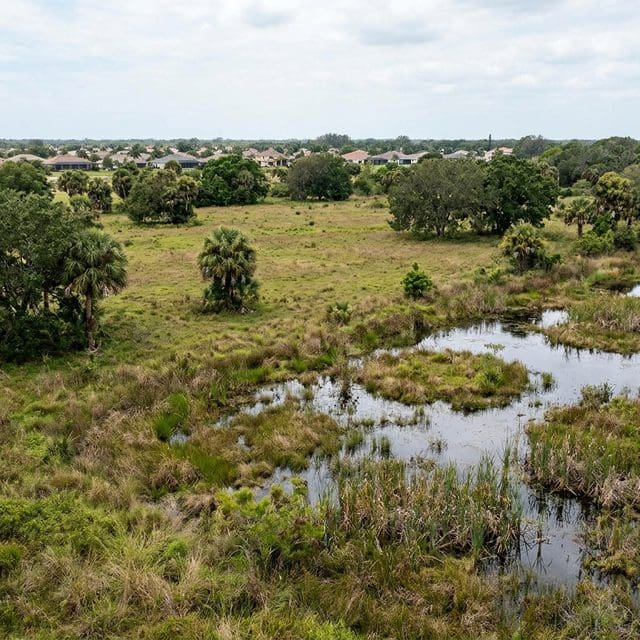
A Sarasota County judge’s ruling sends a proposed Celery Fields apartment project into further review, while county officials prepare to discuss its implications and Port Charlotte residents face a recreation-center closure.
Sarasota County’s effort to block a large apartment proposal near Celery Fields suffered a setback Saturday, Nov. 7, when Circuit Judge Hunter W. Carroll ruled that the development must be allowed to proceed through the review process under Florida’s Live Local Act.
The proposal calls for more than 600 apartments. The ruling does not approve construction, but it limits the county’s ability to stop the project at this stage. The case puts a state housing law in direct tension with local land-use authority, especially in rural areas where Sarasota County zoning has traditionally allowed one home per five acres.
For residents of Sarasota, Venice, North Port and Englewood, the issue is not simply whether more housing is needed. It is also how much discretion county officials retain over where that housing is built. The decision leaves the project’s ultimate approval and design unresolved, along with questions about its effects on the surrounding area.
The ruling may have implications beyond this site. WUSF and Suncoast Searchlight reported Saturday that county records show at least 18 large-scale rural apartment projects proposed under the Live Local Act. That is broader than the five projects tied to lawsuits. Four of those other cases remain pending before Carroll, according to the report.
Carroll described the dispute as a question of state authority, writing that the issue was not whether apartments beside the Celery Fields were wise, but whether the Legislature had prevented Sarasota County from making that decision. The ruling therefore tests how much room local officials have to apply local land-use policies when a state law provides a path for housing proposals. Developers who prevail under the law may recover up to $250,000 in court costs, the report said.
Sarasota County officials have scheduled a more extensive discussion of the Live Local Act for Nov. 17. County Attorney Joshua Moye said the county may review the ruling’s effect on the other active lawsuits. That discussion could clarify the county’s response, but the available reporting does not establish what commissioners will do or how the pending cases will be decided.
The distinction between moving through review and receiving final approval is important: the ruling does not mean the Celery Fields apartments are cleared to be built. It does mean the county’s ability to halt the proposal under its usual rural zoning rules has been challenged, with other projects and lawsuits potentially affected. The number of proposals that will ultimately advance remains uncertain.
In Port Charlotte, residents should plan around a temporary closure at Centennial Park Recreation Center and pool. Charlotte County says the facility will close at 5 p.m. Friday, Nov. 20, for generator installation and is expected to reopen Monday, Nov. 23. The playground will also be closed Nov. 23 and 24. The county said it will issue a notice when the pool reopens. Families and other facility users should account for the closure when scheduling recreation or activities.
Charlotte County’s school-tax referendum also appeared in recent coverage. WINK News updated its report Nov. 7, but the available verified information does not establish the tax rate or vote totals, so those figures are not included here.
The supplied recent coverage provides little verified news specific to Englewood and does not establish fresh developments for local roads, schools or environmental projects beyond the Sarasota County housing dispute. That limitation matters: within this two-day reporting window, the clearest local policy story is the unresolved balance between state housing law and county control over development.

Deborah Cole serves as a Senior Correspondent for Just Right News, where she spearheads the network’s coverage of Housing, Infrastructure, and Mobility. With a career defined by a commitment to rigorous reporting and a focus on the fundamental pillars of American community life, Deborah brings a principled perspective to the complex issues that dictate how and where we live. Her work is grounded in the belief that sound policy, fiscal responsibility, and respect for private property are the essential foundations of a prosperous society.
Originally from Boston, Massachusetts, Deborah’s upbringing in one of the nation’s oldest and most historically significant cities deeply influenced her professional trajectory. Growing up amidst the architectural legacy and dense urban planning of New England, she developed an early appreciation for the importance of durable infrastructure and the role of local tradition in shaping neighborhoods. Her perspective is informed by the classic American values of her hometown—hard work, community cohesion, and a healthy skepticism of top-down bureaucratic mandates that often overlook the unique needs of individual citizens.
Today, Deborah operates from her base in Austin, Texas, a city that serves as a primary laboratory for her reporting. Austin’s rapid expansion and its status as a hub for innovation and migration provide her with a front-row seat to the most pressing challenges in modern infrastructure and housing. From the Lone Star State, she chronicles the tensions between rapid growth and the preservation of the American Dream, often highlighting how market-driven solutions and deregulation can address the housing shortages that plague many of the country’s metropolitan areas.
At Just Right News, Deborah is perhaps best known for her signature feature series, “Where We Live.” Through this platform, she explores the intersection of public policy and private life, moving beyond mere statistics to tell the stories of families, small business owners, and local developers. Her reporting frequently highlights the importance of mobility—not just in terms of transportation and transit, but as a vehicle for economic opportunity and social stability. She remains a staunch advocate for the taxpayer, consistently scrutinizing government spending on large-scale projects and advocating for transparency in how infrastructure dollars are allocated.
Deborah’s beat is more than just a collection of policy topics; it is an investigation into the physical and legal structures that allow families to flourish. Whether she is reporting on the impact of zoning laws on suburban development or the necessity of maintaining the nation’s highway systems, her work is characterized by a dedication to the facts and a respect for the constitutional principles that protect the rights of homeowners.
As a Senior Correspondent, Deborah Cole continues to be a vital voice for Just Right News, providing the audience with the clarity and context needed to navigate an ever-changing landscape. Her reporting ensures that the values of individual liberty and local sovereignty remain at the forefront of the national conversation regarding the future of our cities and towns. Through her tireless efforts, she remains committed to informing the public on the issues that hit closest to home.