

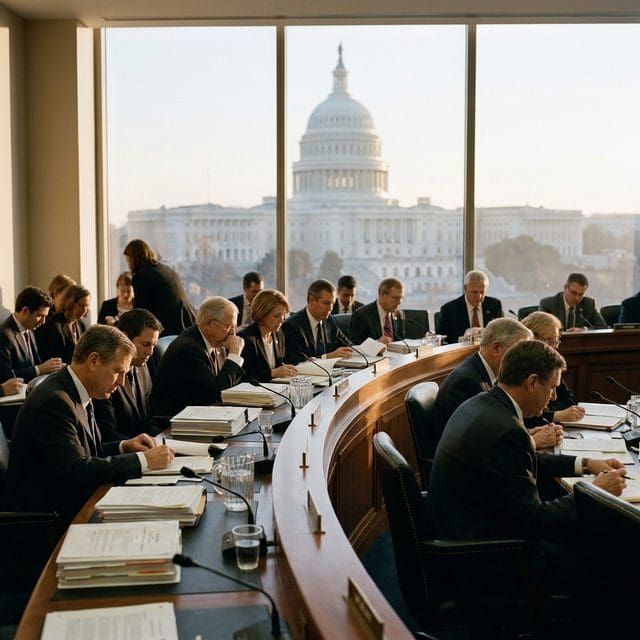
Democrats’ coming control of Congress shifts leverage toward oversight, putting the Iran war, defense leadership and federal grant rules in focus.
Democrats’ midterm victories will soon place both chambers of Congress under opposition control. The immediate tests are taking shape around the Iran war, Defense Secretary Pete Hegseth and federal grant rules—disputes that reach beyond politics to the limits of presidential authority.
The new Congress convenes January 3, 2027. Until then, Democrats do not control committee gavels or chamber agendas. Once they do, their strongest leverage is likely to be oversight: demands for records, subpoenas and hearings. President Donald Trump retains his veto, so major legislation will require bipartisan agreement or veto-proof support. Divided government may stall new laws, but it does not automatically stop the executive branch from acting under existing authority.
The war is already dividing Republicans. Vice President JD Vance publicly attributed the election defeat to the conflict, writing, “The reason we lost is the war,” and arguing that any post-election reckoning must begin there. Trump, by contrast, said Hegseth will remain defense secretary and praised his performance as “a great job.” Pentagon spokesman Sean Parnell said Hegseth intends to serve through the end of Trump’s term.
Republican Rep. Thomas Massie plans to force a House impeachment vote when Congress returns next week. Multiple Republican sources told CNN they expect the measure to pass. The Deep Dive reported Massie is expected to reintroduce eight articles unless Hegseth resigns. A House vote would be a major political rebuke, not removal from office; that would require a Senate conviction. Available reporting does not establish how the Senate would act.
Democrats are preparing possible subpoenas on the Iran war, the legality of strikes on suspected drug-smuggling boats and Hegseth’s unexplained firings of senior military officers, ABC News reported. BBC reporting identifies possible inquiries into civilian casualties, munitions shortfalls, spending and allegations involving inadequately prepared troops and facilities. These are potential investigative subjects, not established findings. Oversight can compel answers, but does not by itself prove an action unlawful.
A quieter dispute over federal grants also puts Congress’s authority in play. More than 100 organizations, including the Association of American Universities and the American Association for the Advancement of Science, warned Congress on November 5 that proposed rules could give political appointees greater control over grants and allow cancellations when projects do not align with presidential priorities. The Office of Management and Budget received at least 164,000 comments; the broad rule cannot be finalized before mid-December, Inside Higher Ed reported.
The organizations argue that agencies could override Congress’s funding instructions, including language in a September temporary funding measure. The question turns on the rule’s text and the appropriations Congress enacted. If agencies use grant conditions to redirect money lawmakers allocated, Congress has a direct institutional stake. If the rule stays within authority delegated by Congress, the issue is how much discretion that delegation allows.
Incoming House Oversight Chairman Robert Garcia has named Trump family businesses, immigration enforcement, corporate donations connected to the White House ballroom and the Epstein files as potential investigative targets. Democrats are also preparing inquiries into military decisions. These are announced priorities, not findings of misconduct.
The election narrows the administration’s legislative path and may increase its reliance on executive authority. Such actions remain subject to statutory limits, court review and congressional scrutiny. The coming contest will turn on the authorities, records and appropriations behind decisions—not on how either side describes them.

Miles Harrington serves as the Senior Correspondent for Federal Systems & Executive Power at Just Right News, where he brings a disciplined, constitutionalist lens to the inner workings of the American government. With a focus on the mechanics of the federal bureaucracy and the limits of executive authority, Harrington has established himself as a vital voice for readers who value transparency, accountability, and the preservation of the separation of powers.
A native of Richmond, Virginia, Harrington’s perspective is deeply rooted in the traditions of the Old Dominion. Growing up in a city defined by its historical significance and its role as a center of American jurisprudence, he developed an early appreciation for the foundational principles of the Republic. His upbringing in Richmond—a place where the legacy of the Founding Fathers is woven into the landscape—instilled in him a belief that the federal government should remain within its constitutional bounds. This background informs his skepticism of centralized overreach and his commitment to reporting on the ways in which the administrative state impacts the lives of everyday citizens.
In his current role, Harrington specializes in the complexities of federal systems. He doesn’t just report on the headlines of the day; he digs into the structural shifts within the executive branch that often go unnoticed by the mainstream press. Whether he is analyzing the implications of a new federal regulation or investigating the expansion of agency jurisdiction, his work is characterized by a rigorous adherence to the facts and a dedication to the rule of law.
Harrington is perhaps best known for his signature feature series, “How Washington Works.” Through this ongoing project, he demystifies the often-opaque processes of the nation’s capital, pulling back the curtain on the “Deep State” and the unelected officials who wield significant influence over national policy. By breaking down complex legislative maneuvers and executive orders, he empowers Just Right News readers to understand the true levers of power in Washington. His reporting serves as a necessary check on the federal government, ensuring that the actions of those in power are held up to the light of public scrutiny.
Now based in Washington, D.C., Harrington operates at the epicenter of the political world, yet he remains intentionally distanced from the “Beltway bubble.” His proximity to the halls of power allows him to maintain a robust network of sources across the federal landscape, but his heart remains in the principled conservatism of his Virginia roots. He views his role not merely as a reporter, but as a steward of the public trust, dedicated to providing the clarity and context that conservative voters need to navigate an increasingly complex political environment.
Through his sharp analysis and unwavering commitment to the truth, Miles Harrington continues to be a cornerstone of the Just Right News team. His work ensures that the principles of limited government and executive restraint remain at the forefront of the national conversation, providing a crucial service to those who believe in a government that is truly of, by, and for the people.