

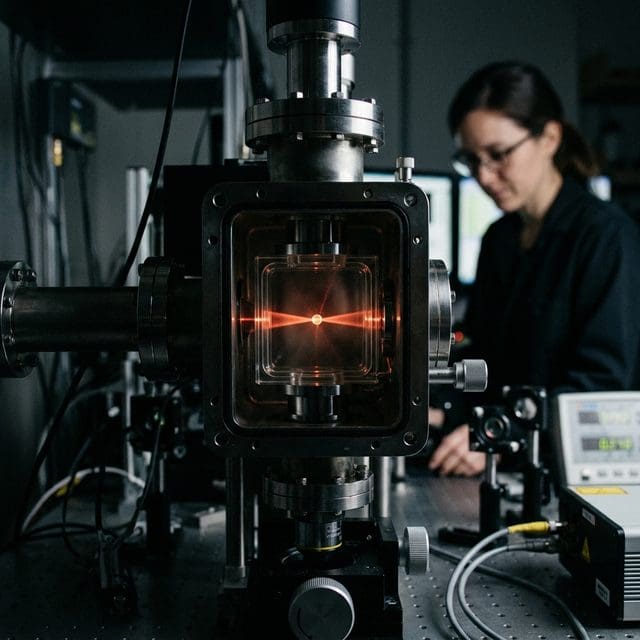
A Yale experiment used a laser-held glass sphere to detect individual gas-particle impacts, offering a new way to study extremely thin gases and the backgrounds that can blur searches for elusive particles.
A glass sphere suspended by light can reveal what is otherwise almost impossible to see: the tiny impacts of individual gas particles. In an experiment reported by Science News on October 23, Yale researchers measured how the sphere moved as atoms and molecules collided with it, distinguishing among krypton, xenon and sulfur hexafluoride.
The finding offers a new way to probe gases at extremely low pressures, where conventional measurements become difficult. It could also help physicists identify stray gas particles that interfere with sensitive searches for neutrinos and dark matter.
The experiment, led by Yu-Han Tseng and colleagues at Yale University, used a laser to hold a small glass nanoparticle in place. When gas was introduced, collisions nudged the particle, changing its motion. Because different gases interact differently with the sphere, the researchers could distinguish their effects. Science News described the work as the first direct measurement of individual gas-particle impacts using a levitated nanoparticle. The research appeared in Physical Review Letters on October 23.
The idea is striking because the sensor is vastly heavier than the particles it detects. Rather than trying to photograph an atom in flight, the researchers read the tiny movement of the sphere after a collision. As gas was added, collision rates rose; the pattern of motion also varied with the gas. That gives scientists a way to infer both the presence and identity of particles from their effects on a much larger object.
“This could enable a very good way to sense pressure,” Tseng told Science News, pointing to extremely low-pressure environments. The experiment is a proof of principle, not yet a ready-made instrument for spacecraft or laboratories. Its importance lies in demonstrating that individual impacts can be detected and differentiated through a nanoparticle’s response.
The work grew out of efforts to build detectors for neutrinos and dark matter, according to Physics World. Those experiments are designed to catch extraordinarily rare events. Residual gas in a detector can create background signals that complicate the search, so understanding which particles remain—and how they behave—can help researchers interpret what their instruments record.
A longer-term possibility is to dope nanospheres with radioactive isotopes. When an isotope emits a neutrino, the sphere’s recoil could potentially help researchers reconstruct the neutrino’s momentum. That is a future research goal, not a capability demonstrated in the Yale experiment. The immediate result is narrower but significant: a tiny sensor has shown that it can register the differing impacts of several gases.
The finding arrives amid rapid progress on a separate challenge in quantum physics: keeping quantum computers’ calculations from being undone by errors. Quantinuum reported October 19 that each tested increase in the distance of its quantum error-correcting code reduced remaining logical errors by a factor of 12. The company says the result is within the target range for its planned Apollo universal fault-tolerant system, which it expects by 2029. That remains a forward-looking company claim, not a delivered capability.
The two efforts share a larger scientific ambition: to measure and control effects that are usually lost in noise. For the Yale team, the next steps are to refine the sensor and determine how useful it can be in real low-pressure environments and detector experiments. The discovery does not yet make a nanoparticle a universal gas monitor. It does show that, when held steady by light, a speck of glass can turn otherwise invisible collisions into measurable evidence.

Mason Reed serves as a Staff Writer for Just Right News, where he spearheads the Future Frontiers & Special Projects desk. In an era defined by rapid technological shifts and evolving social landscapes, Mason provides a steady, principled voice, examining the innovations of tomorrow through the lens of traditional American values. His work is most prominently featured in his signature series, “The Next Horizon,” where he explores the intersection of emerging technology, national sovereignty, and the preservation of individual liberty.
A native of San Diego, California, Mason’s worldview was shaped by the unique culture of his hometown. Growing up in a region defined by its strong military presence and its history of maritime industry, he developed a deep-seated respect for the institutions that provide national stability and the entrepreneurial spirit that drives the American economy. This upbringing instilled in him a belief that true progress is not found in discarding the past, but in building upon a foundation of proven principles. His reporting often reflects this San Diego influence, emphasizing the importance of a robust national defense and the necessity of maintaining a competitive edge in the global marketplace.
Now based in San Francisco, Mason operates from the heart of the world’s technological engine. Living and working in the Bay Area provides him with a front-row seat to the advancements—and the ideological challenges—emanating from Silicon Valley. While many in the region embrace a “move fast and break things” mentality, Mason’s reporting serves as a vital counterweight. He offers Just Right News readers a “boots on the ground” perspective, documenting how radical local policies and the concentration of tech power impact the everyday lives of citizens. His proximity to the industry allows him to cut through the marketing jargon of big tech to uncover the real-world implications for privacy, free speech, and the nuclear family.
In his “Future Frontiers” beat, Mason tackles complex subjects ranging from the ethics of artificial intelligence to the burgeoning private space race. He approaches these topics with a healthy skepticism toward centralized bureaucracy, championing instead the decentralized innovations that empower individuals. Through “The Next Horizon,” he highlights the pioneers and thinkers who are working to ensure that the future remains a place where human dignity and constitutional rights are protected. He believes that the rapid pace of change requires more than just technical expertise; it requires a moral compass rooted in the Western tradition.
Throughout his tenure at Just Right News, Mason has remained committed to the idea that the future is something to be shaped, not merely accepted. His writing is characterized by a rigorous defense of American exceptionalism and a belief that the country’s best days lie ahead, provided it remains true to its founding ideals. Whether he is investigating the impact of automation on the American workforce or profiling the next generation of aerospace engineers, Mason Reed ensures that his readers are equipped with the insights they need to navigate a changing world with confidence and clarity.