

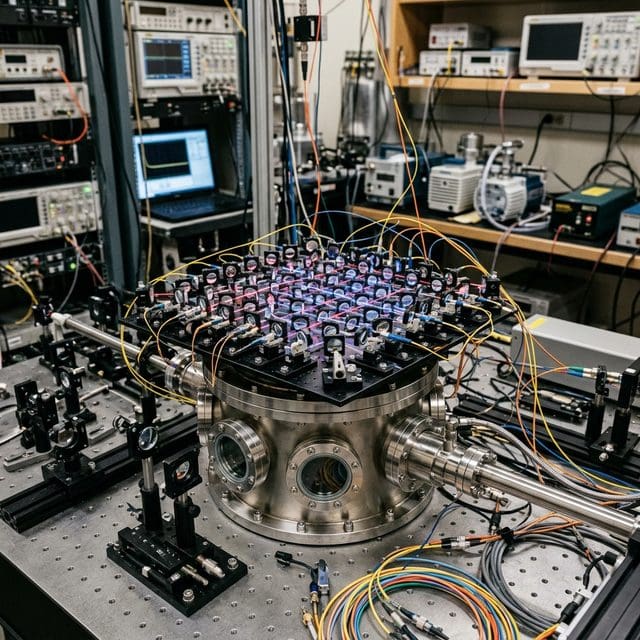
A Nature study shows how optical cavities can collect light from individual neutral-atom qubits in parallel, pointing toward a way for separate quantum processors to communicate.
A quantum computer built from neutral atoms may not need to grow as one enormous array. A study reported in Nature describes a way to collect light from individual atoms across a two-dimensional grid of optical cavities, a possible building block for linking separate quantum processors.
The idea addresses a practical obstacle in scaling quantum machines: getting information out of their qubits and moving it between modules. In a neutral-atom computer, atoms held in place serve as qubits—the units that carry quantum information. Light emitted by an atom can reveal information about its state. But efficiently gathering that light, particularly from many atoms at once, is a demanding engineering problem.
The researchers’ cavity-array microscope couples each atom to its own optical cavity across an array with more than 40 modes, according to the study. A cavity is a space bounded by mirrors that can guide and enhance the collection of light. Here, the design uses lenses inside the cavities and free-space optics, rather than nanophotonic elements. The reported optical modes are on a micrometre scale, compatible with the spacing typically used in neutral-atom arrays.
That arrangement allowed fast, parallel, non-destructive readout on millisecond timescales. In plain terms, the system can gather information from multiple atoms quickly without destroying the quantum states being measured. The team also demonstrated a proof of principle using a fibre array, an early indication of how optical connections might carry information between components.
The larger ambition is modularity. Instead of continually expanding a single atom array, researchers could, in principle, build several processor modules and connect them with optical links. Cavities would help direct light from atoms into those links, allowing quantum information to travel between modules. That is one proposed route to machines larger than a single processor can practically accommodate.
The distinction between a promising interface and a scalable computer matters. The reported work demonstrates a cavity-array platform and readout capabilities; it does not establish that large arrays of processors have already been networked, or that a useful, fault-tolerant quantum computer has been achieved. The study’s significance is that it tackles one piece of the scaling puzzle: collecting light from many atoms in a design that could potentially be extended.
The Nature report is also separate from a recent quantum error-correction demonstration in which errors fell as the number of qubits increased, passing a breakeven point. Error correction addresses how to protect fragile quantum information from mistakes. The cavity-array work instead concerns how to read that information and potentially connect processors. Both problems matter, but progress on one does not by itself solve the other.
What comes next is engineering: increasing the size of the cavity arrays, improving the collection and transfer of photons, and testing whether separate neutral-atom modules can communicate reliably enough for computation. The supplied report does not establish a timetable or provide evidence that those larger systems are already operating. Nor does it show that optical links alone will overcome the other challenges involved in building a practical quantum computer.
For now, the advance is best understood as a new piece of quantum infrastructure. Mirrors and lenses may seem far removed from the abstract rules of quantum physics, yet they could help determine whether atom-based machines remain isolated experiments or become components in a larger system. The path is still experimental, but the study offers a concrete way to think about scaling: not simply adding more qubits, but finding reliable ways for them to share information.

Mason Reed serves as a Staff Writer for Just Right News, where he spearheads the Future Frontiers & Special Projects desk. In an era defined by rapid technological shifts and evolving social landscapes, Mason provides a steady, principled voice, examining the innovations of tomorrow through the lens of traditional American values. His work is most prominently featured in his signature series, “The Next Horizon,” where he explores the intersection of emerging technology, national sovereignty, and the preservation of individual liberty.
A native of San Diego, California, Mason’s worldview was shaped by the unique culture of his hometown. Growing up in a region defined by its strong military presence and its history of maritime industry, he developed a deep-seated respect for the institutions that provide national stability and the entrepreneurial spirit that drives the American economy. This upbringing instilled in him a belief that true progress is not found in discarding the past, but in building upon a foundation of proven principles. His reporting often reflects this San Diego influence, emphasizing the importance of a robust national defense and the necessity of maintaining a competitive edge in the global marketplace.
Now based in San Francisco, Mason operates from the heart of the world’s technological engine. Living and working in the Bay Area provides him with a front-row seat to the advancements—and the ideological challenges—emanating from Silicon Valley. While many in the region embrace a “move fast and break things” mentality, Mason’s reporting serves as a vital counterweight. He offers Just Right News readers a “boots on the ground” perspective, documenting how radical local policies and the concentration of tech power impact the everyday lives of citizens. His proximity to the industry allows him to cut through the marketing jargon of big tech to uncover the real-world implications for privacy, free speech, and the nuclear family.
In his “Future Frontiers” beat, Mason tackles complex subjects ranging from the ethics of artificial intelligence to the burgeoning private space race. He approaches these topics with a healthy skepticism toward centralized bureaucracy, championing instead the decentralized innovations that empower individuals. Through “The Next Horizon,” he highlights the pioneers and thinkers who are working to ensure that the future remains a place where human dignity and constitutional rights are protected. He believes that the rapid pace of change requires more than just technical expertise; it requires a moral compass rooted in the Western tradition.
Throughout his tenure at Just Right News, Mason has remained committed to the idea that the future is something to be shaped, not merely accepted. His writing is characterized by a rigorous defense of American exceptionalism and a belief that the country’s best days lie ahead, provided it remains true to its founding ideals. Whether he is investigating the impact of automation on the American workforce or profiling the next generation of aerospace engineers, Mason Reed ensures that his readers are equipped with the insights they need to navigate a changing world with confidence and clarity.