

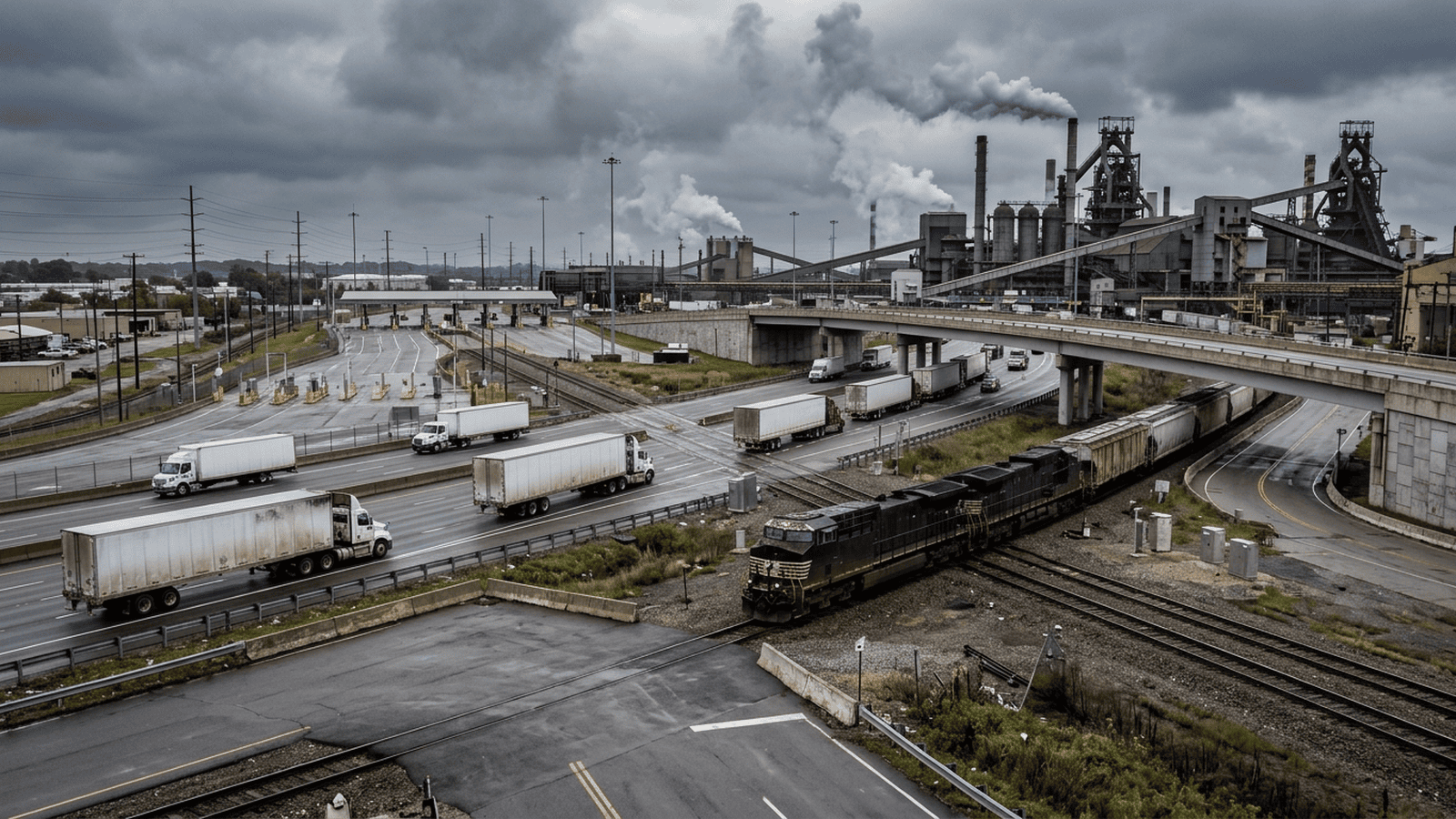
U.S. tariffs and Canadian retaliation have strained a trade relationship that leaders on both sides describe as changed. Mark Carney says the tariffs have raised costs for American families, while reported auto exports have fallen in both directions. Ontario and Ottawa announced a 6.2 billion dollar support package for steelmakers, automakers and critical-mineral development. Separately, the U.S. Embassy accused Canadian politicians of seeking to influence American elections, allegations Carney and Doug Ford rejected; the account does not establish a link between the cited voting cases and Canada’s government. Canada says it remains ready to negotiate, but no trade breakthrough was reported, and the embassy’s claims and Canadian denials remain unresolved.
TLDR: Tariffs, Canadian retaliation and a multibillion-dollar Ontario support plan mark a major shift in cross-border trade. The U.S. Embassy’s election allegations are disputed by Canadian leaders, and the account reports no resolution or new trade agreement.
The U.S.-Canada trade relationship is facing higher tariffs, new Canadian industry support and fresh accusations over political influence. Canadian Prime Minister Mark Carney said Wednesday that U.S. tariffs have raised costs for American families and put Ontario businesses at a disadvantage. The U.S. Embassy in Canada separately accused Canadian politicians of seeking to influence American politics ahead of next month’s midterm elections. Carney and Ontario Premier Doug Ford rejected suggestions of improper interference.
The stated U.S. trade-policy rationale is not provided in the available account. It says President Donald Trump has openly called for automakers to move production from Canada to the United States, and reports that the United States imposed tariffs after trade talks collapsed. The account does not include an administration explanation for the tariffs, so their official purpose is not available here.
Carney described the tariffs as a break with a trade arrangement that had lasted for decades. He said the duties raised costs for American families and increased uncertainty for Ontario workers and businesses. He also said an integrated North American auto industry could benefit both countries, while acknowledging that Washington may no longer treat that arrangement as a priority.
Carney said Canadian auto exports to the United States have fallen by more than 10%, while U.S. auto exports to Canada have dropped by more than 20%. He said tariffs weaken industries on both sides of the border and reduce choices for families. The account does not provide a dollar estimate for added costs faced by American households.
The dispute intensified after negotiations collapsed in August, when the two countries had appeared close to an agreement. The United States then imposed 50% tariffs on about $20 billion in Canadian goods, prompting Canadian retaliation. Carney said he spoke with Trump for “quite some time” about trade and other matters, but gave no indication that the conversation produced a breakthrough. Canada remains ready to negotiate, according to Carney.
Ontario and Ottawa have responded with a major support plan for the province’s manufacturing base. Carney and Ford announced an 8.7 billion Canadian dollar package, valued at $6.2 billion, for steelmakers, automakers and critical-mineral development. The plan includes 5.2 billion Canadian dollars, or $3.7 billion, over five years for steelmakers. It also includes 2.5 billion Canadian dollars, or $1.8 billion, for automakers, with 1.5 billion Canadian dollars, or $1.1 billion, coming from Ottawa.
The announcement comes as U.S.-owned steelmaker Cleveland-Cliffs has announced layoffs at its Hamilton, Ontario, plant. The report does not say how many workers are affected or provide a timetable. Together, the tariffs, retaliation, industry support and layoffs show how trade decisions can affect companies and workers across a closely linked border economy.
Carney has made reducing Canada’s dependence on the United States a priority. He set a goal of doubling Canadian exports to other markets over the next decade. Ford said the relationship between the countries has changed permanently and will not return to its former condition, regardless of the midterm result or who occupies the White House. The account does not describe a completed replacement trade agreement.
The election dispute adds another point of friction. The U.S. Embassy’s fact sheet singled out Industry Minister Mélanie Joly for discussing retaliatory tariffs aimed at Republican states and Ford for airing a U.S. advertisement featuring former President Ronald Reagan criticizing tariffs. Trump canceled trade talks with Canada after the advertisement aired during the World Series in October 2025. The embassy also cited 11 Canadians charged with illegally voting in U.S. elections between 2012 and 2026, without linking those cases to the Canadian government.
The scale of noncitizen voting is contested in the account. The Justice Department says it has arrested more than 200 people since the start of 2026 for illegally voting as noncitizens in past elections. Election experts and administrators describe the issue as comparatively small, given the tens of millions of regular voters. Daniel Béland, a political science professor at McGill University, said the embassy’s examples do not show genuine foreign interference and argued that Canada could not significantly change the midterm outcome. The account reports no finding that resolves the embassy’s accusation and the Canadian officials’ denials.
For households and businesses, the documented effects include tariffs on about $20 billion in Canadian goods, Canadian retaliation, reported declines in auto exports in both directions, higher costs alleged by Carney and uncertainty for Ontario industry. The account specifies no new U.S. paperwork requirements, consumer fees or tariff deadlines. The Canadian support package directs billions of dollars to steel and auto sectors, including five-year funding for steelmakers, but the account gives no application procedures or schedule for automaker funds.
The U.S. midterm elections are approaching, and trade negotiations have not produced a reported breakthrough. Canada says it remains willing to negotiate while its leaders pursue industry support and a longer-term export-diversification goal. The embassy’s election claims, the Canadian denials and the trade measures remain matters for public scrutiny; the account describes no specific oversight process or further deadline.

Miles Harrington serves as the Senior Correspondent for Federal Systems & Executive Power at Just Right News, where he brings a disciplined, constitutionalist lens to the inner workings of the American government. With a focus on the mechanics of the federal bureaucracy and the limits of executive authority, Harrington has established himself as a vital voice for readers who value transparency, accountability, and the preservation of the separation of powers.
A native of Richmond, Virginia, Harrington’s perspective is deeply rooted in the traditions of the Old Dominion. Growing up in a city defined by its historical significance and its role as a center of American jurisprudence, he developed an early appreciation for the foundational principles of the Republic. His upbringing in Richmond—a place where the legacy of the Founding Fathers is woven into the landscape—instilled in him a belief that the federal government should remain within its constitutional bounds. This background informs his skepticism of centralized overreach and his commitment to reporting on the ways in which the administrative state impacts the lives of everyday citizens.
In his current role, Harrington specializes in the complexities of federal systems. He doesn’t just report on the headlines of the day; he digs into the structural shifts within the executive branch that often go unnoticed by the mainstream press. Whether he is analyzing the implications of a new federal regulation or investigating the expansion of agency jurisdiction, his work is characterized by a rigorous adherence to the facts and a dedication to the rule of law.
Harrington is perhaps best known for his signature feature series, “How Washington Works.” Through this ongoing project, he demystifies the often-opaque processes of the nation’s capital, pulling back the curtain on the “Deep State” and the unelected officials who wield significant influence over national policy. By breaking down complex legislative maneuvers and executive orders, he empowers Just Right News readers to understand the true levers of power in Washington. His reporting serves as a necessary check on the federal government, ensuring that the actions of those in power are held up to the light of public scrutiny.
Now based in Washington, D.C., Harrington operates at the epicenter of the political world, yet he remains intentionally distanced from the “Beltway bubble.” His proximity to the halls of power allows him to maintain a robust network of sources across the federal landscape, but his heart remains in the principled conservatism of his Virginia roots. He views his role not merely as a reporter, but as a steward of the public trust, dedicated to providing the clarity and context that conservative voters need to navigate an increasingly complex political environment.
Through his sharp analysis and unwavering commitment to the truth, Miles Harrington continues to be a cornerstone of the Just Right News team. His work ensures that the principles of limited government and executive restraint remain at the forefront of the national conversation, providing a crucial service to those who believe in a government that is truly of, by, and for the people.