

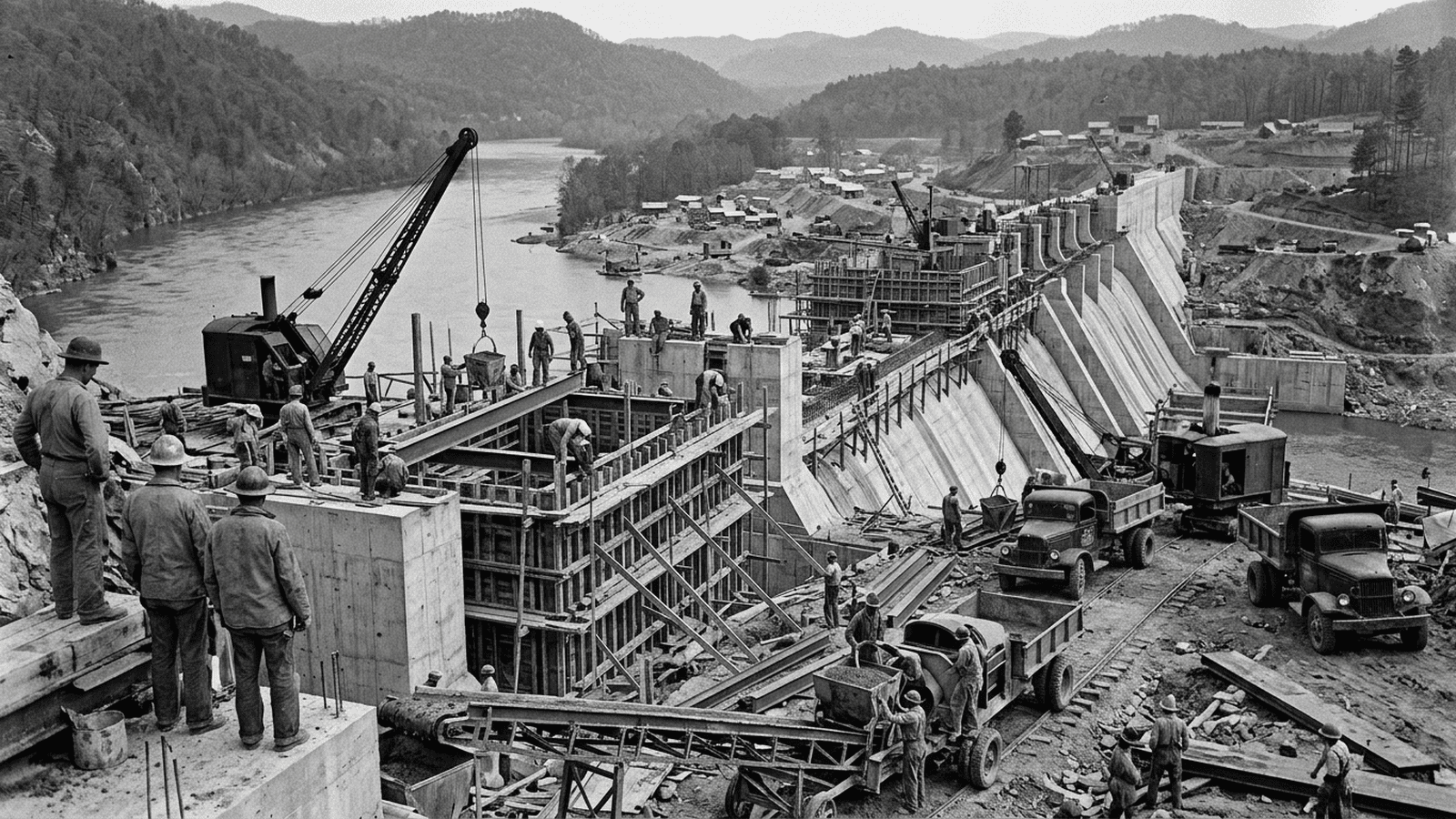
The 1933 Tennessee Valley Authority Act created a federally owned corporation to coordinate electricity generation, flood control, navigation, and regional development across the Tennessee River basin. In the United States, the TVA became a major New Deal experiment in delegated executive power, with its broad mission tested by legal challenges and ongoing congressional oversight.
TLDR: Signed by Franklin D. Roosevelt in 1933, the Tennessee Valley Authority Act created a federally owned corporation to develop the Tennessee River basin. Its work combined public electricity, flood control, navigation, and agricultural programs, while raising enduring questions about delegated executive authority, public power, displacement, and government oversight.
On May 18, 1933, President Franklin D. Roosevelt signed the Tennessee Valley Authority Act, creating an unusual federal agency to plan, build, and operate projects across a large, economically distressed region. The law joined public electricity generation with flood control, navigation, fertilizer research, and regional development. It became one of the New Deal’s consequential experiments in executive administration—and a lasting argument over federal power.
The Tennessee River basin crossed seven states: Tennessee, Alabama, Mississippi, Kentucky, Georgia, North Carolina, and Virginia. Much of the region faced severe poverty, soil erosion, recurrent flooding, and limited access to electricity. Private utilities supplied power unevenly, while the federal government already operated Wilson Dam, built during World War I to support munitions production. Roosevelt and congressional allies saw the dam and basin as a starting point for coordinated public development.
The act established the TVA as a federally owned corporation governed by a three-member board appointed by the president and confirmed by the Senate. Its broad mandate allowed it to generate and sell electricity, improve navigation, control floods, and promote agricultural and industrial development. Instead of creating a conventional cabinet department, Congress gave the authority corporate tools and regional responsibilities. This structure concentrated discretion in appointed administrators while keeping the agency subject to federal law and congressional oversight.
Roosevelt selected Arthur E. Morgan, Harcourt A. Morgan, and David E. Lilienthal as the first board members. Their differing views reflected competing ideas: Arthur Morgan emphasized regional planning and community development, while Lilienthal advocated publicly owned power. The board inherited Wilson Dam and pursued a system of dams and power plants. Those projects required decisions about land, construction priorities, electricity rates, and relations with private utilities.
The authority changed the landscape and the region’s economy. Dams helped regulate floods and improve navigation, while hydroelectric generation expanded the power supply. TVA programs promoted fertilizer use and soil conservation, and construction created Depression-era jobs. The agency also acquired land for reservoirs, displacing families and communities. Development brought new services and opportunities, but carried real costs for people whose homes and farms lay in project areas.
The TVA’s legal and political position drew sharp debate. Private power companies challenged the federal government’s authority to compete in electricity markets, arguing the agency exceeded constitutional limits. Supporters answered that Congress could use its powers over commerce, federal property, and national development to address the basin’s connected problems. The disputes led courts and lawmakers to consider whether a public corporation could combine commercial activity with broad public purposes. The authority’s survival depended on legislation, judicial review, and continued political support—not executive action alone.
Roosevelt’s role was central, but the TVA was not simply an order imposed by the White House. Congress created it by statute, set its mission, and established a process for appointing its leadership. Presidential appointments and board decisions gave the executive branch considerable influence over implementation. The agency showed how a federal administration could turn a broad congressional mandate into a regional program, while raising questions about delegated authority’s limits.
The TVA became a model for debates over public power, regional planning, and federal agencies. Its work expanded during World War II, when electricity supported wartime production, and it continued beyond the New Deal. Congressional appropriations, Senate confirmation, court decisions, and public scrutiny shaped its reach. The 1933 law left a durable institutional legacy: it demonstrated the scale of federal action possible through a public corporation, while keeping its authority contested and subject to oversight.

Miles Harrington serves as the Senior Correspondent for Federal Systems & Executive Power at Just Right News, where he brings a disciplined, constitutionalist lens to the inner workings of the American government. With a focus on the mechanics of the federal bureaucracy and the limits of executive authority, Harrington has established himself as a vital voice for readers who value transparency, accountability, and the preservation of the separation of powers.
A native of Richmond, Virginia, Harrington’s perspective is deeply rooted in the traditions of the Old Dominion. Growing up in a city defined by its historical significance and its role as a center of American jurisprudence, he developed an early appreciation for the foundational principles of the Republic. His upbringing in Richmond—a place where the legacy of the Founding Fathers is woven into the landscape—instilled in him a belief that the federal government should remain within its constitutional bounds. This background informs his skepticism of centralized overreach and his commitment to reporting on the ways in which the administrative state impacts the lives of everyday citizens.
In his current role, Harrington specializes in the complexities of federal systems. He doesn’t just report on the headlines of the day; he digs into the structural shifts within the executive branch that often go unnoticed by the mainstream press. Whether he is analyzing the implications of a new federal regulation or investigating the expansion of agency jurisdiction, his work is characterized by a rigorous adherence to the facts and a dedication to the rule of law.
Harrington is perhaps best known for his signature feature series, “How Washington Works.” Through this ongoing project, he demystifies the often-opaque processes of the nation’s capital, pulling back the curtain on the “Deep State” and the unelected officials who wield significant influence over national policy. By breaking down complex legislative maneuvers and executive orders, he empowers Just Right News readers to understand the true levers of power in Washington. His reporting serves as a necessary check on the federal government, ensuring that the actions of those in power are held up to the light of public scrutiny.
Now based in Washington, D.C., Harrington operates at the epicenter of the political world, yet he remains intentionally distanced from the “Beltway bubble.” His proximity to the halls of power allows him to maintain a robust network of sources across the federal landscape, but his heart remains in the principled conservatism of his Virginia roots. He views his role not merely as a reporter, but as a steward of the public trust, dedicated to providing the clarity and context that conservative voters need to navigate an increasingly complex political environment.
Through his sharp analysis and unwavering commitment to the truth, Miles Harrington continues to be a cornerstone of the Just Right News team. His work ensures that the principles of limited government and executive restraint remain at the forefront of the national conversation, providing a crucial service to those who believe in a government that is truly of, by, and for the people.