

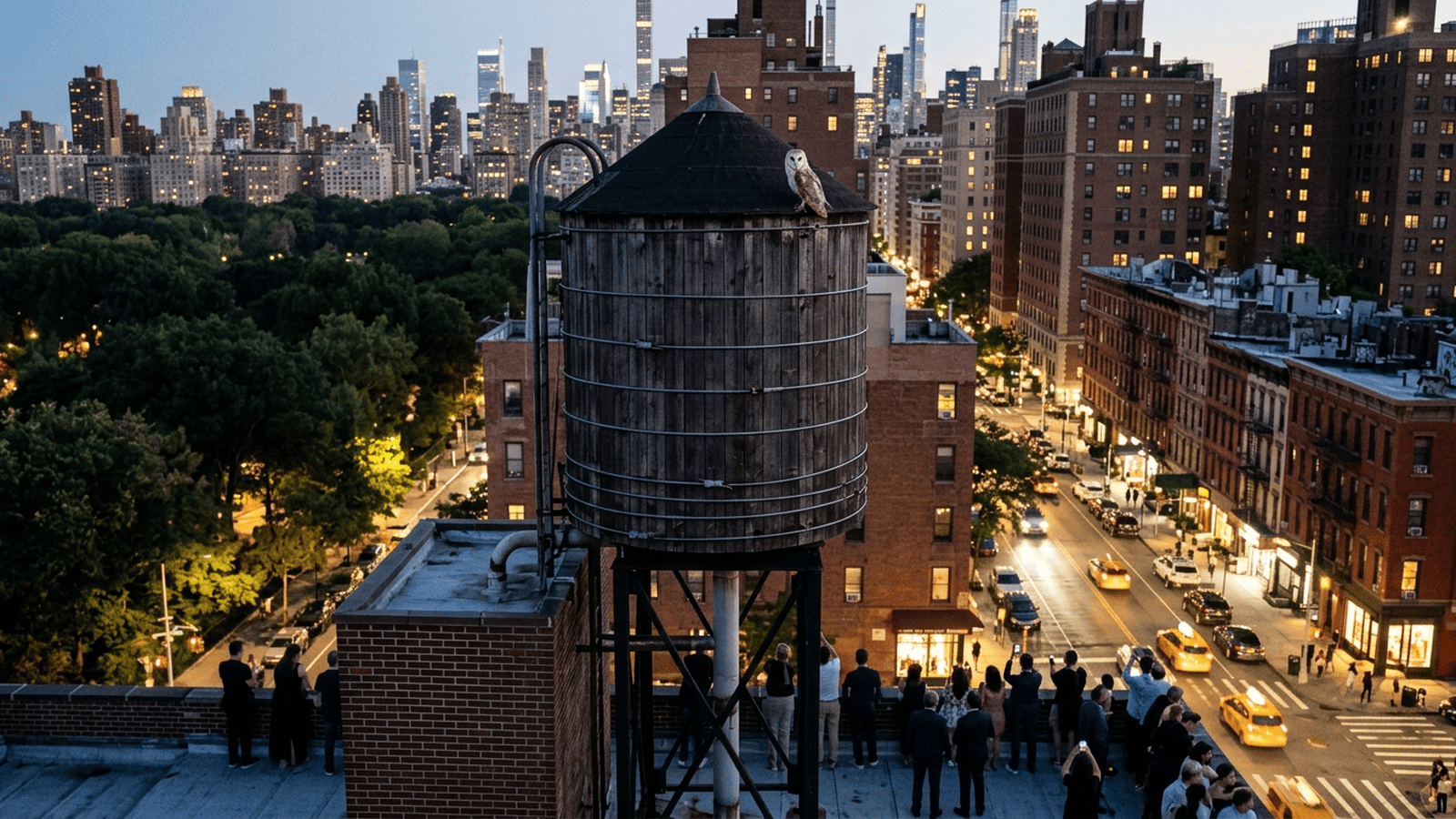
A barn owl family has nested in a water tower on Manhattan’s Upper West Side, near Central Park, in what one expert describes as the first documented Manhattan nest in modern history. The birds have drawn nightly crowds of birders, photographers, and neighborhood residents. Observers report at least one adult and five fledglings, while some photographers say they have seen six young owls. City and state agencies describe barn owl sightings in New York as rare and note a long-term population decline. The account reports no new government policy, fees, forms, enforcement requirements, deadlines, or official management plan; those details are not established in the available reporting.
TLDR: A rare barn owl family nesting near Central Park has brought nightly crowds to Manhattan’s Upper West Side. The sighting is notable against reports of declining barn owl numbers, but no government policy or formal management plan is described.
A family of barn owls has nested in a water tower on Manhattan’s Upper West Side, drawing nightly crowds of photographers and curious residents. The nest, on a building near Central Park, is the first documented barn owl nesting in Manhattan in modern history, according to Andrew Farnsworth, a migration ecologist at the Cornell Lab of Ornithology.
There is no government policy change or official policy rationale described in the available account. The reported story is about a rare wildlife sighting, the public interest it has generated, and the conservation context provided by state and city agencies.
Elisabeth Williams, who lives in the neighborhood, brought the family to wider attention after notifying a local news outlet on October 6. She and her husband had seen several owls at the water tower on West 75th Street, close to Central Park West. A few days earlier, they had seen a single owl on an apartment windowsill.
Williams said that encountering wildlife in Manhattan usually takes effort, making the birds’ appearance outside her window especially striking. She and her husband were not bird watchers before the owls arrived. The experience may change that, she said.
The reports have brought birders and people with no prior interest in birding to the street. Photographers and casual onlookers have gathered there nightly in hopes of seeing the birds. Jessica Wilson, executive director of NYC Bird Alliance, said the owls have attracted attention from both groups because they are nocturnal, secretive, and rarely seen in that part of the city.
David Barrett, a Manhattan birder who runs the social media account Manhattan Bird Alert, said he has observed at least one adult owl and five fledglings at the water tower. He has also seen an adult carrying rodents back to the nest. Two adults are believed to be present, while some photographers have reported seeing six fledglings. The number of young birds has not been confirmed in the account.
Barrett said a single barn owl would be unusual, but a family breeding in Manhattan is exceptional. The city Department of Parks & Recreation says barn owl sightings in New York City parks are very rare. New York lies at the northern edge of the species’ range, and the state Department of Environmental Conservation says the barn owl population has declined at an alarming rate over time.
The unusual visitors have also made their presence known by sound. Williams and her husband heard periodic screeching from early September. Thomas Obersteiner said he heard wailing noises beginning in mid-September, sometimes nightly for two or three weeks. He and his wife occasionally mistook the calls for a child in distress and ran to check on their children.
Farnsworth said the screech is typical of barn owls and is used for communication. The sound had initially confused residents, including people whose phone app identified it as a barn owl. Obersteiner said he understood what was making the noise only after seeing a news report.
Obersteiner has allowed nature photographers onto his roof deck to watch the birds almost every night since the story spread. On one night last week, about 20 people had gathered there. The arrangement offers observers a place to watch, but the account does not describe any formal access rules or organized viewing program.
The owls join a short list of birds that have become familiar subjects of public attention in New York. American woodcocks stop at Bryant Park during their northward migration in early spring. Pale Male, a red-tailed hawk, nested above Fifth Avenue for three decades before dying in 2023. Flaco, a Eurasian eagle-owl who flew around Manhattan after being let out of a zoo enclosure, died in 2024; dozens of fans gathered afterward to mourn him.
The practical impacts described are limited to nightly crowds, photographers’ access to Obersteiner’s roof deck, and residents hearing the owls’ calls. No fees, forms, enforcement rules, deadlines, or official compliance requirements are reported. A possible risk raised by one observer is that the owls could eat rodents poisoned with rodenticide; the account does not establish whether that has happened.
No government management plan, official monitoring schedule, or next deadline is described. The city and state agencies provide context on the rarity and population decline, while birders and residents report observations. Further official oversight or action is not specified in the available account, so no expert assurance that the situation is being managed can be claimed.

Miles Harrington serves as the Senior Correspondent for Federal Systems & Executive Power at Just Right News, where he brings a disciplined, constitutionalist lens to the inner workings of the American government. With a focus on the mechanics of the federal bureaucracy and the limits of executive authority, Harrington has established himself as a vital voice for readers who value transparency, accountability, and the preservation of the separation of powers.
A native of Richmond, Virginia, Harrington’s perspective is deeply rooted in the traditions of the Old Dominion. Growing up in a city defined by its historical significance and its role as a center of American jurisprudence, he developed an early appreciation for the foundational principles of the Republic. His upbringing in Richmond—a place where the legacy of the Founding Fathers is woven into the landscape—instilled in him a belief that the federal government should remain within its constitutional bounds. This background informs his skepticism of centralized overreach and his commitment to reporting on the ways in which the administrative state impacts the lives of everyday citizens.
In his current role, Harrington specializes in the complexities of federal systems. He doesn’t just report on the headlines of the day; he digs into the structural shifts within the executive branch that often go unnoticed by the mainstream press. Whether he is analyzing the implications of a new federal regulation or investigating the expansion of agency jurisdiction, his work is characterized by a rigorous adherence to the facts and a dedication to the rule of law.
Harrington is perhaps best known for his signature feature series, “How Washington Works.” Through this ongoing project, he demystifies the often-opaque processes of the nation’s capital, pulling back the curtain on the “Deep State” and the unelected officials who wield significant influence over national policy. By breaking down complex legislative maneuvers and executive orders, he empowers Just Right News readers to understand the true levers of power in Washington. His reporting serves as a necessary check on the federal government, ensuring that the actions of those in power are held up to the light of public scrutiny.
Now based in Washington, D.C., Harrington operates at the epicenter of the political world, yet he remains intentionally distanced from the “Beltway bubble.” His proximity to the halls of power allows him to maintain a robust network of sources across the federal landscape, but his heart remains in the principled conservatism of his Virginia roots. He views his role not merely as a reporter, but as a steward of the public trust, dedicated to providing the clarity and context that conservative voters need to navigate an increasingly complex political environment.
Through his sharp analysis and unwavering commitment to the truth, Miles Harrington continues to be a cornerstone of the Just Right News team. His work ensures that the principles of limited government and executive restraint remain at the forefront of the national conversation, providing a crucial service to those who believe in a government that is truly of, by, and for the people.