

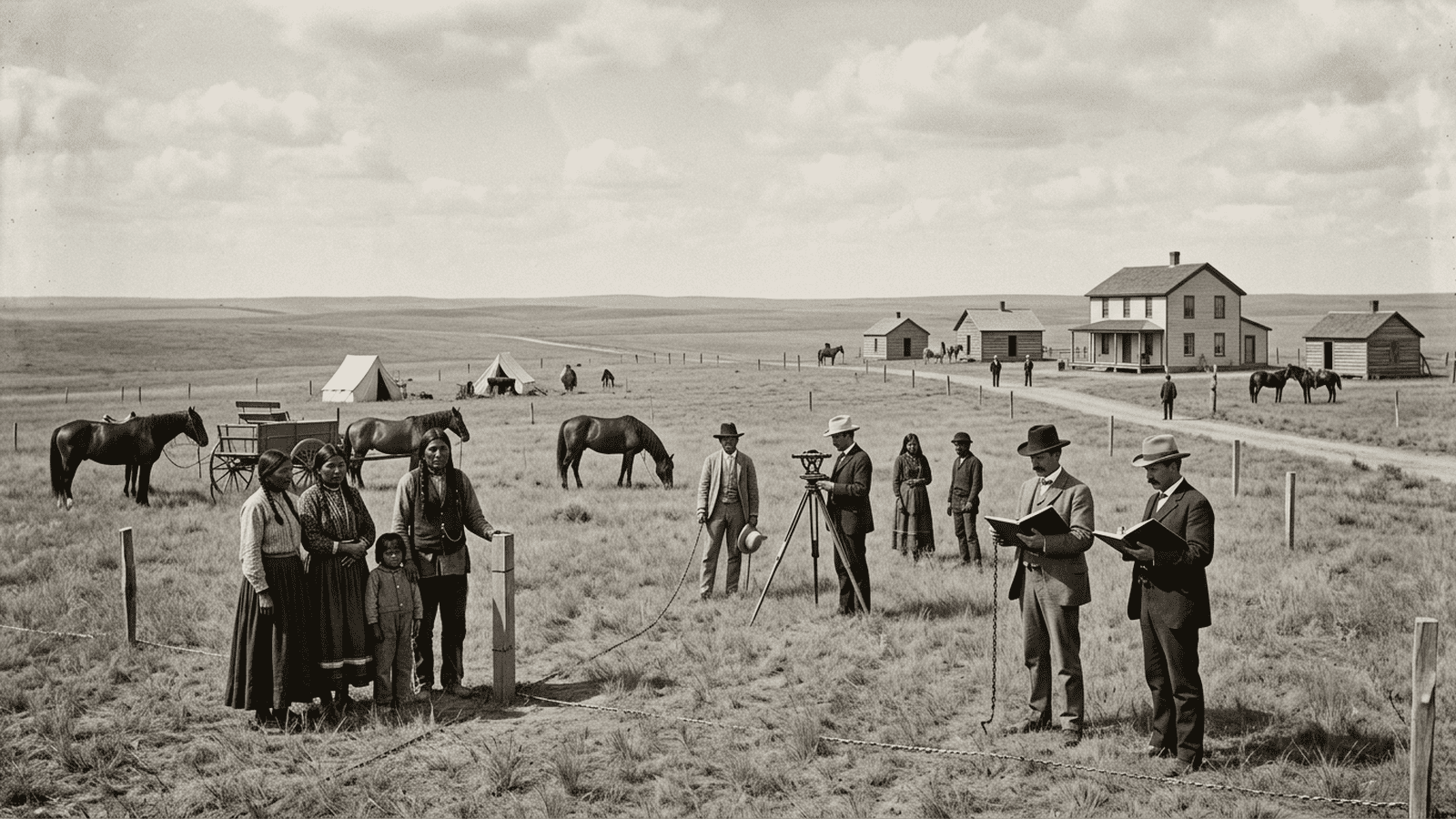
The 1887 Dawes Act authorized federal officials to divide tribal lands into individual allotments, linking property policy to assimilation and conditional citizenship. In the United States, allotment also enabled the transfer of so-called surplus land to settlers, with lasting consequences for Native sovereignty and landownership.
TLDR: Signed in 1887, the Dawes Act authorized allotments of tribal land to individuals and enabled remaining acreage to be opened to non-Native settlement. Promoted as assimilation, the policy weakened Native land bases and political authority. The 1934 Indian Reorganization Act ended general allotment, but its consequences endured.
On February 8, 1887, President Grover Cleveland signed the General Allotment Act, commonly called the Dawes Act. It authorized the federal government to divide communally held tribal lands into individual parcels. Supporters presented allotment as a route to farming, private property, and citizenship. For Native nations across the Great Plains, the law instead brought a sweeping federal effort to reshape land, political authority, and community life.
The act followed decades of pressure to open Indigenous land to non-Native settlement. Reformers, missionaries, and officials argued that communal landholding obstructed assimilation. Western lawmakers and settlers also sought access to land they considered “surplus.” Senator Henry L. Dawes of Massachusetts sponsored the legislation, which Congress passed as federal policy shifted from treaty-making toward tighter administrative control of Native affairs.
Under the law, the president could direct the division of reservation land. A household head could receive 160 acres; single adults and orphaned children generally received 80, while other children could receive 40. Parcels were assigned to individuals, but the federal government held allotted land in trust, ordinarily for 25 years. During that period, owners generally could not sell or transfer it without federal approval.
The act linked allotment to citizenship, but not through a simple, immediate grant to every Native person. People who received allotments and adopted what the law called “civilized life” could become citizens, as could those whose land later received a patent in fee. These conditions made federal officials arbiters of both property and belonging. Citizenship did not erase tribal identity or guarantee equal treatment under state and local law.
The Dawes Act did not initially apply to all Native nations. The Five Tribes in Indian Territory—Cherokee, Chickasaw, Choctaw, Creek, and Seminole—were initially excluded, as were some other communities covered by treaties or specific agreements. Later laws extended allotment to them. The 1898 Curtis Act, for example, imposed major changes on the Five Tribes and helped dismantle their governments and communal land systems.
Implementation depended on surveys, enrollment lists, and federal agents deciding who qualified and which parcels individuals would receive. These processes often disregarded Native systems of governance and land use. Families could find relatives assigned separate parcels, while grazing, hunting, and shared resource practices became harder to sustain. Allotment varied across nations and reservations, but the underlying authority rested with federal officials rather than Native communities.
The policy also created a mechanism for transferring land. After allotments were made, the government could classify remaining reservation acreage as “surplus” and open it to non-Native settlement, often through sale or land runs. The act itself authorized these openings when negotiated agreements or later federal action permitted them. On the Great Plains, that process accelerated settlement and reduced the land base available to Native nations.
The human consequences were profound. Land was not merely an economic asset: it supported political independence, kinship, and cultural practice. Allotment divided territory into individual holdings and facilitated the loss of millions of acres through surplus disposals, fraud, taxation, and sales after trust restrictions ended. By the early twentieth century, many Native landowners faced fragmented holdings, inadequate access to resources, or pressure to sell.
Federal policy eventually changed direction, though not quickly enough to restore what had been lost. The 1934 Indian Reorganization Act ended further general allotment and authorized some land restoration and tribal self-government, while allowing tribes to reject parts of the law. The Dawes Act’s legacy remained visible in divided land ownership and weakened territorial control. Its history continues to inform debates over Native sovereignty, federal oversight, and the meaning of citizenship in the United States.

Miles Harrington serves as the Senior Correspondent for Federal Systems & Executive Power at Just Right News, where he brings a disciplined, constitutionalist lens to the inner workings of the American government. With a focus on the mechanics of the federal bureaucracy and the limits of executive authority, Harrington has established himself as a vital voice for readers who value transparency, accountability, and the preservation of the separation of powers.
A native of Richmond, Virginia, Harrington’s perspective is deeply rooted in the traditions of the Old Dominion. Growing up in a city defined by its historical significance and its role as a center of American jurisprudence, he developed an early appreciation for the foundational principles of the Republic. His upbringing in Richmond—a place where the legacy of the Founding Fathers is woven into the landscape—instilled in him a belief that the federal government should remain within its constitutional bounds. This background informs his skepticism of centralized overreach and his commitment to reporting on the ways in which the administrative state impacts the lives of everyday citizens.
In his current role, Harrington specializes in the complexities of federal systems. He doesn’t just report on the headlines of the day; he digs into the structural shifts within the executive branch that often go unnoticed by the mainstream press. Whether he is analyzing the implications of a new federal regulation or investigating the expansion of agency jurisdiction, his work is characterized by a rigorous adherence to the facts and a dedication to the rule of law.
Harrington is perhaps best known for his signature feature series, “How Washington Works.” Through this ongoing project, he demystifies the often-opaque processes of the nation’s capital, pulling back the curtain on the “Deep State” and the unelected officials who wield significant influence over national policy. By breaking down complex legislative maneuvers and executive orders, he empowers Just Right News readers to understand the true levers of power in Washington. His reporting serves as a necessary check on the federal government, ensuring that the actions of those in power are held up to the light of public scrutiny.
Now based in Washington, D.C., Harrington operates at the epicenter of the political world, yet he remains intentionally distanced from the “Beltway bubble.” His proximity to the halls of power allows him to maintain a robust network of sources across the federal landscape, but his heart remains in the principled conservatism of his Virginia roots. He views his role not merely as a reporter, but as a steward of the public trust, dedicated to providing the clarity and context that conservative voters need to navigate an increasingly complex political environment.
Through his sharp analysis and unwavering commitment to the truth, Miles Harrington continues to be a cornerstone of the Just Right News team. His work ensures that the principles of limited government and executive restraint remain at the forefront of the national conversation, providing a crucial service to those who believe in a government that is truly of, by, and for the people.