

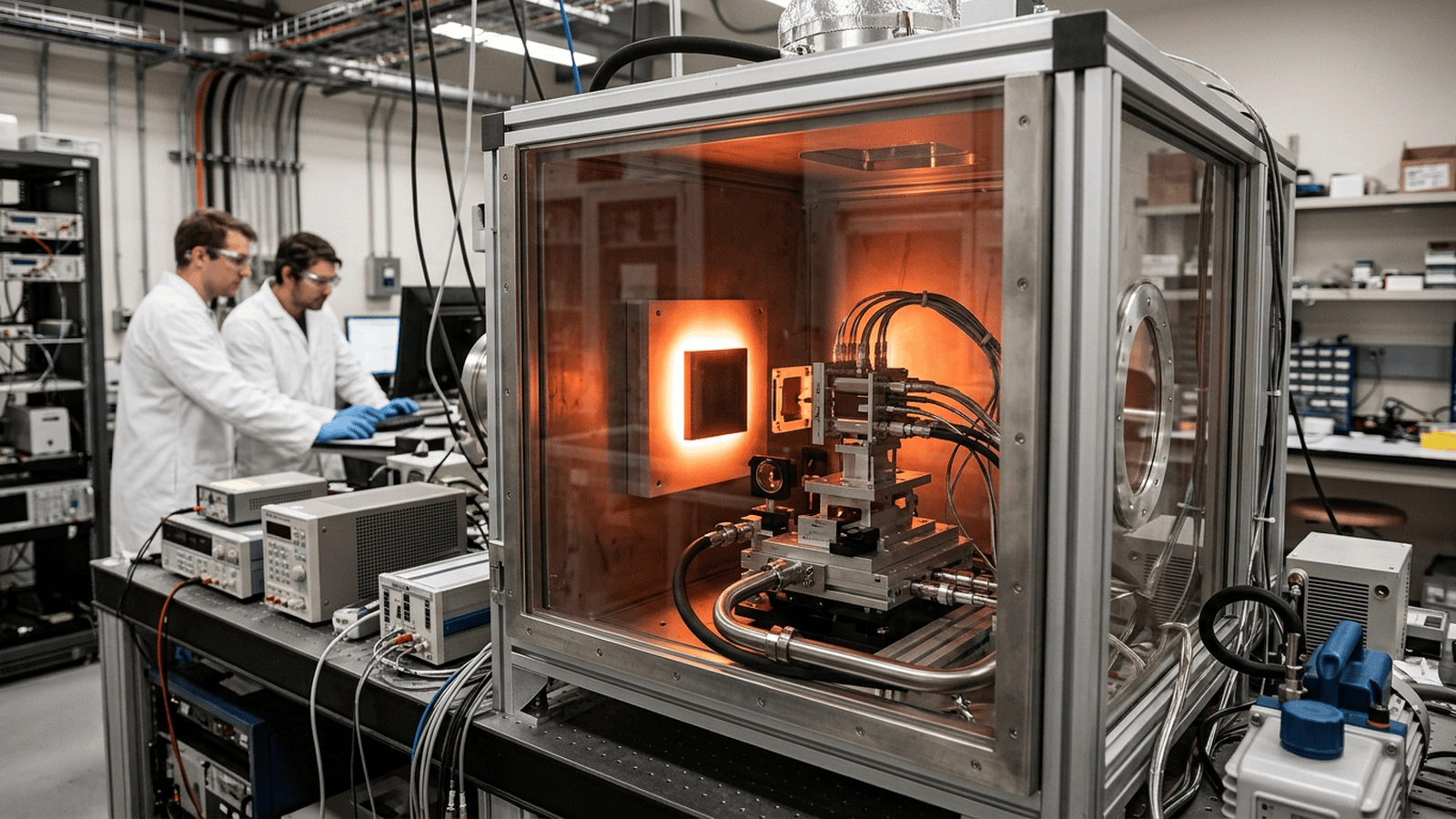
Researchers from MIT, NREL and the University of Rochester demonstrated a thermophotovoltaic cell that converts heat to electricity at more than 40 percent efficiency. The result could support thermal batteries that store surplus renewable electricity as heat, though complete systems still need testing for durability, cost and real-world performance.
TLDR: A U.S. research team demonstrated a thermophotovoltaic cell that converted heat into electricity at more than 40 percent efficiency. The device could help thermal batteries return stored heat to the grid, but larger systems must prove durable and affordable before the technology can compete with existing storage options.
A U.S. research team demonstrated a thermophotovoltaic cell that converts heat into electricity with more than 40 percent efficiency. Reported in Nature in 2022, the result showed that a technology once associated mainly with space power systems could also help store energy for the electric grid.
Thermophotovoltaic, or TPV, cells work somewhat like solar cells, but absorb light emitted by a hot object rather than sunlight. In the demonstration, a high-temperature emitter radiated energy toward the cell. The cell converted some radiation into electrical power, while a reflective layer sent unused light back toward the emitter for reabsorption.
The research team included scientists from the Massachusetts Institute of Technology, the National Renewable Energy Laboratory and the University of Rochester. Their device exceeded 40 percent efficiency with an emitter heated to about 2,400 degrees Celsius. That surpassed earlier TPV demonstrations and approached conventional steam-based power plants, which use heat to drive a turbine. The efficiency set a record for TPV conversion at the time.
The design relies on carefully chosen semiconductor materials and optical layers. The semiconductor absorbs photons with energies above a threshold. Lower-energy photons would ordinarily become wasted heat, but the reflective layer returns much of this radiation to the hot emitter. That recycling preserves energy and reduces heat loss.
The high operating temperature is central to the approach. It allows the emitter to produce radiation the cell can convert efficiently, but creates demanding engineering conditions. Components must withstand intense heat over repeated cycles, and a practical system must maintain a stable temperature while safely containing hot materials.
One proposed application is a thermal battery. Such a system could use excess electricity from wind or solar farms to heat an inexpensive storage material, such as graphite. When electricity is needed, the stored heat would warm an emitter, and TPV cells would convert some resulting radiation back into electrical power. Unlike batteries that store electricity through chemical reactions, this method stores energy as heat.
Thermal storage could help address a familiar challenge for renewable power: supply does not always match demand. Wind and solar output can rise when electricity use is low and fall when demand peaks. A heat-storage plant could, in principle, hold energy for hours or longer and dispatch electricity when needed. The cell breakthrough does not itself establish that such a plant will be economical, but improves a key part of the conversion process.
The researchers also demonstrated that their cell could produce useful power at high temperatures, rather than only displaying promising efficiency under limited laboratory conditions. Still, the experiment was a component-level achievement. It did not test a complete grid-scale installation, and did not resolve questions about the lifetime, cost or performance of all system components during long operation.
TPV technology has a long history, including use in concepts for converting heat from radioactive sources into power in space. Grid storage changes design priorities: systems would need to be large, durable and maintainable, with materials and manufacturing costs low enough to compete with other storage options. Researchers will need to assess how cells perform through many heating and cooling cycles and how well reflective layers retain their properties.
The result offers a route for turning stored high-temperature heat into electricity without moving parts such as turbines. Further work will test larger devices, improve the durability of materials and integrate cells with complete thermal-storage systems. Whether the approach becomes a practical grid resource will depend on those engineering advances and on comparisons with the cost and performance of other long-duration storage technologies.

Mark Davis serves as the Senior Correspondent for Energy, Climate, and Resource Economics at Just Right News. In an era where the conversation around the environment is often dominated by alarmism and top-down mandates, Mark provides a vital, market-oriented perspective on the complex forces shaping our world. As the lead voice behind the acclaimed feature series “Power and the Planet,” he explores the intersection of environmental policy, global energy markets, and the fundamental economic principles that sustain modern civilization.
Mark’s pragmatic approach to resource management was forged in the high desert of his hometown, Albuquerque, New Mexico. Growing up in a region defined by both its breathtaking natural beauty and its rugged, resource-dependent landscape, he developed an early appreciation for the delicate balance between conservation and utilization. New Mexico’s unique position as a hub for both traditional energy production and cutting-edge scientific research provided Mark with a front-row seat to the evolution of the American energy sector. This upbringing instilled in him a deep-seated belief that true environmental stewardship is inseparable from economic prosperity and technological innovation.
Now based in Boulder, Colorado, Mark operates from the heart of the nation’s climate research community. While Boulder is often seen as a bastion of environmental idealism, Mark utilizes his post to provide a necessary counterweight, grounded in the realities of resource economics. He understands that energy policy does not exist in a vacuum; it has tangible consequences for the American taxpayer, the stability of the national power grid, and the strength of the domestic manufacturing sector. By reporting from the front lines of the climate debate, he is able to challenge prevailing narratives with hard data and a commitment to the principles of the free market.
Throughout his tenure at Just Right News, Mark has distinguished himself by focusing on the “Resource Economics” aspect of his beat. He frequently highlights the hidden costs of rapid energy transitions and advocates for an “all-of-the-above” energy strategy that prioritizes American energy independence. His work often shines a light on the geopolitical implications of resource scarcity, arguing that a secure nation must first be an energy-secure nation. Whether he is analyzing the impact of federal land-use regulations or investigating the supply chains required for new technologies, Mark remains focused on how policy decisions affect the lives and livelihoods of everyday citizens.
In “Power and the Planet,” Mark continues to bridge the gap between complex scientific concepts and the economic realities facing the country. He rejects the false choice between a healthy environment and a thriving economy, instead seeking out solutions that leverage American ingenuity and private-sector competition. For Mark, reporting on the climate is not about following the latest trends, but about ensuring that the conversation remains tethered to the foundational values of liberty, property rights, and fiscal responsibility. His contributions ensure that Just Right News readers receive a comprehensive, clear-eyed view of the challenges and opportunities defining the future of our planet.