

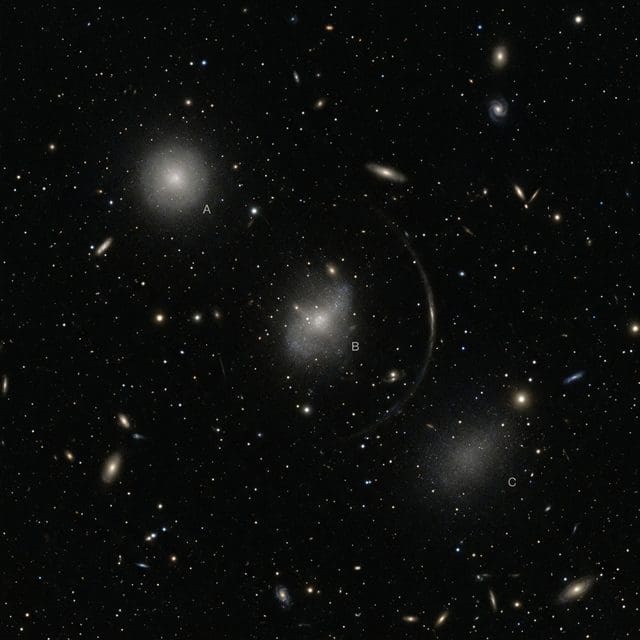
Three faint galaxies appear to contain far less dark matter than expected, offering a striking test of competing theories as researchers explore quantum computers for particle-physics calculations.
Three faint galaxies that seem to be missing most of their dark matter are giving physicists a rare way to test competing ideas about what holds the universe together—and whether gravity behaves as expected on cosmic scales.
The galaxies, DF2, DF4 and DF9, lie about 65 million light-years away. In an October 14 report for Quanta Magazine, Robin George Andrews describes them as diffuse systems with little apparent dark matter. The finding does not resolve the puzzle, but the three galaxies together make it harder to dismiss as an oddity in a single system.
Dark matter is the unseen material astronomers infer from its gravitational effects. In the standard picture, it outweighs ordinary matter in galaxies and helps provide the gravitational scaffolding around which stars and gas gather. Researchers estimate its presence by observing how matter moves and how gravity shapes its surroundings.
DF9, announced in 2026, has roughly the mass of 100 million Suns, according to the report. If it contained the dark matter expected under conventional models, it would be about 100 times more massive. DF2 had previously been estimated to contain up to 400 times less dark matter than expected. The contrast raises a basic question: are these galaxies truly short of dark matter, or are the measurements or assumptions incomplete?
One proposed explanation is an ancient collision that separated ordinary matter from dark matter. If so, the galaxies could be remnants of a violent cosmic event, rather than evidence that dark matter is absent from the universe. The finding could also challenge modified-gravity theories such as MOND, which seek to explain galactic motion by changing how gravity works instead of invoking dark matter. The observations, however, do not settle the debate.
The galaxies’ importance lies in offering physicists natural laboratories where competing predictions can be compared with observations. The report does not provide a definitive account of their origin; further scrutiny of their properties and possible histories will be needed to determine which explanation fits best.
A separate effort announced by Florida State University on October 13 points to a possible tool for particle physics. The project, “Seeking Quantum Advantage in High-Energy QCD,” will apply quantum computing to predictions for collider experiments, including those at CERN’s Large Hadron Collider. It will also search for rare phenomena that might lie beyond the Standard Model, the framework describing known elementary particles and three fundamental forces.
Quantum chromodynamics, or QCD, describes how quarks and gluons interact. Calculations in the theory help researchers interpret collider data, but some problems are difficult for conventional computers. Florida State says researchers Laura Reina, Fernando Febres Cordero and Herschel Chawdhry will lead the project. The university says the work contributes to the Quantum Genesis Initiative within the Genesis Mission, which aims to deliver scientifically relevant quantum computing by 2028. That is a goal, not a guarantee that quantum machines will soon outperform conventional computers on these tasks.
Another quantum-computing result, reported by ScienceDaily on October 13, demonstrated a simulation of the Aharonov–Bohm effect. Oxford researchers used a hybrid machine combining trapped-ion qubits and quantum oscillators. In the simulation, magnetic flux caused destructive interference that completely suppressed a particle’s tunneling motion. The experiment did not discover a new particle or force; it showed that quantum hardware can reproduce a subtle effect in which magnetic flux changes particle behavior through interference.
These are distinct developments, not parts of a single breakthrough. The galaxies raise questions about the universe’s invisible mass, while quantum-computing projects test whether new machines can help solve difficult calculations. This week’s available reporting offers no additional major finding in condensed matter physics. For the galaxy puzzle, the next test is whether the proposed collision and other explanations withstand closer examination; for quantum computing, the measure will be whether the systems can produce reliable, useful predictions for real physics problems.

Mason Reed serves as a Staff Writer for Just Right News, where he spearheads the Future Frontiers & Special Projects desk. In an era defined by rapid technological shifts and evolving social landscapes, Mason provides a steady, principled voice, examining the innovations of tomorrow through the lens of traditional American values. His work is most prominently featured in his signature series, “The Next Horizon,” where he explores the intersection of emerging technology, national sovereignty, and the preservation of individual liberty.
A native of San Diego, California, Mason’s worldview was shaped by the unique culture of his hometown. Growing up in a region defined by its strong military presence and its history of maritime industry, he developed a deep-seated respect for the institutions that provide national stability and the entrepreneurial spirit that drives the American economy. This upbringing instilled in him a belief that true progress is not found in discarding the past, but in building upon a foundation of proven principles. His reporting often reflects this San Diego influence, emphasizing the importance of a robust national defense and the necessity of maintaining a competitive edge in the global marketplace.
Now based in San Francisco, Mason operates from the heart of the world’s technological engine. Living and working in the Bay Area provides him with a front-row seat to the advancements—and the ideological challenges—emanating from Silicon Valley. While many in the region embrace a “move fast and break things” mentality, Mason’s reporting serves as a vital counterweight. He offers Just Right News readers a “boots on the ground” perspective, documenting how radical local policies and the concentration of tech power impact the everyday lives of citizens. His proximity to the industry allows him to cut through the marketing jargon of big tech to uncover the real-world implications for privacy, free speech, and the nuclear family.
In his “Future Frontiers” beat, Mason tackles complex subjects ranging from the ethics of artificial intelligence to the burgeoning private space race. He approaches these topics with a healthy skepticism toward centralized bureaucracy, championing instead the decentralized innovations that empower individuals. Through “The Next Horizon,” he highlights the pioneers and thinkers who are working to ensure that the future remains a place where human dignity and constitutional rights are protected. He believes that the rapid pace of change requires more than just technical expertise; it requires a moral compass rooted in the Western tradition.
Throughout his tenure at Just Right News, Mason has remained committed to the idea that the future is something to be shaped, not merely accepted. His writing is characterized by a rigorous defense of American exceptionalism and a belief that the country’s best days lie ahead, provided it remains true to its founding ideals. Whether he is investigating the impact of automation on the American workforce or profiling the next generation of aerospace engineers, Mason Reed ensures that his readers are equipped with the insights they need to navigate a changing world with confidence and clarity.