

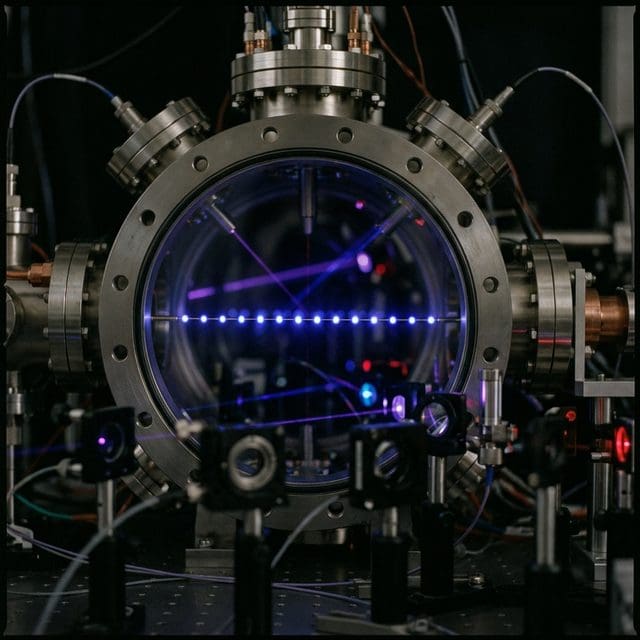
A trapped-ion experiment modeled gluon string breaking and found the simulated process began at the system’s edges, offering a new way to probe the force that binds matter.
A quantum computer has reproduced a small but revealing piece of particle physics: the breaking of a gluon “string,” a process in which energy binding particles can give rise to new particle pairs. In the trapped-ion simulation, the change began at the edges of the system and moved inward—a pattern that differs from the conventional expectation associated with physicist Julian Schwinger.
The work, led by Christopher Monroe of Duke University, was reported by Physics World on October 13 and published in Nature Physics. The team did not calculate the full complexity of matter’s strongest force. Instead, it built a controlled model of one of that force’s behaviors and tracked how the system changed.
The force is governed by quantum chromodynamics, or QCD. It describes how quarks—the constituents of protons and neutrons—interact through gluons. Quarks are not found in isolation under ordinary conditions. As they are pulled apart, the energy in the gluon field between them increases; eventually, that energy can produce a new quark-antiquark pair. The original connection effectively breaks into shorter links, rather than yielding a lone quark.
The researchers represented particles as “domain walls” in a chain of trapped ions: boundaries between neighboring ions with opposite spins. An external magnetic field increased the energy of the simulated gluon field. Once the field crossed a threshold, the initial two domain walls produced additional ones, modeling particle-pair creation. In Physics World’s account, researcher Arinjoy De described the change as going from two domain walls—or two particles—to creating more particles beyond a certain magnetic-field threshold.
The location of the change was the surprise. Rather than beginning in the middle of the simulated system, string breaking started at its edges and advanced inward. That differs from the bulk-centered picture commonly associated with Schwinger’s account of pair creation. The result does not overturn QCD or establish that the process unfolds this way in every physical setting. It identifies behavior in this model that researchers can investigate further.
That distinction matters because a quantum simulation is not a miniature copy of a particle collision. It is a controlled system designed to follow mathematical rules that resemble those of a difficult physical problem. The domain walls are analogues of particles, and the applied field lets researchers explore how the modeled system responds as its energy changes. The surprising edge-first behavior is therefore a clue about the simulation’s dynamics—and a question for further testing, not a direct observation of gluons breaking apart in a detector.
The broader promise is to build systems that can probe quantum chromodynamics, where interacting fields can generate complex behavior that is difficult to calculate directly. A separate Oxford-led experiment reported around the same time used a hybrid quantum computer combining trapped-ion qubits and quantum oscillators to simulate the Aharonov–Bohm effect in a lattice gauge theory. That work offers another example of researchers using quantum hardware to study gauge fields and particle-like behavior, though it is a distinct experiment from Monroe’s string-breaking simulation.
For now, the trapped-ion device is too small to outperform a classical supercomputer. University of Washington researcher Boris Blinov, quoted by Physics World, called the result significant as a demonstration of quantum simulators’ potential for QCD, gauge theories and fundamental physics. This is a proof of scientific capability, not a claim of practical quantum advantage.
The experiment also adds to efforts to test these models on different hardware. Earlier demonstrations of gluon string breaking used neutral-atom and superconducting platforms. A trapped-ion version gives researchers another way to compare what different systems can represent and where their limits lie. Agreement across platforms could strengthen confidence in the models; differences could reveal which details of the hardware shape what researchers see.
Monroe’s team plans to increase the number of qubits and the depth of its calculations, then study more widely separated domain walls and the reverse process: string formation during particle collisions. Larger simulations could test whether edge-first breaking persists and bring the models closer to questions relevant to real particle experiments.
The payoff is not a new particle discovered in a detector. It is another way to explore the rules governing particles, with the possibility of calculating phenomena beyond today’s methods. The next test is whether larger quantum devices can turn this miniature model into a more complete window on the strong force.

Mason Reed serves as a Staff Writer for Just Right News, where he spearheads the Future Frontiers & Special Projects desk. In an era defined by rapid technological shifts and evolving social landscapes, Mason provides a steady, principled voice, examining the innovations of tomorrow through the lens of traditional American values. His work is most prominently featured in his signature series, “The Next Horizon,” where he explores the intersection of emerging technology, national sovereignty, and the preservation of individual liberty.
A native of San Diego, California, Mason’s worldview was shaped by the unique culture of his hometown. Growing up in a region defined by its strong military presence and its history of maritime industry, he developed a deep-seated respect for the institutions that provide national stability and the entrepreneurial spirit that drives the American economy. This upbringing instilled in him a belief that true progress is not found in discarding the past, but in building upon a foundation of proven principles. His reporting often reflects this San Diego influence, emphasizing the importance of a robust national defense and the necessity of maintaining a competitive edge in the global marketplace.
Now based in San Francisco, Mason operates from the heart of the world’s technological engine. Living and working in the Bay Area provides him with a front-row seat to the advancements—and the ideological challenges—emanating from Silicon Valley. While many in the region embrace a “move fast and break things” mentality, Mason’s reporting serves as a vital counterweight. He offers Just Right News readers a “boots on the ground” perspective, documenting how radical local policies and the concentration of tech power impact the everyday lives of citizens. His proximity to the industry allows him to cut through the marketing jargon of big tech to uncover the real-world implications for privacy, free speech, and the nuclear family.
In his “Future Frontiers” beat, Mason tackles complex subjects ranging from the ethics of artificial intelligence to the burgeoning private space race. He approaches these topics with a healthy skepticism toward centralized bureaucracy, championing instead the decentralized innovations that empower individuals. Through “The Next Horizon,” he highlights the pioneers and thinkers who are working to ensure that the future remains a place where human dignity and constitutional rights are protected. He believes that the rapid pace of change requires more than just technical expertise; it requires a moral compass rooted in the Western tradition.
Throughout his tenure at Just Right News, Mason has remained committed to the idea that the future is something to be shaped, not merely accepted. His writing is characterized by a rigorous defense of American exceptionalism and a belief that the country’s best days lie ahead, provided it remains true to its founding ideals. Whether he is investigating the impact of automation on the American workforce or profiling the next generation of aerospace engineers, Mason Reed ensures that his readers are equipped with the insights they need to navigate a changing world with confidence and clarity.