

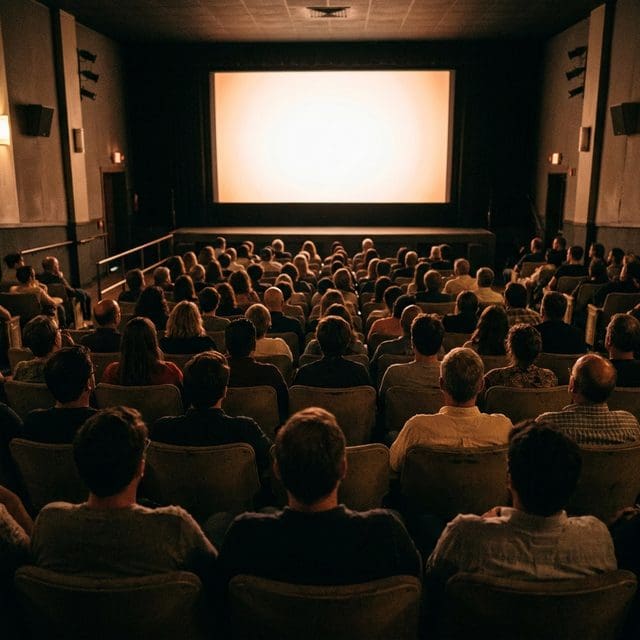
A Princeton screening of Mira Nair’s Mississippi Masala and a community cinema effort in Rockaway show two ways film can bring questions of belonging into local spaces.
A film screening is a modest civic event: a title on a calendar, a room, and a group of people who may not otherwise have chosen to sit together. But the choice of film can make the room a place to consider questions that often arrive in public life as abstractions—who belongs, what makes a country, and how different communities share it.
Princeton University listed a screening of Mira Nair’s Mississippi Masala for Wednesday, October 14, as part of a series of landmark films exploring the diversity of the American experience. The university’s description centers Mina, an Indian Ugandan woman, and Demetrius, an African American man, and the complications that arise in their relationship. The event was presented with Princeton-affiliated and community partners, according to the listing.
That framing gives the evening a purpose beyond showing a well-known film. The story brings questions of migration, race and intimacy down to the scale of two people. The listing does not report who attended or what they made of the film, so the screening cannot be taken as evidence of a broader change in attitudes. It does show how a university and local cultural organizations can create a setting for encountering a complicated American story together.
A different approach is taking shape in Rockaway, where Sam Fleischner, co-founder and artistic director of the Rockaway Film Festival, has discussed developing a model for community cinema. An IndieWire headline published October 14 described Fleischner’s focus as “developing a new model for community cinema.” The festival’s own materials say it began in 2018 as an effort to restore cinema to Rockaway. Its 2026 archive lists a five-day edition in September, followed by a local filmmakers’ showcase on October 10.
The details available do not establish how many people attended those events, or whether the festival has secured a permanent home for its screenings. A September report in the Business Times said the outdoor site at the Arverne Cinema could face displacement, while the indoor cinema was expected to remain operational. That distinction matters: a community’s access to film can depend not only on what is made, but on whether there is a place to show it.
Princeton and Rockaway are not interchangeable settings. One is a university-backed program built around a film with an international and interracial love story; the other is a festival working to make cinema part of neighborhood life. Their common thread is less a shared policy than a practical question: who gets to shape the cultural spaces where people meet, and how durable those spaces are.
The available reporting does not offer audience interviews or the finances behind either effort. It would be easy to claim that a screening changes minds, or that a festival can reverse the loss of local theaters. The evidence here does not support either conclusion. What it does support is a smaller observation: institutions and organizers are making room for films that invite viewers to consider American identity through individual lives, and the success of that effort depends in part on local venues and local choices.
For Mina and Demetrius, the country’s larger questions are bound up in a relationship. For a neighborhood festival, the question is whether a screen can remain close enough for residents to gather around it. Neither question is settled by one event. But each becomes easier to see when it is attached to a specific story and a place where people can watch it together.

Ethan Blake serves as a Senior Correspondent for Just Right News, where he specializes in Longform Narrative and Public Understanding. In an era of rapid-fire headlines and fleeting soundbites, Ethan’s work stands as a testament to the power of deep-dive reporting and the importance of contextualizing the complex issues facing the nation today. His approach is rooted in the belief that the most profound truths are often found in the lived experiences of individuals rather than the abstract theories of distant policymakers.
Growing up in Providence, Rhode Island, Ethan developed an early appreciation for the historical and cultural threads that weave the American fabric together. Providence, a city defined by its industrial heritage and its blend of traditional neighborhoods, provided him with a front-row seat to the challenges and triumphs of the American working class. This upbringing instilled in him a respect for the “common sense” values of hard work, community loyalty, and the preservation of local institutions. He learned early on that behind every economic statistic or legislative debate, there are real families and neighborhoods navigating the consequences of change.
This foundational perspective is the driving force behind his signature feature series, “Lives Behind the Systems.” Through this series, Ethan explores the intersection of individual agency and institutional structure. Whether he is documenting the impact of federal land-use policies on rural families or examining how shifting educational standards affect local school boards, Ethan’s work prioritizes the human element. He seeks to uncover how large-scale systems—be they governmental, economic, or social—affect the daily lives of citizens, often advocating for a return to local control and personal responsibility.
Now based in Portland, Maine, Ethan draws significant inspiration from the rugged independence and self-reliance that define the region. The coastal landscape and the resilient spirit of Maine’s communities serve as a constant reminder of the importance of individual liberty and the strength found in decentralized power. Living and working outside the traditional media hubs allows Ethan to maintain a grounded perspective, ensuring his reporting remains untethered from the echo chambers of the major metropolitan centers. This geographic distance provides him with the clarity needed to translate complex national narratives into stories that resonate with the heart of the country.
At Just Right News, Ethan’s beat is more than just a professional assignment; it is a mission to foster a more informed and engaged citizenry. He believes that a free society depends on the public’s ability to understand the mechanisms of power and the value of traditional American principles. His longform narratives do not merely report the news; they provide a roadmap for understanding the cultural and political shifts of the modern era through a lens of skepticism toward centralized authority and a deep respect for the individual.
Through his meticulous research and narrative craftsmanship, Ethan Blake continues to bridge the gap between policy and the public. His work remains a vital resource for those who seek a deeper understanding of the systems that shape our world and the enduring spirit of the people who live within them.