

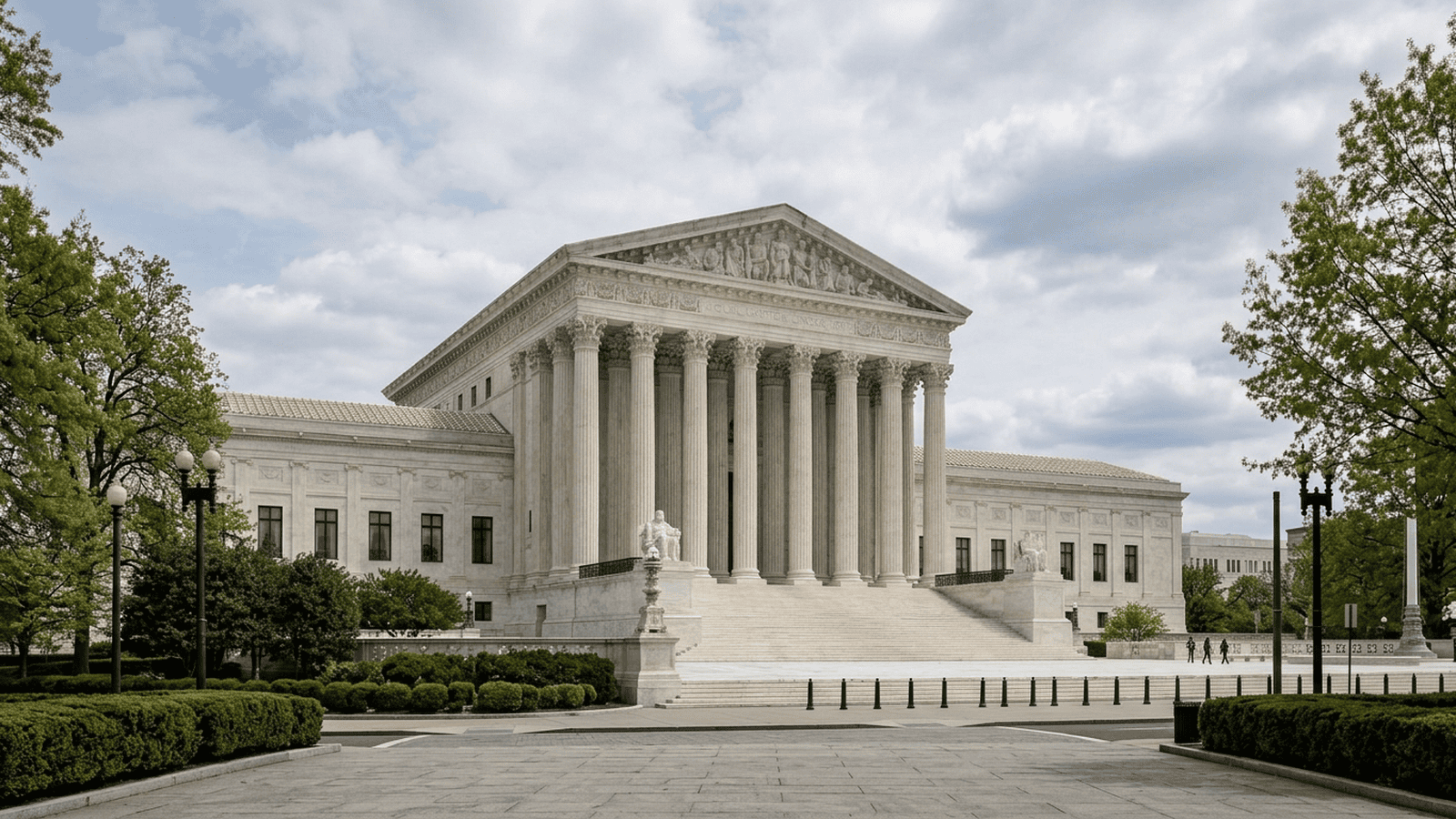
The Supreme Court will consider the Trump administration’s appeal in a case about whether cooking meals for leaders of a group the U.S. government considers a terrorist organization counts as material support. The administration says the 4th Circuit’s decision conflicts with rulings from at least three other circuits and could limit deportations in other cases. Ozurumba’s lawyers say he was forced to work without pay and argue that no circuit split exists. The 4th Circuit majority viewed him as a captive laborer and vacated his removal order. The justices will hear arguments on the legal standard, but the excerpt gives no date for arguments or a decision.
TLDR: The Supreme Court will review whether a Nigerian man’s cooking work at a camp for leaders of the Unknown Gunmen qualifies as material support. The decision could resolve a dispute between the administration and the 4th Circuit over the basis for his removal order.
The Supreme Court has agreed to hear the Trump administration’s appeal in an asylum case involving a Nigerian man who cooked meals at a camp for leaders of the Unknown Gunmen. The government considers the group a terrorist organization. It argues that providing meals to its members can count as “material support,” a legal standard at the center of the dispute. The justices will review a decision that blocked the man’s removal order. They have not yet decided whether his work meets that standard.
The administration says Supreme Court review is needed because the 4th U.S. Circuit Court of Appeals reached a result that conflicts with decisions from at least three other federal appeals courts. It argues that the ruling could weaken the government’s ability to deport immigrants with terrorism ties in other cases. That is the administration’s stated reason for asking the court to intervene. The justices have agreed to consider the dispute, not to adopt the government’s position.
The case concerns Izuchukwu Ozurumba, whose work at a camp for leaders of the Unknown Gunmen became central to his asylum case. The Justice Department asked the justices to review the Richmond-based 4th Circuit’s decision to vacate his removal order. The government says providing meals to members of a terrorist organization can amount to material support, much as providing gasoline for its vehicles would. The court will consider whether that standard applies to Ozurumba’s cooking job.
Ozurumba testified that he did not know the camp’s true purpose when he began working there. His lawyers say the group’s leaders forced him to work without pay and repeatedly threatened him after he escaped. The 4th Circuit majority described him as appearing to be “simply a captive laborer” whose work had nothing to do with terrorist activities. His account of coercion and what he knew when he started are part of the dispute now before the justices.
The Unknown Gunmen is believed to be a separatist group operating in southern Nigeria. Ozurumba fled the camp near his home in Lagos, traveled to Venezuela and entered the United States illegally in July 2023. He surrendered to Border Patrol. Several months later, an immigration judge ordered him deported to Nigeria. The 4th Circuit later vacated that order, setting up the legal question the Supreme Court has agreed to review.
A divided panel of the 4th Circuit concluded that Ozurumba’s work did not constitute material support for terrorism. The administration says that ruling conflicts with decisions by at least three other circuits. Ozurumba’s attorneys dispute that account. They say no circuit split exists for the Supreme Court to resolve. They also argue that the government’s proposed rule could treat any interaction with a terrorist organization as material support, however limited or inconsequential.
The dispute is about how broadly the material-support standard should reach. The administration says meals supplied to group members are a meaningful form of support. Ozurumba’s attorneys point to his account of forced work and lack of knowledge when he began. The lower court majority treated the difference between forced labor and support for terrorist activity as central to its decision. The Supreme Court will weigh those competing positions as it considers the law behind the removal order.
The case has a direct consequence for Ozurumba: the 4th Circuit vacated his removal order, and the Supreme Court’s review will address the legal issue behind that result. The dispute concerns his asylum eligibility and potential deportation to Nigeria. The available account identifies no filing fees, new forms, compliance requirements or deadlines for individuals. It also gives no date for the court’s arguments or a deadline for a decision. Those details should not be assumed from the court’s agreement to hear the case.
The justices’ next step is to hear arguments and decide whether cooking meals in these circumstances qualifies as material support. The administration says the 4th Circuit decision could affect deportation cases involving terrorism ties. Ozurumba’s lawyers say the ruling reflects the particular facts of his case and reject the government’s claim that other appeals courts have taken conflicting positions. The Supreme Court’s decision will resolve the legal question in this dispute. The available information does not say when that decision will come or what the justices will decide.

Greg Sanders serves as the Senior Correspondent for Corporate Power and Antitrust at Just Right News, where he brings a principled, conservative perspective to the complex intersection of big business, government regulation, and the American consumer. With a career dedicated to investigative depth and economic clarity, Greg has become a leading voice in examining how the consolidation of industry power impacts the foundational values of the free market and individual liberty.
Raised in Denver, Colorado, Greg’s reporting is deeply informed by the Western spirit of independence and a healthy skepticism of centralized authority. Growing up in the shadows of the Rockies, he witnessed firsthand the importance of local entrepreneurship and the vital role that small-medium enterprises play in sustaining vibrant communities. This upbringing instilled in him a belief that the American Dream is best preserved when the playing field remains level and when competition—rather than backroom deals between corporate lobbyists and federal regulators—dictates success. For Greg, the rugged individualism of his home state serves as a constant reminder that the economy should serve the people, not the other way around.
Now based in Chicago, Illinois, Greg operates from the heart of the nation’s industrial and financial crossroads. His location in the Midwest provides him with a unique vantage point to observe the real-world consequences of corporate overreach. From the boardrooms of the Loop to the manufacturing hubs that define the region, he tracks the movement of capital and the shifting tides of market influence. Chicago’s history as a center of trade and labor offers a rich backdrop for his work, allowing him to bridge the gap between high-level economic theory and the lived experiences of hardworking Americans who feel the squeeze of monopolistic practices.
At Just Right News, Greg’s beat focuses on the “new monopolies” and the rise of “woke” corporate culture. He argues that when corporations become too large, they often abandon their fiduciary duties to shareholders in favor of social engineering and political posturing. His reporting seeks to hold these “Titans” accountable, ensuring that the power of the purse is not used to silence dissent or bypass the democratic process. He is a firm advocate for the idea that true conservatism requires a vigilant defense of competition, preventing any single entity—public or private—from exerting undue control over the lives of citizens.
This mission is most clearly seen in his acclaimed feature series, “The Titans and the Toll.” In this ongoing project, Greg explores the human cost of market consolidation, from the erosion of consumer choice to the decline of local economies. Through rigorous analysis and boots-on-the-ground reporting, he documents how the concentration of power in sectors like tech, agriculture, and finance creates a “toll” paid by the average family.
Greg Sanders remains committed to the idea that a transparent, competitive market is the greatest engine for prosperity ever devised. Through his work at Just Right News, he continues to provide the essential oversight necessary to protect that engine from the encroaching influence of corporate giants and the bureaucratic structures that enable them.