

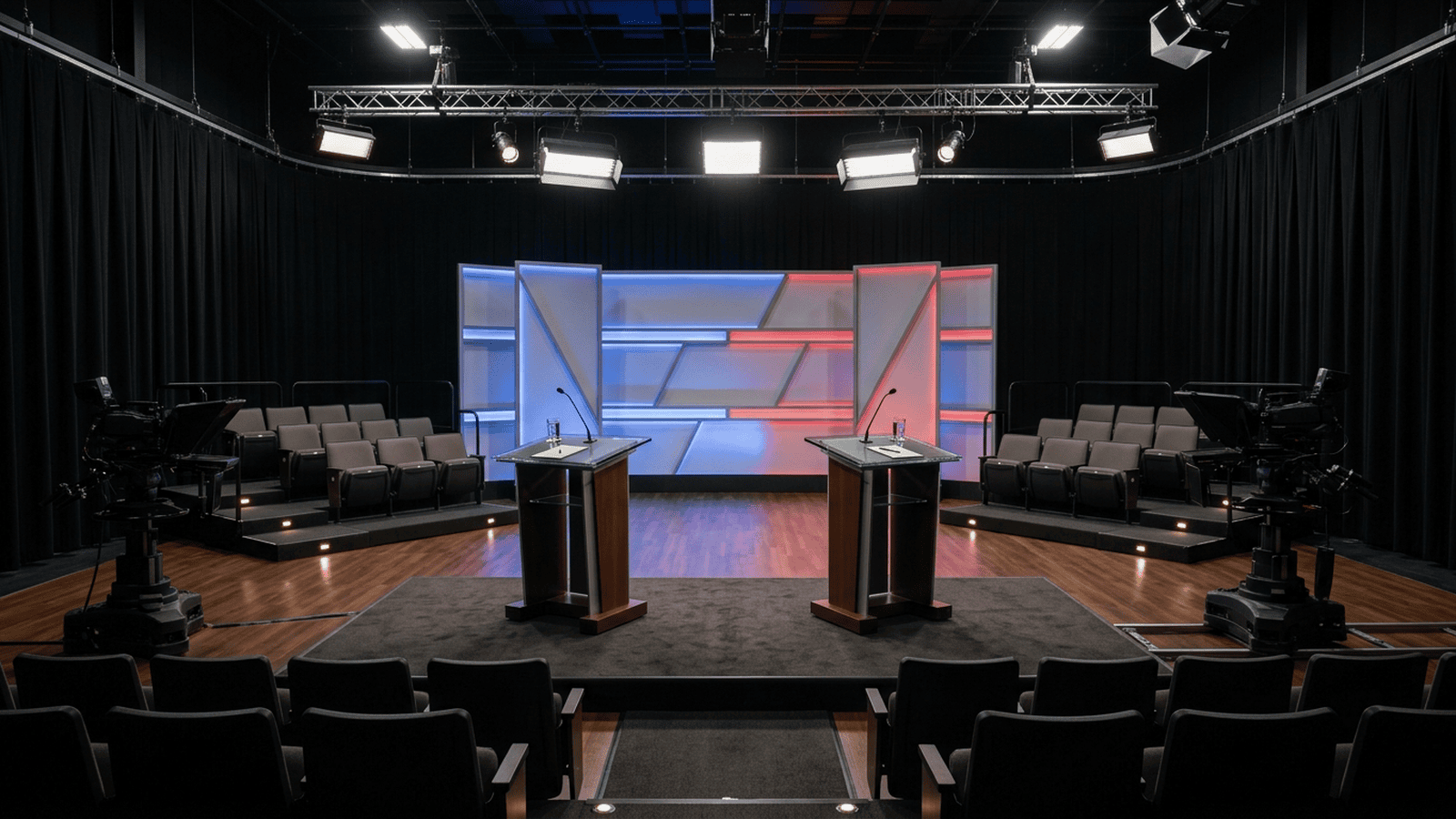
Abdul El-Sayed and Mike Rogers used their hourlong Michigan Senate debate to argue over the Iran war, trade with Canada, immigration, health care and energy costs. Both called for pausing the gas tax and questioned the tariff dispute, while Rogers said he wanted a deal with Canada and an end to the Iran war. El-Sayed emphasized diplomacy and raised concerns about immigration enforcement and constitutional limits. The candidates sharply disputed Medicare for All, Israel policy and each other’s records, finances and statements. The debate described competing positions but did not provide detailed costs, implementation plans or deadlines for the proposals discussed.
TLDR: The Michigan Senate candidates debated foreign policy, immigration, health care and household costs, with both backing a temporary gas-tax pause. Their proposals remained broad, and the debate report offered few details on costs, implementation or timelines.
Democrat Abdul El-Sayed and Republican Mike Rogers clashed over foreign policy, immigration, health care and household costs in Thursday’s hourlong Michigan Senate debate. The candidates also traded personal insults and challenged each other’s records and finances. The contest could help determine which party controls the Senate, according to the debate report.
No new government policy was announced in the debate. The candidates instead described opposing views on current issues and discussed possible actions, including a pause in the gas tax and a deal to end the trade dispute with Canada.
The exchanges were frequently disorderly. El-Sayed called Rogers “weak,” “cowardly” and a “sock puppet for the Trump administration.” Rogers called El-Sayed a “glitchy AI chatbot” and accused him of running a “con.” They also accused each other of changing positions and having financial entanglements.
Rick Albin, the WOOD-TV moderator, asked the candidates to keep the event orderly. After the only commercial break, he said they had continued arguing while off air. At one point, he told them, “I appreciate your passion, but please, let’s try to keep this orderly.” The sharp exchanges repeatedly competed with discussion of the issues.
On costs, both candidates called for pausing the gas tax as conflict in the Middle East kept energy prices high. They also questioned the tit-for-tat tariff dispute with Canada. Rogers said the trade dispute should end through a deal with Canada and said he had spoken with Commerce Secretary Howard Lutnick about reaching one. The debate report did not provide details about the proposed tax pause, its duration, or how it would be carried out.
The candidates offered different accounts of the Iran war. Rogers said it was time to “wrap it up” and argued the war could end because Iran’s nuclear program and conventional military had been severely degraded. El-Sayed criticized the war and said he favored diplomacy, pointing to the Obama-era agreement that limited Iran’s uranium enrichment. President Trump ended that agreement during his first term.
El-Sayed accused Rogers of failing to use his access to President Trump to press for an end to the conflict. Rogers, who received Trump’s endorsement in the Republican primary, said the war could end now. Their disagreement reflected a wider argument over the president’s foreign policy and the role a senator should play in it.
Israel also featured prominently. El-Sayed, a critic of the Israeli government’s conduct during its war against Hamas in Gaza, opposes U.S. military assistance to Israel. Asked whether Iran or Israel posed a greater threat, he rejected the question as a “ridiculous hypothetical” and said both had proved dangerous in different ways. Rogers described himself as a strong supporter of Israel and said he would withdraw his support if Israel discussed using nuclear weapons, adding that he had not heard such discussion.
Rogers challenged El-Sayed over whether he had issued a statement marking three years since Hamas’s October 7, 2023, attack on Israel. Rogers said El-Sayed had not acknowledged the attack’s victims. El-Sayed said he had condemned the attack but had not turned it into political theater. After the debate, he told reporters he believed any statement he made would be scrutinized and politicized.
Immigration policy produced another sharp exchange. Rogers said intense immigration operations in Minnesota earlier in the year were “probably not appropriate,” adding that officials had made a correction and adjustment. He said agents were targeting people who had entered illegally and committed serious crimes. El-Sayed, who has called for abolishing Immigration and Customs Enforcement, said an undocumented immigrant who committed a violent crime should be deported, while arguing that enforcement must not violate the Constitution.
Health care drew a dispute over El-Sayed’s support for Medicare for All. Rogers said the approach would take private health insurance from families and give it to the government. El-Sayed said families who wanted to keep private insurance could do so, prompting Rogers to say that position was news to him. The debate report did not include cost estimates, implementation details, or a timetable for either candidate’s health care proposals.
The candidates also questioned each other’s campaign donations and finances. El-Sayed raised Rogers’s ownership of a waterfront home in Florida, while Rogers cited a rental property in the United Arab Emirates owned by El-Sayed’s wife. The exchanges included a brief dispute over whether Florida was an appropriate comparison for a Michigan Senate race. The report did not provide further financial records or details about the claims.
The practical policy details remain limited. The candidates discussed a possible gas-tax pause, a Canada trade deal, immigration enforcement and competing health care approaches, but the debate account gives no proposed fees, forms, compliance rules or implementation deadlines for these ideas. The directly affected groups include Michigan taxpayers and drivers, families with health insurance, people subject to immigration enforcement and businesses exposed to trade policy. The election is the next step in deciding who will represent Michigan; the debate report identifies no specific oversight schedule or compliance process.
Daniel Owens serves as a Senior Correspondent for Just Right News, where he leads the newsroom’s coverage of Education, Workforce, and Upward Mobility. In an era where the national conversation often overlooks the practical foundations of success, Owens brings a principled perspective to the forefront of the media landscape. His work is defined by a commitment to the idea that a strong society is built on the pillars of quality education, a robust work ethic, and the removal of bureaucratic barriers to individual achievement.
Born and raised in Cleveland, Ohio, Owens’s worldview was shaped by the industrial landscape of the Midwest. Growing up in a city known for its grit and resilience, he witnessed firsthand the transformative power of steady employment and the devastating effects of economic stagnation. This background instilled in him a deep respect for the American worker and a healthy skepticism toward top-down government solutions that often fail to reach the communities they intend to help. As an African American man who has navigated the path to professional success, Owens approaches his beat with a nuanced understanding of how meritocracy and personal responsibility intersect with opportunity. He frequently draws on his roots to highlight the importance of family stability and community-led initiatives in fostering the next generation of leaders.
At Just Right News, Owens is the architect of the acclaimed feature series, “The Learning Curve.” Through this platform, he explores the evolving landscape of American schooling, from the rise of the school choice movement to the revitalization of trade schools and vocational training. He frequently challenges the status quo of higher education, advocating for a return to academic rigor and the practical alignment of degrees with market demands. For Owens, education is not merely about obtaining credentials; it is about equipping young people with the tools necessary to lead self-sufficient, meaningful lives. His reporting on “The Learning Curve” has become essential reading for parents and policymakers who believe that educational competition and parental rights are the keys to a brighter future.
Now based in Raleigh, North Carolina, Owens finds himself at the heart of one of the nation’s most dynamic regions for innovation and growth. Raleigh’s unique blend of traditional values and a fast-paced economy provides the perfect backdrop for his reporting on the modern workforce. From the tech hubs of the Research Triangle to the rural communities of the South, he tracks how shifts in the economy are impacting families and local industries. His reporting often highlights the success stories of entrepreneurs and workers who are thriving by embracing the values of hard work and innovation.
Throughout his career, Daniel Owens has remained a steadfast voice for the student seeking a better path and the worker striving for a better life. His reporting for Just Right News serves as a vital resource for readers who value common-sense solutions to the challenges of the 21st-century economy. By focusing on the intersection of policy and the human spirit, Owens continues to provide a roadmap for how individuals and communities can achieve lasting upward mobility.