

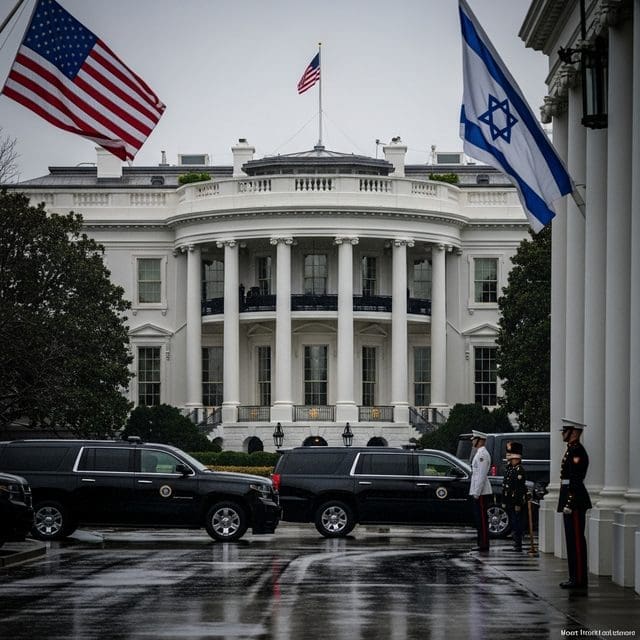
President Trump and Prime Minister Netanyahu met at the White House to discuss the Iran conflict and Lebanon operations as the administration faces mounting pressure to secure a diplomatic off-ramp.
President Donald Trump hosted Israeli Prime Minister Benjamin Netanyahu at the White House on Tuesday for a pivotal summit intended to chart the future of the war on Iran. This meeting, the first between the two leaders since the initiation of strikes on Tehran in February, occurs at a moment of significant strategic tension. While the White House has expressed a desire to shift toward a diplomatic framework following the June 17 ceasefire, the Israeli delegation continues to lobby for expanded military operations against Hezbollah in Lebanon and more stringent constraints on Iranian missile capabilities.
The backdrop of this meeting is a domestic landscape increasingly weary of foreign entanglements. A CBS News/YouGov poll conducted in late July indicates that 78 percent of respondents believe the war on Iran has been significantly harder than the Trump administration initially projected. This public skepticism serves as a backdrop to the President’s reported private frustrations. Sources indicate Trump has criticized the Prime Minister for potentially undermining U.S. diplomatic efforts through escalations in Lebanon, even as the administration maintains that Israel would not survive without continued American military and financial backing.
The policy divide extends to the West Bank, where the Israeli government has taken a more aggressive posture. On the very day of the White House meeting, Israeli Defense Minister Israel Katz instructed the military to widen operations in the West Bank and prepare for the evacuation of certain refugee camps to facilitate the establishment of dozens of new Jewish communities. This expansionist policy directly challenges the White House’s stated opposition to annexation and has drawn sharp criticism from over 600 former Israeli officials who warned the Trump administration that such moves could ignite a broader regional conflagration.
Beyond the immediate conflict, the leaders are reviewing the potential expansion of the Abraham Accords. The White House view is that adding new Arab states, potentially including Kazakhstan, to the normalization framework could serve as a vital bargaining chip in de-escalating the Iran-Lebanon axis. However, this regional package is complicated by Netanyahu’s opposition to the U.S. sale of F-35 fighter jets to Turkiye. While Netanyahu argues the sale would disrupt the regional power balance, President Trump has asserted his executive authority to sell military hardware to any partner he deems appropriate, further illustrating the transactional nature of the current bilateral relationship.
The timing of the visit is also inextricably linked to the passing of Senator Lindsey Graham, a stalwart of the Republican foreign policy establishment. The funeral has drawn an array of international figures to Washington, including Ukrainian President Volodymyr Zelenskyy, who is seeking his own assurances regarding U.S. support. As the Senate prepares for a special primary in South Carolina to fill Graham’s seat—where ten Republican candidates, including Graham’s sister Darline Graham Nordone, have filed to run—the administrative state finds itself at a crossroads between the hawkish legacy of the past and the pragmatic demands of a war-weary electorate.
Ultimately, much of the substantive progress from the Trump-Netanyahu meeting is expected to remain shielded from public view. Analysts suggest that the administration will rely on signaling and strategic leaks rather than formal joint statements to convey the next phase of the Iran air war. Whether the current pause in U.S. strikes becomes a permanent ceasefire or a prelude to renewed escalation remains a question of executive discretion, as the President continues to insist that he, rather than any foreign ally, calls the shots in American foreign policy.

Miles Harrington serves as the Senior Correspondent for Federal Systems & Executive Power at Just Right News, where he brings a disciplined, constitutionalist lens to the inner workings of the American government. With a focus on the mechanics of the federal bureaucracy and the limits of executive authority, Harrington has established himself as a vital voice for readers who value transparency, accountability, and the preservation of the separation of powers.
A native of Richmond, Virginia, Harrington’s perspective is deeply rooted in the traditions of the Old Dominion. Growing up in a city defined by its historical significance and its role as a center of American jurisprudence, he developed an early appreciation for the foundational principles of the Republic. His upbringing in Richmond—a place where the legacy of the Founding Fathers is woven into the landscape—instilled in him a belief that the federal government should remain within its constitutional bounds. This background informs his skepticism of centralized overreach and his commitment to reporting on the ways in which the administrative state impacts the lives of everyday citizens.
In his current role, Harrington specializes in the complexities of federal systems. He doesn’t just report on the headlines of the day; he digs into the structural shifts within the executive branch that often go unnoticed by the mainstream press. Whether he is analyzing the implications of a new federal regulation or investigating the expansion of agency jurisdiction, his work is characterized by a rigorous adherence to the facts and a dedication to the rule of law.
Harrington is perhaps best known for his signature feature series, “How Washington Works.” Through this ongoing project, he demystifies the often-opaque processes of the nation’s capital, pulling back the curtain on the “Deep State” and the unelected officials who wield significant influence over national policy. By breaking down complex legislative maneuvers and executive orders, he empowers Just Right News readers to understand the true levers of power in Washington. His reporting serves as a necessary check on the federal government, ensuring that the actions of those in power are held up to the light of public scrutiny.
Now based in Washington, D.C., Harrington operates at the epicenter of the political world, yet he remains intentionally distanced from the “Beltway bubble.” His proximity to the halls of power allows him to maintain a robust network of sources across the federal landscape, but his heart remains in the principled conservatism of his Virginia roots. He views his role not merely as a reporter, but as a steward of the public trust, dedicated to providing the clarity and context that conservative voters need to navigate an increasingly complex political environment.
Through his sharp analysis and unwavering commitment to the truth, Miles Harrington continues to be a cornerstone of the Just Right News team. His work ensures that the principles of limited government and executive restraint remain at the forefront of the national conversation, providing a crucial service to those who believe in a government that is truly of, by, and for the people.