

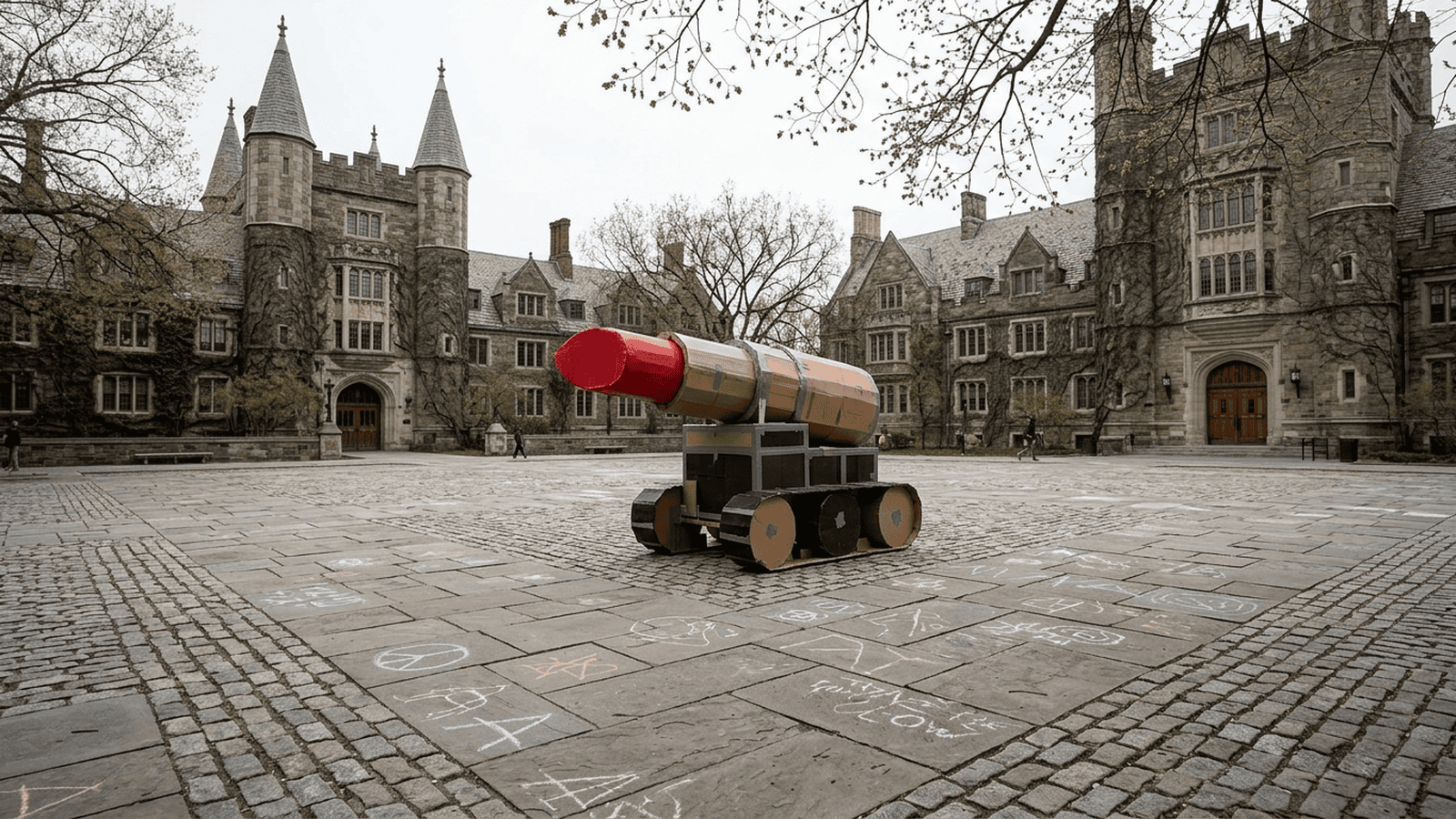
Hundreds marched at Yale’s Beinecke Plaza around a cardboard recreation of Claes Oldenburg’s lipstick sculpture, reviving a protest image last seen there more than fifty years ago. The gathering was organized by Democratize Yale, a coalition opposing the university’s negotiations with the federal government and seeking shared governance, free expression, and academic freedom. Protesters also challenged campus rules by holding an unregistered rally and displaying artwork without administrative approval. The dispute follows years of student efforts to change trustee selection and investment policy, neither of which Yale had acted on three years after a 2023 referendum and repeated requests. The excerpt does not specify fines, new deadlines, enforcement actions, or Yale’s official rationale for its rules.
TLDR: A Yale protest brought a cardboard version of Oldenburg’s lipstick sculpture back to Beinecke Plaza and challenged university rules on gatherings, artwork, and banners. The coalition’s demands over governance and federal negotiations remain unresolved, while the excerpt gives no details on fines or upcoming enforcement deadlines.
A twelve-foot cardboard sculpture returned to Beinecke Plaza last Friday, bringing an image from Yale’s protest history into a new dispute over campus rules and the university’s negotiations with the federal government. Hundreds marched to the plaza, where students gathered around a replica of Claes Oldenburg’s lipstick sculpture for the first time in more than fifty years.
The protest was the second organized by Democratize Yale, a coalition of students, staff, faculty, and alumni. It formed after Yale began settlement negotiations with the federal government over alleged racial discrimination in admissions. The Justice Department accused Yale’s medical school in May of illegally favoring Black and Hispanic applicants. Yale President Maurie McInnis later confirmed that separate investigations involving Yale College and Yale Law School were pending and that the university was negotiating with the government. The account gives no official explanation for the campus rules. The coalition says it sees the negotiations as an effort to appease President Trump.
The sculpture recalled an earlier era of campus protest. In 1969, Claes Oldenburg installed Lipstick (Ascending) on Caterpillar Tracks on Beinecke Plaza. The work showed a large lipstick tube rising from tank treads. Students for a Democratic Society used it as a platform for speakers at anti-war rallies near Woodbridge Hall, where university presidents historically had offices and trustees met. The Vietnam War had killed tens of thousands of young American men, while millions joined marches across the country.
The original sculpture was later moved to the Yale University Art Gallery’s sculpture garden. A permanent version, made of steel, aluminum, and fiberglass, was given to the gallery in 1974. For last week’s demonstration, Yale College students built a cardboard version about half the size of the original and placed it near the old site. The image connected today’s arguments about university authority with a protest tradition that began generations ago.
The current dispute is not limited to the sculpture. The gathering was unregistered and deliberately violated Yale’s campus free-expression policies, according to the account. The cardboard work also went against a rule requiring administrative approval for outdoor art. Sam Callaway and Stuart Wrede, two architects who helped build Oldenburg’s original sculpture, sent organizers a statement describing the ban as censorious. Yale rules also forbid banners on building facades and require posters to include the name of the person who posted them and the date.
Students had already tested those rules. On September 26, before the Yale Corporation’s first meeting of the academic year, students hung banners around campus. Some called for shared governance; another read “Trustees, you can’t hide.” Trustees traveled in black town cars toward Science Hill, where a Yale junior said they meet away from central campus. The account also notes criticism of the Corporation’s business ties, secretive structure, and lack of accountability to students, faculty, and alumni.
The protests followed years of efforts to use Yale’s established channels. In a 2023 Yale College Council referendum, almost 90 percent of voting students said trustees should be democratically elected. The Endowment Justice Collective organized the vote, and the Corporation responded with a letter acknowledging its result. Students also asked Yale’s Advisory Committee on Investor Responsibility three times to divest from weapons manufacturers. The account says Yale had acted on neither demand three years later.
A wider coalition formed this fall around those long-running demands. It includes the Endowment Justice Collective, Yale College Council, Yale College Democrats, the Black Student Alliance at Yale, Mecha de Yale, and alumni group Stand Up for Yale. Its newest demand is that Yale leave its federal negotiations.
Last week’s gathering included Senator Richard Blumenthal, Representative Rosa DeLauro, New Haven Mayor Justin Elicker, and members of Yale’s chapter of the American Association of University Professors. Blumenthal was seen chanting with students. Organizers passed chalk through the crowd so people could write what they would change if they ran the university. Messages and peace signs covered the granite, including “Make love not war.” A student also led a chant during an hour when Yale policy does not permit chanting on Beinecke Plaza.
The practical effects described in the account are institutional, not financial. Organizers held an unregistered gathering and displayed unapproved outdoor art. Students who hang banners or post notices face rules about location, approval, names, and dates. The account specifies no fines, enforcement actions, registration forms, or future deadlines. Those policies remain part of the dispute as students and coalition members press their demands, putting free expression and campus control against Yale’s authority to set and enforce its rules.
The next steps are not detailed in the account. Yale’s negotiations and investigations remain in progress, while the coalition’s call to withdraw and its governance demands remain unresolved. Further attention to the university’s process and its enforcement of campus rules will show how the dispute develops.

Sophie Carter serves as a Staff Writer for Just Right News, where she anchors the outlet’s critical coverage of Elections, Influence, and Democracy Infrastructure. In an era where the mechanics of voting and the flow of political capital are under constant scrutiny, Sophie provides a steady, principled voice dedicated to the preservation of American institutional integrity and the rule of law.
Raised in Charlotte, North Carolina, Sophie’s perspective was forged in a community that balances rapid modern growth with a deep respect for tradition and civic duty. Growing up in the Queen City, she witnessed firsthand how a robust local culture depends on the trust between the citizen and the state. This upbringing instilled in her a foundational belief that the right to vote is a sacred trust—one that must be protected from both administrative overreach and the encroaching influence of special interest groups. Her reporting reflects these North Carolina roots, emphasizing the importance of community-led governance and the preservation of the individual’s voice in the face of nationalized political movements.
Now based in Atlanta, Georgia, Sophie operates from the heart of one of the nation’s most pivotal and contested political landscapes. Her location allows her to report from the front lines of the debate over election security, legislative reform, and the modernization of voting systems. For Sophie, the “infrastructure” of democracy is not merely a matter of machines and ballots; it is the collection of laws, people, and transparent processes required to maintain public confidence. Her work often highlights the necessity of clear, enforceable standards that ensure every legal vote is counted fairly and that the machinery of our republic remains accountable to the taxpayers who fund it.
Central to her work at Just Right News is her acclaimed feature series, “The Price of a Vote.” Through this ongoing project, Sophie explores the complex web of influence that shapes modern campaigns and policy decisions. She delves into how high-level lobbying, non-governmental organizations, and shifting bureaucratic regulations impact the weight of an individual citizen’s ballot. By examining the financial and structural pressures placed on the electoral process, she provides readers with a comprehensive look at the forces vying for control over the American political system.
Sophie’s approach to journalism is rooted in a commitment to the constitutional framework. She views her role as a watchdog for the voter, ensuring that the systems meant to serve the public remain transparent and free from corruption. Whether she is analyzing the implementation of new voting technologies or investigating the influence of outside money on state-level policy, her work is characterized by a rigorous adherence to facts and a refusal to succumb to the sensationalism that often plagues modern political reporting.
At Just Right News, Sophie Carter continues to be a vital resource for readers who value clarity, conviction, and a defense of traditional American values. Her deep ties to the Southeast and her specialized focus on the mechanics of our republic make her an essential voice in the ongoing conversation about the future of American self-governance. Through her reporting, she remains dedicated to the idea that a secure and honest electoral system is the bedrock of a free and prosperous society.