

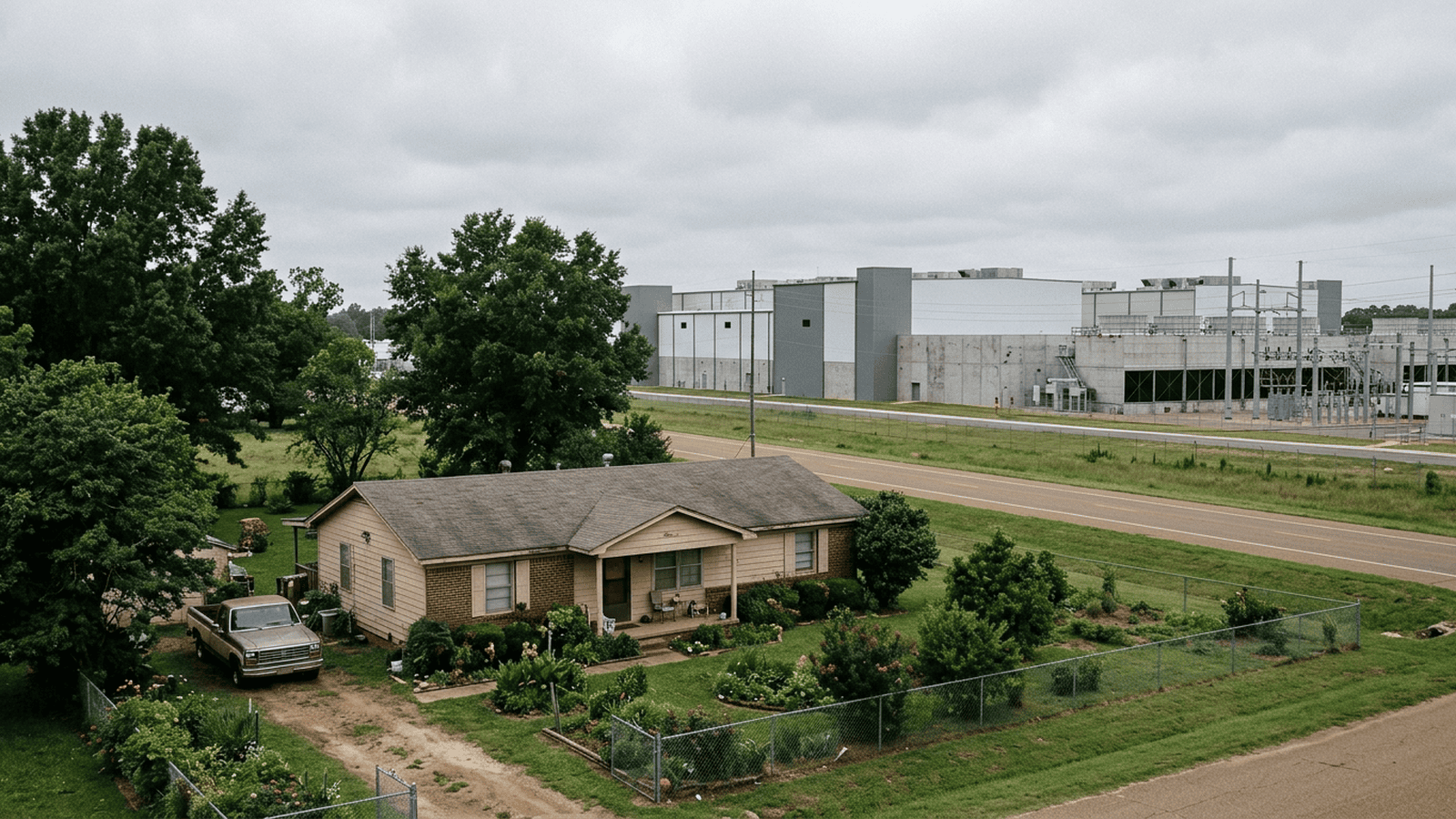
A power plant serving SpaceXAI data centers has left Krystal Polk’s four-generation family property in Southaven mostly empty, she says, because of constant noise. SpaceXAI says it is spending millions on sound walls and silencers, though residents say one installed wall has offered little relief. Under an agreement with Mississippi’s environmental agency, the company is to replace 69 temporary turbines with 41 permanent turbines over a year. The state says the permitting process required proof that the facility would meet air-quality standards, while a lawsuit alleging harmful pollution remains unresolved. Polk’s family is also weighing whether to keep its land, as investment and development continue across the region.
TLDR: SpaceXAI’s Southaven-area growth is accompanied by a year-long turbine replacement agreement and continuing disputes over noise and pollution. A four-generation family property sits mostly empty, while its future and the pending lawsuit remain unresolved.
Krystal Polk’s family property in Southaven, Mississippi, has been passed down through four generations. The two-acre tract once supported chickens, pigs, onions and herbs, and family members traded peaches for pears. Now the land sits mostly empty, Polk says, after a nearby power plant began operating and the sound drove her family away.
The plant supplies power to Elon Musk’s SpaceXAI data centers in the Memphis area. Southaven residents have raised concerns about its noise and air pollution, while the company’s projects are expected to bring more than $20 billion in investment to the region. Mississippi Gov. Tate Reeves has said the investment will bring opportunities to residents for generations.
The official rationale presented in the account is that the Justice Department views the permitting dispute as a national security matter. It said the case concerns Mississippi’s lawful permitting action and that the NAACP’s lawsuit could hinder the War Department’s use of AI for national defense. The excerpt does not provide a broader formal rationale for the data-center expansion.
Polk’s family acquired the property before, she said, people of color were allowed to own land. It has remained in the family for four generations. She recalls growing up there, churning ice cream, hosting holiday gatherings and planning to return after retirement before passing the land to her children. Those plans are now on hold as the family weighs what to do with a property it has struggled to keep and does not want to sell.
The nearby plant changed the property’s daily conditions. Polk described hearing a constant roar, comparing it to planes taking off at an airport without ever leaving the ground. She said the sound continues to linger after she leaves. The land has been mostly vacant since the family moved away, with the plant’s hum replacing the quieter setting she remembers.
SpaceXAI said in a July press release that it is spending millions of dollars on sound walls and silencers using what it called advanced quieting technologies. Residents told CBS News that one wall installed so far has provided little relief. The gap between the company’s stated investment and residents’ experience remains part of the local dispute.
The expansion has moved quickly. Construction of the Colossus 1 data center began just north of Southaven in 2024. Two more data centers were announced by January 2026, and Musk confirmed another local facility, Minihard, in July. The scale of the investment gives the region a major economic prospect, while leaving families such as Polk’s to assess changes close to home.
Health concerns are also part of the debate. Polk said she and her family have asthma and worry about fumes from the plant’s gas turbines. The NAACP and other groups sued xAI and subsidiary MZX Tech in April, alleging that the plant emits significant amounts of harmful pollutants. In June, SpaceXAI moved to dismiss the case, and the Justice Department also sought to intervene and dismiss it. Those are allegations and legal filings, not a final court finding.
A study by EmPower Analytics Group found that the planned turbines would increase air pollution in the area, with pollution concentrated in communities that are disproportionately Black. The Southern Environmental Law Center, which is co-counsel for the plaintiffs, commissioned the study. The Mississippi Department of Environmental Quality said it does not comment on third-party reports or pending litigation. It said MZX Tech had to demonstrate during permitting that the proposed facility would not violate air-quality standards, and that the department remains committed to enforcing state and federal environmental laws.
The practical changes are defined in an agreement between SpaceXAI and the state department. The company is to remove 69 temporary turbines and replace them with 41 permanent turbines over the course of a year. The excerpt gives no fee, household paperwork requirement, or specific compliance deadline beyond that one-year timetable. The directly affected group includes nearby residents, while Polk’s family faces the separate question of whether to keep or sell its land. A real estate firm explored a possible acquisition on behalf of an unnamed client, but Polk declined to disclose the offer and said it was not worth anything.
The family’s choices remain constrained by the noise, health concerns and uncertainty about the property’s future. A petition organized by the resident-run Safe and Sound Coalition seeking to shut down the plant has more than 1,400 signatures. The lawsuit and permitting process continue, and the state’s turbine-replacement agreement sets the next concrete step: a year-long transition from temporary to permanent equipment. That timetable and the state’s stated enforcement role are necessary steps for tracking compliance, while the legal claims remain unresolved.

Daniel Owens serves as a Senior Correspondent for Just Right News, where he leads the newsroom’s coverage of Education, Workforce, and Upward Mobility. In an era where the national conversation often overlooks the practical foundations of success, Owens brings a principled perspective to the forefront of the media landscape. His work is defined by a commitment to the idea that a strong society is built on the pillars of quality education, a robust work ethic, and the removal of bureaucratic barriers to individual achievement.
Born and raised in Cleveland, Ohio, Owens’s worldview was shaped by the industrial landscape of the Midwest. Growing up in a city known for its grit and resilience, he witnessed firsthand the transformative power of steady employment and the devastating effects of economic stagnation. This background instilled in him a deep respect for the American worker and a healthy skepticism toward top-down government solutions that often fail to reach the communities they intend to help. As an African American man who has navigated the path to professional success, Owens approaches his beat with a nuanced understanding of how meritocracy and personal responsibility intersect with opportunity. He frequently draws on his roots to highlight the importance of family stability and community-led initiatives in fostering the next generation of leaders.
At Just Right News, Owens is the architect of the acclaimed feature series, “The Learning Curve.” Through this platform, he explores the evolving landscape of American schooling, from the rise of the school choice movement to the revitalization of trade schools and vocational training. He frequently challenges the status quo of higher education, advocating for a return to academic rigor and the practical alignment of degrees with market demands. For Owens, education is not merely about obtaining credentials; it is about equipping young people with the tools necessary to lead self-sufficient, meaningful lives. His reporting on “The Learning Curve” has become essential reading for parents and policymakers who believe that educational competition and parental rights are the keys to a brighter future.
Now based in Raleigh, North Carolina, Owens finds himself at the heart of one of the nation’s most dynamic regions for innovation and growth. Raleigh’s unique blend of traditional values and a fast-paced economy provides the perfect backdrop for his reporting on the modern workforce. From the tech hubs of the Research Triangle to the rural communities of the South, he tracks how shifts in the economy are impacting families and local industries. His reporting often highlights the success stories of entrepreneurs and workers who are thriving by embracing the values of hard work and innovation.
Throughout his career, Daniel Owens has remained a steadfast voice for the student seeking a better path and the worker striving for a better life. His reporting for Just Right News serves as a vital resource for readers who value common-sense solutions to the challenges of the 21st-century economy. By focusing on the intersection of policy and the human spirit, Owens continues to provide a roadmap for how individuals and communities can achieve lasting upward mobility.