

Tehran is keeping the Strait of Hormuz closed while signaling possible wider retaliation, as Russia intensifies strikes on Ukraine and Germany commits new military and energy support to Kyiv.
Iran’s closure of the Strait of Hormuz, Russia’s expanding attacks on Ukraine and Germany’s new commitments to Kyiv are testing how far allied governments can coordinate when several fronts demand attention at once.
Tehran said October 4 that the strait would remain closed until its seven conditions are met, including an end to hostilities and sanctions relief. Iranian Foreign Minister Abbas Araqchi said it could reopen within seven days if Washington accepts Iran’s proposal. The terms and the diplomatic response remain unresolved, leaving a critical shipping route subject to a political decision by Tehran.
The pressure is not limited to the waterway. Reuters reported October 1–2 that Iranian officials had instructed allied groups in Lebanon, Yemen and Iraq to prepare for a coordinated response if large-scale U.S. attacks resume. Iranian planners were considering targets beyond U.S.-linked assets and potentially outside the Middle East, Reuters reported. The reports describe preparations, not a confirmed attack, but indicate Tehran may seek to widen the costs of renewed fighting rather than confine retaliation to a direct exchange with Washington.
Yemen’s Houthis claimed October 3–4 to have attacked an Aramco facility in Riyadh with a ballistic missile and drones. Saudi Arabia reportedly struck Houthi positions in Sanaa. Those claims and reported strikes add another point of pressure around Gulf security, where instability can affect energy infrastructure and shipping as well as military calculations.
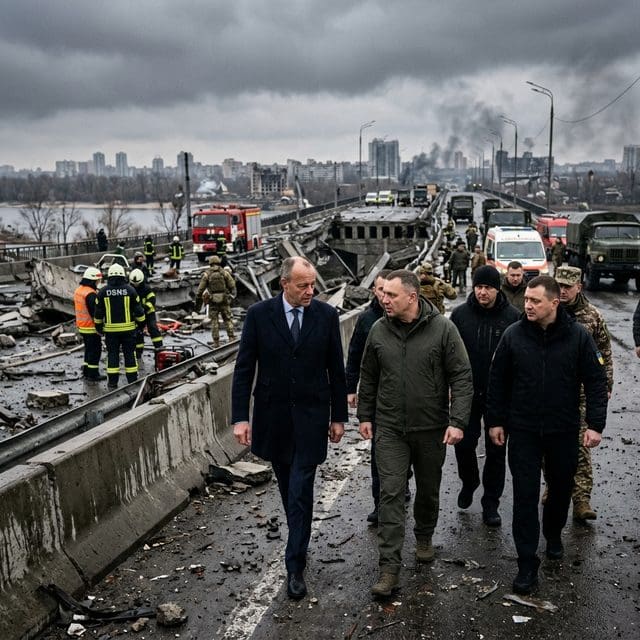
At the same time, Russia continued its campaign against Ukraine’s cities. A Russian drone hit Kyiv’s Northern Bridge on October 4 during Merz’s unannounced visit, injuring two people and damaging the roadway and hot-water supply, Ukrainian officials said. It was the fourth consecutive day of bridge attacks in the capital. Russia’s latest barrage across Ukraine killed at least five people and injured 30, according to the supplied reporting. Ukrainian air defenses said they destroyed 125 targets, including 123 Shahed-type and other drones and two Banderol loitering munitions.
Moscow said October 3 it would continue “targeted retaliatory strikes” on Kyiv and other Ukrainian cities and urged foreign diplomats and nationals to leave the capital. That warning, alongside attacks on infrastructure during a high-level European visit, underscores the limits of diplomatic symbolism when Russia is still using force to shape conditions on the ground.
Merz’s visit brought a concrete European response. Germany announced €1 billion in military aid and €350 million for repairs to Ukraine’s energy system. Berlin and Kyiv also moved toward joint production of drones, missiles and related software. The industrial partnership could matter beyond the immediate aid package: it points to a longer-term effort to expand Ukraine’s ability to produce and sustain weapons with European support.
Ukrainian military officials also claimed battlefield gains near Lyman under Operation Vivaldi, describing a robot- and drone-led campaign that retook about 176 square kilometers and inflicted more than 2,000 Russian losses, including over 250 prisoners. Those figures are Ukrainian claims and have not been independently established in the supplied material.
For Washington, the strategic problem is the interaction among these theaters. A wider Iranian response could demand U.S. attention and resources while European partners are seeking to strengthen Ukraine against Russia. Germany’s aid and joint-production plans show an effort to shoulder more of that burden, but they do not by themselves establish how much capacity Europe can sustain. The immediate stakes are practical: safe shipping, protection of energy infrastructure and whether Ukraine can keep its defenses supplied as Russia maintains pressure.

Olivia Kendall serves as the Senior Correspondent for Geopolitics, Defense, and Foreign Policy at Just Right News, where she provides a principled, conservative perspective on the complex forces shaping the global stage. With a career dedicated to deconstructing the intricacies of international relations, Kendall has become a trusted voice for readers who value national sovereignty, a robust military, and a foreign policy that prioritizes American interests above all else.
A native of Washington, D.C., Kendall’s professional journey is deeply rooted in her upbringing within the nation’s capital. Growing up in the epicenter of American political life, she developed an early and profound understanding of how policy is crafted and, more importantly, how it often fails to account for the values of the American heartland. This unique vantage point allowed her to witness firsthand the rise of globalist bureaucracies, fueling her commitment to reporting that champions the constitutional foundations of the United States. Her background as a British White American further informs her worldview, providing her with a keen appreciation for the Western tradition and the enduring importance of the “Special Relationship” in maintaining global stability.
Now based in Arlington, Virginia, Kendall operates from the doorstep of the Pentagon and the heart of the nation’s defense establishment. Her proximity to the decision-makers in the military and intelligence communities allows her to provide boots-on-the-ground reporting that is both timely and deeply informed. For Kendall, Arlington is more than just a base of operations; it is a daily reminder of the sacrifices made by the men and women in uniform. This connection to the defense community drives her rigorous coverage of military readiness and her advocacy for a “peace through strength” approach to diplomacy.
At Just Right News, Kendall is perhaps best known for her acclaimed feature series, “The World’s Shadow on America.” In this ongoing project, she explores the direct correlation between international developments and the daily lives of American citizens. Whether she is analyzing the encroachment of foreign adversaries in domestic supply chains or the impact of international treaties on local economies, Kendall’s work serves as a vital bridge between distant geopolitical shifts and their consequences at home. She rejects the notion that foreign policy is an abstract concern for elites, instead proving that what happens in the corridors of power in Brussels or Beijing has a tangible “shadow” that falls across every American doorstep.
Throughout her tenure, Kendall has remained a steadfast critic of international overreach and a vocal proponent of a clear-eyed, realistic foreign policy. She brings a sharp analytical mind to her beat, often challenging the prevailing narratives of the mainstream media to uncover the underlying truths that affect national security. Her reporting is characterized by a refusal to compromise on the truth and a dedication to the idea that a strong, secure America is the world’s best hope for liberty. As a Senior Correspondent, Olivia Kendall continues to lead the charge in providing the essential context and conservative insight necessary to navigate an increasingly volatile world.