

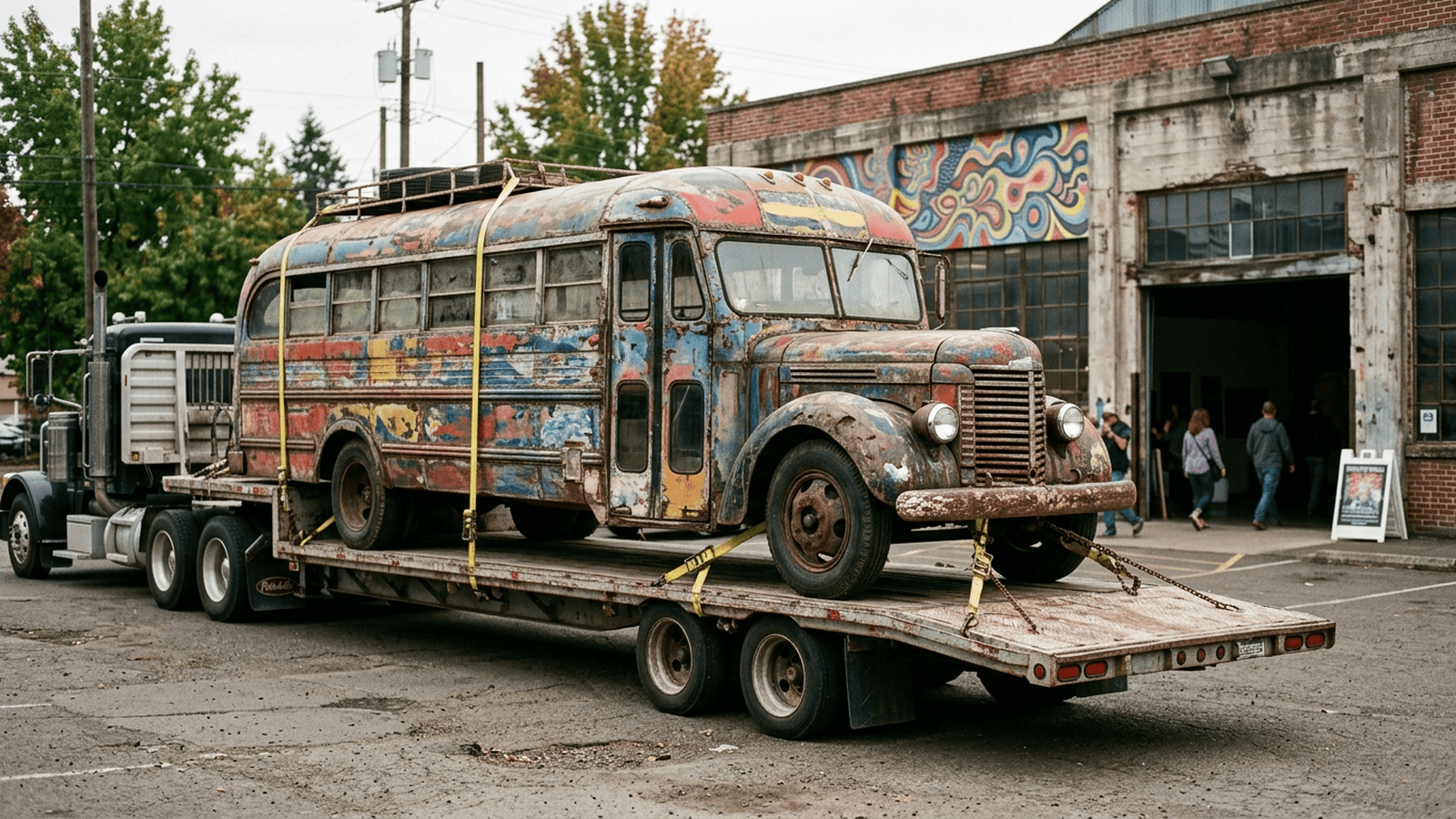
Ken Kesey’s 1939 International Harvester bus, Furthur, made its first journey in more than 50 years this past August, when a crew moved it onto a flatbed truck. The bus is the centerpiece of the ongoing “Forever Grateful” exhibit, and the Kesey family hopes public exhibits will help fund its preservation and display. The project faces a clear challenge: the vehicle has rusted steel, peeling paint, and shattered glass, and Zane Kesey says saving it will be expensive. Its history includes the 1964 trip from California to New York and the cultural influence that followed, as well as accounts of participants who suffered psychological harm. Fundraising and preservation are the next steps, but no budget, deadline, or formal oversight plan is reported.
TLDR: Furthur has been moved for the first time in more than 50 years, giving the historic bus a chance to be exhibited and preserved. Its restoration will be costly, and the family hopes public exhibits will help raise the funds needed.
Furthur has moved again. The 1939 International Harvester school bus, long associated with author Ken Kesey and the Merry Pranksters, was carefully loaded onto a flatbed truck this past August. It was the bus’s first journey in more than 50 years. The move gives the battered vehicle a chance to be seen and preserved, though the work ahead will be expensive.
The stated reason for the effort is to save the bus and make it available to future generations. The Kesey family hopes public exhibits will help raise funds for preservation and display. That is a practical goal: a historic object cannot tell its story if it is left to decay out of view.
The bus is now the centerpiece of “Forever Grateful,” an ongoing exhibit celebrating the countercultural movement that followed in its wake. Kelly Harris, director of San Francisco’s Haight Street Art Center, describes Furthur as a call to keep creating and exploring. The exhibit’s purpose is cultural, not governmental. The source material reports no new government policy, public rules, or official policy rationale tied to the bus.
Furthur’s significance begins with Kesey, who studied creative writing at Stanford in the early 1960s and volunteered as a test subject in U.S. government experiments using LSD. At the time, LSD was legal for public use. Kesey’s 1962 novel, “One Flew Over the Cuckoo’s Nest,” drew on drug-induced visions, according to the account of his life in the source material.
In June 1964, Kesey and the Merry Pranksters traveled aboard the bus from California to the World’s Fair in New York. They filmed the trip in color, documenting a journey that exhibit curator Ben Marks describes as a social experiment fueled by alcohol and LSD. The footage preserves a group experience, but it does not make the consequences uniformly positive.
Marks said some participants suffered emotional and psychological harm and had trouble navigating the experience. That part of the history belongs alongside the bus’s later reputation as a symbol of liberation. The record is more useful when it includes both: the cultural change that participants helped set in motion and the personal costs that some experienced.
After returning to California, Furthur became an emblem of a culture shifting in ways people did not yet understand, Marks said. Kesey’s influence continued as he invited a local band to play at Prankster parties. The group became known as the Grateful Dead, whose music still draws fans to the exhibit six decades later.
The bus also has a quieter history. By the late 1960s, Kesey had moved with his family to Oregon, where he farmed and returned to writing. Furthur was left in a bog and began to rust. Kesey died in 2001. His son, Zane Kesey, now keeps the bus’s legacy alive and has said the vehicle is in sad shape and needs substantial help.
The physical condition is difficult to overlook. The bus is about 37 feet long, with rusted steel, peeling paint, and shattered glass. Its deterioration makes preservation more than a matter of displaying a recognizable relic. The work will require resources, and Zane Kesey said saving as much of the bus as possible will be expensive. The source does not give a dollar estimate, a formal repair schedule, specific preservation procedures, or a fundraising deadline.
The immediate steps described are limited but concrete. A crew moved Furthur onto a flatbed in August, and the family hopes public exhibits will support fundraising for preservation and display. The exhibit gives visitors a chance to encounter the bus while that effort continues. No application forms, compliance rules, enforcement process, government fees, or oversight schedule are reported. The people directly involved are the Kesey family, the preservation crew, and the exhibit organizers; the public may encounter the bus through exhibits.
For supporters, the case for preserving Furthur does not require pretending that its past was simple or that the restoration will be cheap. The bus represents an episode of experimentation that produced both cultural influence and harm, and its material condition sets a real cost. Keeping the object visible may help future visitors weigh that history for themselves. The next steps are fundraising and preservation, with public exhibits intended to support the effort; no formal deadline or oversight plan is reported.

Chloe Foster serves as a Staff Writer for Just Right News, where she spearheads the outlet’s coverage of Media, Culture, and Information Integrity. In an era defined by rapid-fire digital communication and shifting societal norms, Chloe has distinguished herself as a vital voice for readers seeking clarity amidst the noise. Her signature feature series, “The Story Wars,” has become a cornerstone of the publication, offering a deep dive into the ideological battles currently shaping American life and the ways in which mainstream narratives are constructed, disseminated, and often manipulated.
Chloe’s unique perspective is informed by a life lived in two of the nation’s most influential cultural hubs. Raised in Los Angeles, California, she grew up in the shadow of the world’s most powerful media and entertainment apparatus. This upbringing provided her with a front-row seat to the “dream factory,” allowing her to observe firsthand how cultural exports are crafted and how they often diverge from the lived experiences of everyday Americans. Her time in Los Angeles instilled in her a healthy skepticism of manufactured consensus and a passion for uncovering the truths that lie beneath polished public relations campaigns.
Today, Chloe operates from Brooklyn, New York, a vantage point that places her at the epicenter of the modern media landscape. Living and working in a deep-blue urban environment as a conservative journalist has sharpened her reporting, requiring a rigorous commitment to intellectual honesty and a steadfast defense of traditional values. Her base in Brooklyn allows her to engage directly with the institutions and influencers who drive the national conversation, providing Just Right News readers with an “on-the-ground” look at the cultural shifts originating in the Northeast.
As a Hispanic woman, Chloe brings a nuanced understanding of community and heritage to her beat. She frequently explores how media portrayals of the Latino community often overlook the deep-seated faith, entrepreneurial spirit, and family-centric values that define it. Her work challenges the monolithic labels often applied by mainstream outlets, instead highlighting the diversity of thought and the conservative principles that resonate within her community.
In her role at Just Right News, Chloe views “Information Integrity” not merely as a buzzword, but as a mission. She believes that a healthy republic requires a media landscape where facts are prioritized over agendas and where the public is empowered to think for themselves. Through “The Story Wars,” she deconstructs the framing of major news events, exposing bias and providing the context necessary for readers to understand the broader cultural implications of the day’s headlines.
Chloe Foster’s reporting is more than just a collection of articles; it is a sustained effort to reclaim the narrative for those who feel sidelined by the prevailing media establishment. By bridging the gap between her West Coast roots and her East Coast base, she continues to provide essential commentary on the forces that define our shared American culture.