

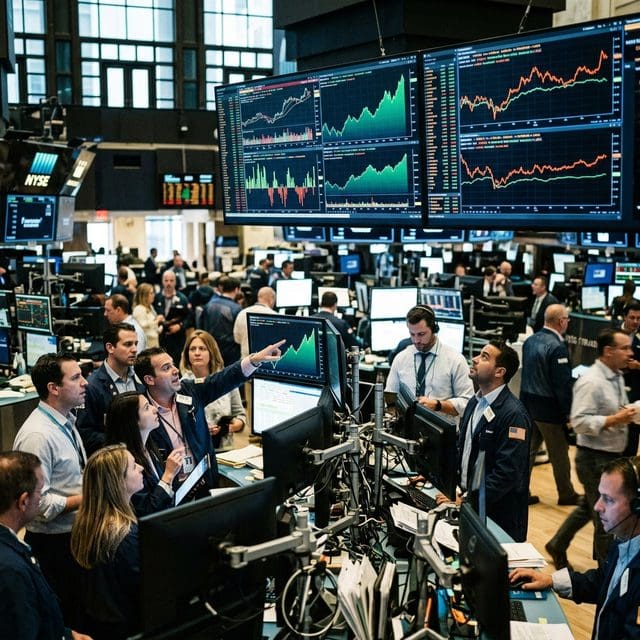
U.S. shares advanced against a +0.73% SPY benchmark as a weak jobs report reduced expectations for an October rate hike, while high Treasury yields and falling oil shaped the cross-asset picture.
U.S. stocks rose on October 2, with SPY up 0.73% on the session, as investors reassessed the Federal Reserve’s interest-rate outlook after a much weaker-than-expected jobs report. The move was strongest in technology shares: the Nasdaq Composite gained 1.19% to 27,190.86, briefly touching a record, while the Dow added about 0.5%. The Nasdaq’s outperformance against SPY reflected the greater sensitivity of growth stocks to expectations for borrowing costs.
September payrolls increased by just 29,000, well below forecasts of roughly 84,000 to 90,000. Unemployment rose to 4.2%, and August job growth was revised to 133,000. The report shifted rate expectations sharply: estimates for the chance of a Federal Reserve hike at its October 27–28 meeting fell to roughly 17%–23%, compared with about 64% a week earlier. December remained the more likely window for a next increase.
That change in expectations helped lift equities, but it did not erase uncertainty about inflation or the path of rates. Fed Vice Chair Philip Jefferson said on October 1 that judging the timing of further increases “may take more time,” a signal that the central bank would need to weigh incoming data. A softer labor market can make further tightening less urgent; it can also raise questions about the economy’s momentum.
Nvidia rose between 1.34% and 1.9%, briefly reaching an intraday record and providing the strongest single-stock boost to the S&P 500. Tesla gained 4.65% after reporting 486,532 third-quarter deliveries, above estimates near 461,000. Deliveries nevertheless declined about 2% from a year earlier, a reminder that a market-beating quarterly figure does not necessarily mean demand is accelerating.
Treasury trading offered a more mixed signal. The 10-year yield initially fell below 5.17% after the employment figures, then reversed to around 5.26%–5.28%. The two-year yield ended near 4.76%. Lower short-term rate expectations supported shares, but the rebound in longer yields suggests investors have not set aside concerns about inflation, government borrowing or the compensation required to hold long-duration bonds.
Overseas, the STOXX 600 gained 0.8%, and Germany’s 10-year yield fell 12 basis points in a broader relief move. The response was not universal: Asian markets were weaker in the market data cited by the Financial Times, including declines in Japan and Hong Kong. That split underscores that a U.S. rally tied to Fed pricing does not guarantee a synchronized global advance.
Currencies and commodities also reflected the changing rate outlook. The dollar index slipped 0.1% to 101.86, while the yen strengthened 0.6% to 157.11 per dollar after Japanese inflation accelerated to 2.7% year over year. WTI crude fell 3.7% to $89.43 a barrel and Brent declined 2.7% to $99.45. Cheaper oil can ease pressure on fuel and transport costs, though one session’s move does not determine what households will pay at the pump.
For working households, the day’s main takeaway is a trade-off rather than a clean all-clear. A reduced chance of an immediate Fed hike can support stocks and limit pressure on some borrowing costs, but elevated longer-term Treasury yields remain relevant to mortgages, auto loans and other financing. The jobs figures also point to slower hiring. The market welcomed the possibility of less near-term tightening; households still face uncertainty about both employment and the cost of credit.

Jordan Lee serves as the Senior Correspondent for Wall Street, Finance, and Monetary Systems at Just Right News. Based in the heart of the world’s financial capital, New York City, Lee brings a sharp, principled eye to the complex mechanisms that drive the global economy. His reporting is defined by a commitment to fiscal responsibility, the defense of the free market, and a deep-seated belief that a transparent monetary system is the bedrock of a free society.
Raised in Portland, Oregon, Lee’s perspective was forged in a city that has undergone significant cultural and economic shifts. His upbringing in the Pacific Northwest instilled in him a profound appreciation for the industriousness of small business owners and the importance of local economic stability. Watching the evolution of his hometown’s landscape sparked an early interest in how federal fiscal policy and large-scale financial trends eventually trickle down to the average citizen. This background provides him with a unique vantage point; he understands the growing disconnect between the policy-making elite and the reality of Main Street, a theme that frequently resonates throughout his work.
Now operating from his base in New York City, Lee bridges the gap between the high-stakes trading floors of Manhattan and the households of everyday Americans. He views the financial sector not merely as a collection of numbers and tickers, but as a vital engine of American prosperity that requires constant vigilance and accountability. His reporting often highlights the dangers of centralized financial control and the necessity of maintaining a system that rewards merit, risk-taking, and innovation.
As the creator and lead of the featured series, “The Invisible Economy,” Lee pulls back the curtain on the often-opaque world of monetary systems. He specializes in translating the dense jargon of central banking and international finance into actionable insights for the Just Right News audience. His work explores the “invisible” forces—such as inflationary pressures, regulatory creep, and the expansion of the administrative state—that erode the purchasing power of American families. By focusing on these systemic issues, Lee empowers readers to understand the hidden forces shaping their financial independence.
Lee’s journalistic philosophy is rooted in a steadfast commitment to traditional American values. As an Asian American professional who has navigated the competitive corridors of the financial world, he is a vocal advocate for meritocracy and the preservation of the American Dream. He believes that a stable currency and a predictable regulatory environment are essential for national sovereignty and individual liberty. His reporting frequently warns against the risks of government overreach in the private sector, arguing that the most effective solutions to economic challenges arise from competition and individual enterprise rather than bureaucratic mandates.
At Just Right News, Jordan Lee remains dedicated to providing a clear-eyed defense of the taxpayer. Whether he is analyzing market volatility or investigating the long-term implications of national debt, his mission is to provide the truth about where the money is going and what it means for the future of the country. Through his rigorous analysis and principled stance, Lee has become a trusted voice for those who value a strong, sovereign, and fiscally sound America.