

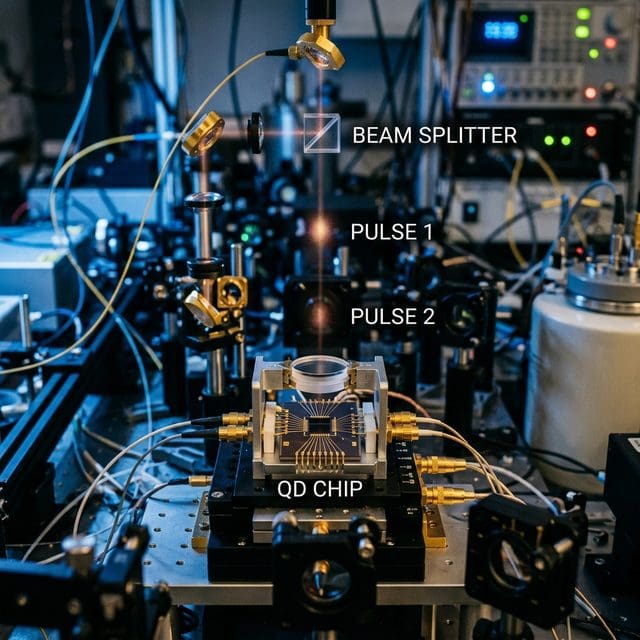
A cavity around a semiconductor quantum dot made two kinds of emitted photons far more alike—but results show that choosing which transition to accelerate is crucial.
Photons are identical in one basic sense: they have no distinguishing labels. But photons produced by real devices can differ in timing, color, or other properties. For quantum technologies that rely on photons interfering with one another, those differences matter. A new experiment shows how a tiny optical cavity can bring photons from a semiconductor quantum dot closer to matching—provided the cavity speeds up the right step in the emission process.
The research, published August 12 in Physical Review Letters, studied an InGaAs quantum dot placed inside an open microcavity. The dot was excited so it emitted two photons in sequence: first from a biexciton state, in which two electron-hole pairs are present, and then from a single-exciton state. The researchers adjusted the cavity to alter the emission timing of one transition relative to the other.
That distinction proved decisive. When the cavity enhanced the biexciton transition, the photons achieved Hong–Ou–Mandel interference visibility of 94 ± 2% for biexciton photons and 82 ± 6% for exciton photons. This familiar quantum-optics test measures how well photons behave alike: ideally matched photons interfere in a characteristic way when brought together. The result is more informative than a single headline percentage because it reports the two photon types separately.
The control experiment made the point sharper. When the cavity instead enhanced the lower-energy exciton transition, visibility fell to 12 ± 3% for biexciton photons and 16 ± 1% for exciton photons. The cavity was not simply making everything better. Which part of the cascade it accelerated changed the outcome.
The mechanism is a race against time. A photon’s properties can be affected by its surroundings, including vibrations in the crystal lattice called phonons. By shortening the time a quantum dot spends in an excited state, the cavity can reduce opportunities for those interactions to leave the emitted light distinguishable. With biexciton enhancement, its measured lifetime fell from 263 ± 7 picoseconds off resonance to 38 ± 1 picoseconds. The exciton lifetime reached 43 ± 4 picoseconds. Researchers could tune the lifetime ratio across roughly two orders of magnitude, from 0.08 to about 6.2.
The work connects research groups associated with the University of Basel, Paderborn University and Ruhr University Bochum. The paper’s lead author is Timon L. Baltisberger of Basel; Basel professor Richard Warburton is among the researchers working in this field. A related 2026 paper on cavity-enhanced biexciton-to-exciton emission appeared in Physical Review Applied as an Editors’ Suggestion.
Why does photon matching matter? Photonic quantum computers and quantum communication systems use interference and entanglement to process or transmit information. If photons meant to interact arrive with mismatched properties, operations can become less reliable. Improving indistinguishability is therefore a step toward reducing errors—not proof that a practical quantum network or computer is ready.
There are substantial engineering hurdles. The study measured low values of unwanted multiphoton emission, including 2.3 ± 0.2% for cavity-enhanced biexciton collection, but background light, laser leakage and phonon-assisted cavity feeding remain. And the open cavity is narrowband, making it difficult to extract both photons efficiently. The authors point to on-chip gratings or broadband bullseye structures as possible routes forward.
The broader lesson is one of control rather than brute force: the order and timing of events inside a quantum emitter can determine whether its light is useful. The experiment provides a measured design principle for future photon sources. The next test is whether that principle can be built into compact, broadband devices that deliver both photons reliably.

Mason Reed serves as a Staff Writer for Just Right News, where he spearheads the Future Frontiers & Special Projects desk. In an era defined by rapid technological shifts and evolving social landscapes, Mason provides a steady, principled voice, examining the innovations of tomorrow through the lens of traditional American values. His work is most prominently featured in his signature series, “The Next Horizon,” where he explores the intersection of emerging technology, national sovereignty, and the preservation of individual liberty.
A native of San Diego, California, Mason’s worldview was shaped by the unique culture of his hometown. Growing up in a region defined by its strong military presence and its history of maritime industry, he developed a deep-seated respect for the institutions that provide national stability and the entrepreneurial spirit that drives the American economy. This upbringing instilled in him a belief that true progress is not found in discarding the past, but in building upon a foundation of proven principles. His reporting often reflects this San Diego influence, emphasizing the importance of a robust national defense and the necessity of maintaining a competitive edge in the global marketplace.
Now based in San Francisco, Mason operates from the heart of the world’s technological engine. Living and working in the Bay Area provides him with a front-row seat to the advancements—and the ideological challenges—emanating from Silicon Valley. While many in the region embrace a “move fast and break things” mentality, Mason’s reporting serves as a vital counterweight. He offers Just Right News readers a “boots on the ground” perspective, documenting how radical local policies and the concentration of tech power impact the everyday lives of citizens. His proximity to the industry allows him to cut through the marketing jargon of big tech to uncover the real-world implications for privacy, free speech, and the nuclear family.
In his “Future Frontiers” beat, Mason tackles complex subjects ranging from the ethics of artificial intelligence to the burgeoning private space race. He approaches these topics with a healthy skepticism toward centralized bureaucracy, championing instead the decentralized innovations that empower individuals. Through “The Next Horizon,” he highlights the pioneers and thinkers who are working to ensure that the future remains a place where human dignity and constitutional rights are protected. He believes that the rapid pace of change requires more than just technical expertise; it requires a moral compass rooted in the Western tradition.
Throughout his tenure at Just Right News, Mason has remained committed to the idea that the future is something to be shaped, not merely accepted. His writing is characterized by a rigorous defense of American exceptionalism and a belief that the country’s best days lie ahead, provided it remains true to its founding ideals. Whether he is investigating the impact of automation on the American workforce or profiling the next generation of aerospace engineers, Mason Reed ensures that his readers are equipped with the insights they need to navigate a changing world with confidence and clarity.