

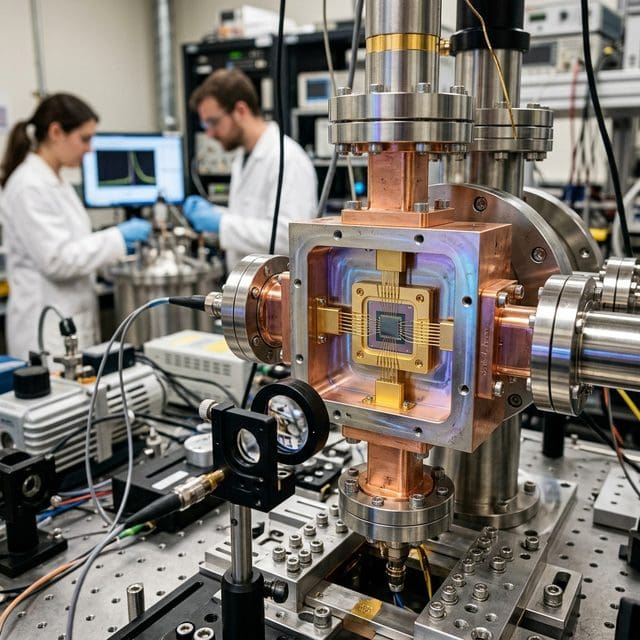
Researchers report that a terahertz cavity strengthened superconductivity in a six-layer niobium selenide sample, offering a new way to probe and perhaps tune quantum materials.
What if the apparently empty space around a material could help it carry electricity without resistance? A team from the Chinese Academy of Sciences and Shanghai Jiao Tong University has reported an experimental result pointing in that direction: placing a six-layer sample of niobium diselenide, or NbSe₂, inside a terahertz “dark cavity” raised its superconducting transition temperature by as much as 5.4 percent.
The researchers describe the work, reported in Nature on Oct. 3, as the first experimental observation of superconductivity enhanced by vacuum fluctuations. They also found increases in the sample’s critical current and the magnetic field it could withstand, particularly near the transition into the superconducting state.
Superconductors conduct electricity without electrical resistance below a particular temperature. That property makes them valuable in technologies such as medical imaging magnets and quantum devices, but many superconductors must be cooled to extremely low temperatures. Even a small, repeatable change in the conditions under which superconductivity appears could help physicists understand how these materials work—and how to control them.
The cavity’s role is not to supply ordinary heat or electricity. In quantum physics, a vacuum is not simply nothing: even when a space contains no particles, fields still have fluctuations. A cavity can shape the electromagnetic environment around a material, potentially changing how those fluctuations interact with it. The new experiment suggests that this interaction can favor superconductivity in the thin NbSe₂ sample.
That is a striking result, but not a recipe for room-temperature superconductors. The reported increase is up to 5.4 percent, and the available findings do not establish that the effect will persist in other materials, at larger scales, or under practical operating conditions. The next questions are whether other research groups can reproduce it, what physical mechanism produces the change, and whether cavity design can make the effect stronger or more predictable.
The finding arrives amid a busy week in quantum research, where scientists are learning to manipulate unusual states rather than simply observe them. University of Chicago researchers reported a coherent, interaction-driven flat electronic band in the layered magnet Fe₅GeTe₂. Electrons in a flat band have little dispersive motion, and the reported coherent state persisted to about 100 degrees above absolute zero. The team is testing whether laser pulses can switch the material’s state, a possible starting point for memory research—not yet a working memory device.
Quantum computing offered a different kind of milestone. Researchers using Quantinuum’s H2 processor combined the braiding and fusion of non-Abelian anyons, exotic quantum excitations, in a demonstration of operations needed for universal quantum computing. The work involved Quantinuum, Caltech, the University of Chicago and Harvard, and used 54 qubits. It shows progress toward controlling complex quantum behavior, though it does not mean a general-purpose quantum computer is ready for everyday tasks.
Other reports extended the field’s reach: a 13-ion quantum simulator recreated a particle-forming process associated with early-universe physics, while researchers demonstrated a method for identifying multiphoton W states, a form of entanglement. Stanford researchers also reported observing quantum jumps of sound, tracking individual phonons as they changed energy states.
Together, these results show quantum physics becoming more experimentally accessible—from materials whose properties can be tuned by their surroundings to simulators that recreate processes too difficult to study directly. The cavity experiment’s immediate importance is not a new commercial technology, but evidence that the quantum vacuum can be an active part of materials engineering. Establishing how far that control can go will require replication, mechanism-focused experiments and tests beyond a single ultrathin material.

Mason Reed serves as a Staff Writer for Just Right News, where he spearheads the Future Frontiers & Special Projects desk. In an era defined by rapid technological shifts and evolving social landscapes, Mason provides a steady, principled voice, examining the innovations of tomorrow through the lens of traditional American values. His work is most prominently featured in his signature series, “The Next Horizon,” where he explores the intersection of emerging technology, national sovereignty, and the preservation of individual liberty.
A native of San Diego, California, Mason’s worldview was shaped by the unique culture of his hometown. Growing up in a region defined by its strong military presence and its history of maritime industry, he developed a deep-seated respect for the institutions that provide national stability and the entrepreneurial spirit that drives the American economy. This upbringing instilled in him a belief that true progress is not found in discarding the past, but in building upon a foundation of proven principles. His reporting often reflects this San Diego influence, emphasizing the importance of a robust national defense and the necessity of maintaining a competitive edge in the global marketplace.
Now based in San Francisco, Mason operates from the heart of the world’s technological engine. Living and working in the Bay Area provides him with a front-row seat to the advancements—and the ideological challenges—emanating from Silicon Valley. While many in the region embrace a “move fast and break things” mentality, Mason’s reporting serves as a vital counterweight. He offers Just Right News readers a “boots on the ground” perspective, documenting how radical local policies and the concentration of tech power impact the everyday lives of citizens. His proximity to the industry allows him to cut through the marketing jargon of big tech to uncover the real-world implications for privacy, free speech, and the nuclear family.
In his “Future Frontiers” beat, Mason tackles complex subjects ranging from the ethics of artificial intelligence to the burgeoning private space race. He approaches these topics with a healthy skepticism toward centralized bureaucracy, championing instead the decentralized innovations that empower individuals. Through “The Next Horizon,” he highlights the pioneers and thinkers who are working to ensure that the future remains a place where human dignity and constitutional rights are protected. He believes that the rapid pace of change requires more than just technical expertise; it requires a moral compass rooted in the Western tradition.
Throughout his tenure at Just Right News, Mason has remained committed to the idea that the future is something to be shaped, not merely accepted. His writing is characterized by a rigorous defense of American exceptionalism and a belief that the country’s best days lie ahead, provided it remains true to its founding ideals. Whether he is investigating the impact of automation on the American workforce or profiling the next generation of aerospace engineers, Mason Reed ensures that his readers are equipped with the insights they need to navigate a changing world with confidence and clarity.