

Anthropic is investing in enterprise AI training, Google and OpenAI are expanding model capabilities, and FieldAI’s reported $700 million financing remains unclosed.
The latest AI competition is moving beyond model launches toward the people and systems needed to put those models to work. Anthropic is building an enterprise training pipeline, Google is limiting initial access to a new model aimed at cyber defense, and OpenAI is expanding tools for agents that can interact with software. Meanwhile, a headline-grabbing financing for robotics startup FieldAI remains a proposal, not a completed round.
Anthropic’s Claude Frontier Academy is operating in San Francisco, New York and London, with participation by company nomination. The company says it has committed $100 million to train 10,000 Frontier Deployed Engineers by the end of 2027. Its initial cohorts include engineers from Accenture, Bain, Capgemini, Commonwealth Bank of Australia, Deloitte, McKinsey, Morgan Stanley and Novo Nordisk.
The 12-week residency requires participants to lead a Claude implementation inside their organization, with support from Anthropic engineers. The first Frontier Deployed Engineer credentials are expected in early 2027. Anthropic says its broader Claude Partner Network spans 46,000 firms, with 175,000 certifications and nearly 4,000 Basecamp graduates.
That is a strategic bet on implementation as well as software. If enterprises lack staff who can integrate AI into existing operations, access to a capable model may not translate into routine use. Anthropic’s investment could expand Claude’s footprint in large organizations, while tying training and deployment expertise more closely to its own ecosystem.
Google has announced Gemini 4 Argon, a frontier model designed for sustained reasoning, software engineering, enterprise legal and finance work, and cybersecurity. The initial access group is selected cyber defenders; Google has not announced a public release date. Introductory pricing is $2 per million input tokens and $10 per million output tokens.
OpenAI is also emphasizing production use. It describes GPT-6.1 Sol as an upgrade for agentic coding, computer use and professional work, and says it delivers near-Astra performance at one-fifth Astra’s standard token price. The company’s Agents API now supports computer use, tool search, context compaction and multi-agent capabilities. GPT-6 Sol and Luna have also been added to ChatGPT Work and Codex for eligible paid, business, enterprise and education users. OpenAI says their API prices are 50% below GPT-5.6 promotional pricing.
For developers, these moves make cost, access and integration as consequential as headline performance claims. Tools that can use software may reduce repetitive work, but they also raise practical questions about permissions, oversight and reliability when an AI agent acts inside a business system.
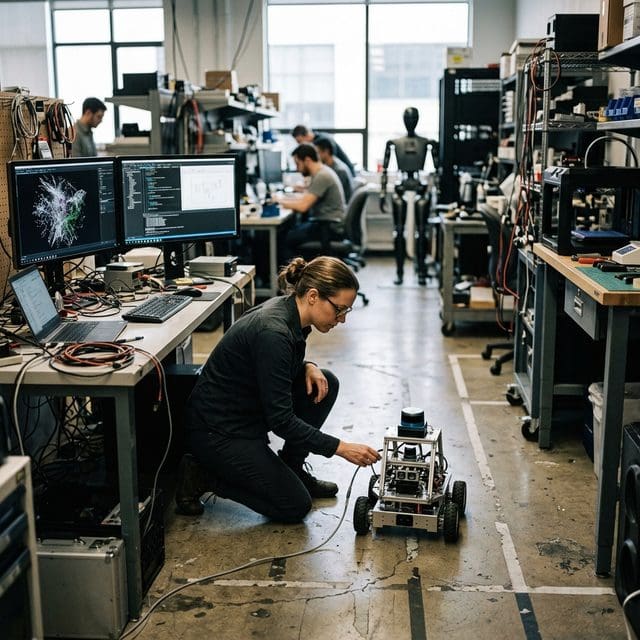
FieldAI is developing software intended to serve as a general-purpose “brain” for robots, including humanoids, robot dogs, drones and industrial rovers operating in unpredictable environments. Business Insider reported the company signed a term sheet for $700 million in financing at a proposed $10 billion valuation, up from $2 billion. The lead investor has not been disclosed, and FieldAI did not comment.
The distinction matters: the financing has not closed, so the proposed valuation should not be treated as a completed transaction. FieldAI’s reported commercial progress is notable nonetheless. Since June, it has added at least $35 million in revenue and customer contracts, taking the total above $135 million across more than 30 customers, including companies in construction, data centers and defense.
Taken together, the developments show an industry competing on deployment capacity as much as model capability. The opportunity is real, but so is the need for clear accounting: a model’s announced features are not proof of dependable performance, and a signed term sheet is not cash in the bank.

Mason Reed serves as a Staff Writer for Just Right News, where he spearheads the Future Frontiers & Special Projects desk. In an era defined by rapid technological shifts and evolving social landscapes, Mason provides a steady, principled voice, examining the innovations of tomorrow through the lens of traditional American values. His work is most prominently featured in his signature series, “The Next Horizon,” where he explores the intersection of emerging technology, national sovereignty, and the preservation of individual liberty.
A native of San Diego, California, Mason’s worldview was shaped by the unique culture of his hometown. Growing up in a region defined by its strong military presence and its history of maritime industry, he developed a deep-seated respect for the institutions that provide national stability and the entrepreneurial spirit that drives the American economy. This upbringing instilled in him a belief that true progress is not found in discarding the past, but in building upon a foundation of proven principles. His reporting often reflects this San Diego influence, emphasizing the importance of a robust national defense and the necessity of maintaining a competitive edge in the global marketplace.
Now based in San Francisco, Mason operates from the heart of the world’s technological engine. Living and working in the Bay Area provides him with a front-row seat to the advancements—and the ideological challenges—emanating from Silicon Valley. While many in the region embrace a “move fast and break things” mentality, Mason’s reporting serves as a vital counterweight. He offers Just Right News readers a “boots on the ground” perspective, documenting how radical local policies and the concentration of tech power impact the everyday lives of citizens. His proximity to the industry allows him to cut through the marketing jargon of big tech to uncover the real-world implications for privacy, free speech, and the nuclear family.
In his “Future Frontiers” beat, Mason tackles complex subjects ranging from the ethics of artificial intelligence to the burgeoning private space race. He approaches these topics with a healthy skepticism toward centralized bureaucracy, championing instead the decentralized innovations that empower individuals. Through “The Next Horizon,” he highlights the pioneers and thinkers who are working to ensure that the future remains a place where human dignity and constitutional rights are protected. He believes that the rapid pace of change requires more than just technical expertise; it requires a moral compass rooted in the Western tradition.
Throughout his tenure at Just Right News, Mason has remained committed to the idea that the future is something to be shaped, not merely accepted. His writing is characterized by a rigorous defense of American exceptionalism and a belief that the country’s best days lie ahead, provided it remains true to its founding ideals. Whether he is investigating the impact of automation on the American workforce or profiling the next generation of aerospace engineers, Mason Reed ensures that his readers are equipped with the insights they need to navigate a changing world with confidence and clarity.